Sunday, June 11, 2023

Sabbatical 2023: Orvieto, the Miracle at Bolsena, and the Feast of Corpus Christi

Everything over these past two weeks in Orvieto has been leading to this day, June 10th, when the entire Orvietani community celebrates the Feast of Corpus Christi (Domini). They don't celebrate it, though, like anyone else. Because it was right here, in this small, enchanting village where this feast originated. It all started with the Miracle at Bolsena.

Before I jump to the story of the miracle, a little about Bolsena. When Rome defeated the Etruscans here in 264 BCE, when it was known as Velzna, the Romans "exiled" all of the residents to an area called Volsinii Nova, 21 kilometers (13 miles) away. This became the town of Bolsena. 

In 1263, a German priest - Peter of Prague - stopped at Bolsena while he was on a pilgrimage to Rome. He is described as being a pious priest, but was struggling with believing that Christ as actually present in the consecrated Host (or bread) of Holy Communion. This is a Roman Catholic theological belief - transubstantiation - that teaches that at the time the priest consecrates the bread and the wine with the words Jesus spoke at the Last Supper ("This is my body...This is my blood."), the elements of communion are changed into the actual body and blood of Christ. 

(As an aside, the words "hocus pocus" are believed to be a perversion of this blessing from the Latin Catholic mass, Hoc est corpus meum, or "This is my body." But back to the story and to Father Peter!!)

Tapestry of Peter of Prague consecrating the Host

While he was celebrating mass in the church in Bolsena, named for the martyr St. Christina, he had barely spoken these words of consecration when blood started to drip from the consecrated Host and trickle on his hands and then onto the altar and the corporal. [The corporal is a square of white linen cloth onto which the containers for wine (chalice) and bread (paten) are placed during celebration of the mass.] Peter was immediately confused by this. At first, he tried to hide the blood. But, then, he interrupted the Mass and asked to be taken to Orvieto, where Pope Urban IV was residing. 

The Pope listened to his account, absolved Peter of any potential wrongdoing, then sent representatives to investigate. When he received the results of the investigation, the Pope ordered that the Host and the linen cloth bearing the bloodstains be brought to Orvieto. These relics were placed in the cathedral, in a special reliquary, and to this day - on this day - are brought out and reverently exhibited in the cathedral and then during a massive procession that winds through the streets of Orvieto. 

Exactly one year after the miracle, in August 1264, Pope Urban IV instituted the Feast of Corpus Christi (or Corpus Domini, as it's also called). After today's celebration, these relics will be returned to the Chapel of the Miracle in the duomo at Orvieto. The altar where all of this happened is still preserved at St. Christina Church in Bolsena. 

This is THE major festival each year in Orvieto. It's not only a significant religious day, celebrated with a special mass using the Aquinas liturgy that is broadcast on speakers throughout the village, but one that involves the entire community. Volunteers dress in beautiful medieval costume, carrying colorful banners that represent the four districts, or quarters, of Orvieto: Corsica, Serancia, Olmo and Santa Maria della Stella. Children, women and men are dressed as peasants, carrying their wares for sale. Representatives of the medieval guilds also dress in costume, holding aloft the many banners representing the different guilds of the time - artists, olive oil makers, carpenters, and farmers, to name just a few. Volunteers dress as members of the Knights Templar and the Swiss Guard, along with others dressed in ancient military garb, carry their jousting lances and represent the defenders of the church, the government, and the people. 

Dignitaries from the Comune de Orvieto (City of Orvieto) and from communities across Umbria dress in their official garb and walk in procession. The municipal band marches and plays melodies from the ancient liturgy written for this feast day by Dr. Thomas Aquinas. There are a series of ancient tapestries carried that tell the story of the Miracle at Bolsena. It is a spectacular sight - the ultimate Renaissance festival!!


All of this, though, is overshadowed by the relic - the cloth - as it is carried by priests, accompanied by the bishop and the many other priests, nuns and seminarians who process throughout the streets of this medieval hill town and are greeted by its residents with cheers and flowers along the way.

There is nothing quite like being in Orvieto on THIS day - the day remembering the Miracle at Bolsena and reminding us under our own slightly different Lutheran theology, that each week, as we participate in the mystery of Holy Communion, somehow Christ's body and blood are in, with and under the bread and wine, and God is truly with us.  

Happy Feast Day of Corpus Christi!!


Friday, June 2, 2023

Sabbatical 2023: Republic Day in Orvieto

Today - June 2nd - is Republic Day (Festa della Repubblica) in Italy. It's a day that recalls the post-World War 2 referendum in 1946, in which the citizenry of the kingdom of Italy chose to be a republic over a monarchy. To understand this more fully, one needs to go back in history a bit to the medieval period and the rise of the city-states. 

These were many different independent and political entities that arose after the collapse of Rome and the descent of Germanic "barbarians" into northern Italy. Orvieto was also invaded and came under control of the Longobard duchy. In 774 CE, the area was liberated and Orvieto became a province of the Papal State. This began a long era of great wealth, beauty and expansion. Orvieto became one of several modern, functional, democratic city-states (communes) with a well organized political system and urban structure. (These are the basis for our modern-day democracy in the U. S.) Because of a civil war in Rome during this time, Pope Urban IV lived in Orvieto. His residency led to the construction of a pontifical palace in the city, as well as, the commissioning of the construction of the duomo to be built beside his palace. In this medieval period each major square in the city represented an institution - Piazza Duomo represented religious power; Piazza del Popolo, the power of the people, and Piazza della Repubblica, the power of the polis (political power). These city squares still exist today. 

Orvieto's prosperity lasted until 1348, when the plague and fighting between the noble families (especially the Monaldeschi and Fileppeschi families) put an end this time of expansion. However, the city still found economic prosperity, thanks to its close connection to and popularity with the papacy - it was viewed as a quiet and safe place to stay not far from Rome. Orvieto continued as an important papal province until 1860, when Italy was unified and it became part of the Kingdom of Italy, a constitutional monarchy governed by the House of Savoy. 

It was under the rule of this House that Mussolini came to power in the early 1920's, leading to the fascist regime in Italy and the Axis alliance with Nazi Germany. After disastrous defeats in Eastern Europe and North Africa, the Italian empire collapsed. Mussolini was arrested by order of King Victor Emmanuel III, which provoked a civil war. The northern half of the country was occupied by the Nazis with the cooperation of Italian fascists, becoming a puppet-state. The south was controlled by the monarchy, which fought for the Allied cause. However, the Italian resistance movement (the "partisans") operated all over Italy. In April 1945, Mussolini was assassinated by Italian partisans two days before Hitler's suicide. This led to the call for a national referendum for Italians to decide whether they wanted to be a republic or a monarchy.

The results of the referendum are quite interesting to me, which ended up with about 55% of the population voting to become a republic versus the 45% who wanted to remain a monarchy. The blue in this image represents those areas with a majority vote for a republic, the red for the monarchy. In central Italy in particular - where the independent city-states and democratic institutions were formed - the population overwhelmingly voted to form a republic, to be self-governing.

Italy's history is so much more complex than what I've captured in these few paragraphs. It's a fascinating study of the struggle between the three areas represented by the three piazzas - that of the church, the people, and the political system. 

One last note about the preservation of the cathedral in Duomo. There's a fascinating story captured here on how this lily of Italian cathedrals was preserved near the end of the second World War. As Allied forces approached from the south, they were greeted by a Volkswagen, carrying a young German officer waving a white flag who spoke perfect English. He carried a message from the German commander based in the city: "In consideration of the historic beauty of Orvieto, the German commander proposes to the allied command that the city of Orvieto be declared open." 

The allied commander agreed and fighting continued away from the city, saving this beautiful medieval city with its incomparable duomo. 

Fino a tardi, arrivederci!

(Molte grazie to the website, Orvieto Viva, for much of the history on this and previous blog pages.)


Saturday, May 27, 2023

Sabbatical 2023: Time for Vita Comunitaria

I made the mistake yesterday of going to the local grocery store during the noon rush. Here, as in most small villages in Italy, things shut down around 12:30 or so for the afternoon riposo. So, right around this time, the grocery store is packed with people headed home from work or from school to pick up a few things for lunch. Italians don't shop for groceries once a week, but, because they can so easily walk to the grocery store, usually go every day or couple of days. 

Looking at this idea of riposo (or siesta in Spanish, which you might know better) from an American cultural viewpoint, we might consider this unproductive. And unnecessary. A waste of good working or learning time. This tradition, though, came out of necessity, especially in more southern places where the heat of the day can be intense. Buildings weren't air conditioned. It was dangerous for workers to be outside in these high temperatures. So, this cultural phenomenon developed. Everyone goes home to have lunch and to rest. Then, around 5p, when things started to cool down, they return to work and school for about another 3 hours or so.

This is possible when you live and work and go to school in a small village because you live within easy walking distance of everywhere you need to be. School is a 5-10 minute walk away. The grocery store and other shops are the same. So, are workplaces. By slowing down the pace of life, spending time together, meeting one another on the street as you're walking to and fro, and even running into each other in the grocery store during the noon rush - all of this creates community. Add into it the evening tradition of the la passeggiata - an evening stroll where the entire family goes out and walks the main corso together, running into friends and other family members, catching up on the news of the day - then followed by another time of gathering together for a meal that often stretches late into the evening, and vita comunitaria (communal life) just happens. Naturally. All the time.

During the period of the Middle Ages, all three of the major religions - Judaism, Islam and Christianity - innovated their spiritual traditions centered around the idea of God as lover and human beings as beloved, an acknowledgement of the feminine in spirituality. The many rich and abundant texts by female mystics were composed in and for very specific communities. As urban centers grew, the need for pastoral care in towns and cities required greater lay participation. Lay women and men organized themselves into these communities, some endorsed by the Church and others not. Spirituality was formed in community. Pastoral care was offered from within these communities. Even in the U.S., up until the individualism of the 20th century, much of faith life was developed through communal life. 

My time in Orvieto reflecting on vita comunitaria, both past and present, makes me recognize that we've lost something in America. Faith is meant to be shaped and lived out communally. Each of us is blessed by God with unique gifts to serve that community, which then offers them more fully in greater society. We are called to be the body of Christ, working together, then sent out to perform what Ulrike Wietnaus calls "street mysticism." It is on the streets where we find sacred space like the feminine mystics did - in the open spaces of markets, churches, shrines dedicated to the saints, shops, apothecaries, roads and hospitals. It is on the streets where the spiritual and the secular mix. (Perrin, 4-7)

This Sunday is Pentecost Sunday. It's a huge festival in Orvieto that celebrates the outpouring of the Holy Spirit on the Apostles. Here, it is celebrated in the streets of this village - communally - with a Vigil mass, processions, an art festival, an evening dance, then culminating on Sunday with the palombella, an ancient aerial transit of a dove (la columba) from the Church of St. Frances (Chiesa de San Francesco) to the duomo with fireworks. (I promise to take pictures as long as you don't show them to PETA!) Here, the sacred intermingles with the secular. There is no separation. One can only wonder how much fuller the lives of Orvietans are because these two aspects of life - and our very beings - aren't separated from each other, but fully intertwined as part of life together. 

Something to think about on this Vigil of Pentecost. Fino a tardi!

Thursday, May 25, 2023

Sabbatical 2023: Orvieto - A Little History

The history of Orvieto is quite fascinating. Like the other hill towns of central Italy, it sits on a huge mass of tufa rock, likely from an ancient volcanic eruption. This rock is solid in some parts, not so solid in others.

Orvieto's first traceable history comes from the Etruscan civilization, beginning about the 9th century BCE. This was a culture of great splendor and importance and Orvieto (known then as Velzna) was the most important town in the Etruria territory. Below the cliffs of this village, archaeologists and histories discovered what they think is the Fanum Volumnae, an ancient sanctuary that was thought to be the center of the Etruscan religion. 

Here, the Crocifisso del Tufo necropolis was excavated, along with remains of the Temple of Belvedere. The necropolis is an ancient burial site consisting of over 200 tombs made of tuff (tufa) blocks. This is a likely predecessor to what tombs looked like in the the time of Christ. Each tomb was owned by individual families and was marked with family names, which can still be seen. In a tour I took in my last visit, our archaeologist tour guide mentioned that there is an early connection between one of the families, whose tomb is in this burial site, with that of Remus and Romulus, the traditional founders of Rome. 

Velzna was also the political center, where the leaders of the 12 major Etruscan cities (dodecapoli) would gather to worship the gods and decide by common consent the political strategies to adopt.

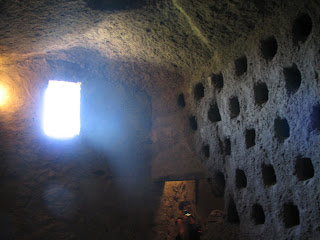
Under the settlement, the Etruscans built a series of caves and tunnels to connect themselves. They did this because they often were under siege from unfriendly neighbors. Many of the homes in the village have underground "basements," some of which have been excavated to connect up to the various tunnels. There are still olive presses in some of these caves, dating from the Middle Ages. And they are still great places to store cheese and wine, two commodities for which Orvieto is famous. 

Eventually, Orvieto fell to Rome in the third century BC, although it took them two years to conquer this natural fortress, with cliffs on all sides and its intricate web of caves and numerous wells. The Romans destroyed most of the evidence of the Etruscans and then used the area to supply crops, wine and other goods to Rome. There are only a few traces of Roman civilization in the village.  

This area was dominated by the Goths, Byzantines and Lombards until about 1000 CE. It was then that Orvieto began to repopulate, especially on the northwest side, which is known today as the Medieval Quarter. This is evidenced by the presence of the Chiesa d'San Giovenale (Church of St. John), whose first documentation was in 1004. (More on Orvieto churches later!)

During the 13th and 14th centuries, Orvieto, then called Urbs Vetus (See the present name taking shape?), advanced and increased its power. It was a time of great artistic and cultural flourishing. Thomas Aquinas taught in a school here and composed a special liturgy for the Feast of Corpus Christi, which originated here (more on that later). Pope Urban IV found refuge here from a civil war in Rome for a couple of years. Other popes "summered" in Orvieto. Most importantly, this time included the construction of the duomo. The cathedral, besides being known for its beautiful mosaic facade, also contains in its chapel (Chapel of San Brizio) frescoes by Fra Angelico and, most famously, Luca Signorelli's masterpiece, the Last Judgment, based on Dante's Divine Comedy, written in 1314. 

This amazing time ended in 1348, when a pandemic followed by continuous internal fighting within a ruling family (sound at all familiar?) destroyed the Comune of Orvieto. It came under the rule of the Papal State and, then, in 1860, was annexed to the Kingdom of Italy. 

This history with all of its drama and richness is, in large part, what draws me to Orvieto. Sometimes, I think that, in the US, we're too young as a nation to understand that our hold on democracy is tenuous. That it takes constant work and effort to maintain it. Here, in Italy, the people understand this. And, they also know that life goes on. That history continues. And that, no matter what, there is resurrection and life even after death and destruction. 

Or, in the words of Julian of Norwich (b. 1343), an English feminine mystic: "All will be well. And all will be well. And all manner of things will be well."

Fino a tardi, arrivederci!

Wednesday, May 24, 2023

Sabbatical 2023: First Days in Orvieto

In these early days of my sabbatical, I have been simply trying to rest and relax and unplug a little. Last week I spent most of it in riposo, as Italians might call it. This week I'm actually in Italy - more precisely in my favorite hill town, Orvieto, located in the province of Umbria. Orvieto is most known for it's duomo, one of the most beautiful in all of Italy that is called the "lily" of all cathedrals.

This area is rich in so many ways - natural beauty, art, food, beverages, and, especially, history. It's a place in my personal history, too. In 2006, I came here along with a small cohort from Fuller Seminary for a summer intensive. We immersed ourselves in the theology, spirituality and art of the medieval period - a time so integral to this area, to the church, and, honestly, to Western civilization. These Middle Ages - often misnamed as the Dark Ages - were actually a time of great expansion, whether culturally, artistically, spiritually and theologically. During my few weeks here that summer, I learned so much about the important influence that women had then in the church through their writing and witness - an understanding that we've only just begun to unearth over the past several decades. During those weeks, I also made a few lifelong friends.

So, I'm back in 2023 to this place so dear to my heart. It's my fourth time here. Each time I arrive I feel like I've returned to my spiritual home. This time is no different, other than that it will be the longest number of days I've spent here. I'm trying not to live as a tourist, but to settle in. To shop for food every day or so in Pam Local, the nearby grocery store. To honor this culture's daily period of afternoon repose. To make new friendships and to renew old ones. To rest and to renew. 

During this time, I'll be refreshing my memory and expanding my learning of the feminine mystics of the Middle Ages, who come from this part of Italy. In a Facebook post a few days ago, I mentioned that I'll be reading Women Christian Mystics: Speak to Our Times, edited by David B. Perrin, OMI. In his introduction to a series of essays, this is what HE writes about listening again to these women who have "lived valiantly the drama of human life and who, to date, have not had the opportunity to teach us."

"Listening again does not mean we sit back in our comfortable tightly knit intellectual dwelling places and sigh contently knowing we've done our part to heal past wounds by passively patronizing women's stories with albeit our attentive ears. No, listening again means to allow their stories to touch our stories, to let their lives enter into our lives such that we gain the hard-won wisdom they have to offer. Nor does listening again mean we laboriously try to fit their stories into our preconceived categories. Rather, we listen in order to allow their stories to BREAK OPEN the sealed containers within which we sometimes live. We need their stories to provide for us the grist for our own wisdom. They have walked treacherous and burdensome ways, as do we as individuals and as a collective body. Taking up their stories into our lives provides some wider context within which we can reflect and expand our own worlds outside the often times patriarchal or other limiting horizons against which we have come to know and define who we are as Christians and as human beings."

May this time break me open from the sealed container in which I often live. May it provide discernment and wisdom. May it open me to a broader context and expansion of my own thought and being. And, particularly, may I be renewed and refreshed to live authentically.

Hello, Orvieto - my old friend! And, to you dear reader, welcome to Orvieto!


Sunday, March 12, 2023

Seeking: Who is invited?

Once more Jesus spoke to them in parables, saying: “The kingdom of heaven may be compared to a king who gave a wedding banquet for his son. He sent his slaves to call those who had been invited to the wedding banquet, but they would not come. Again he sent other slaves, saying, ‘Tell those who have been invited: Look, I have prepared my dinner, my oxen and my fat calves have been slaughtered, and everything is ready; come to the wedding banquet.’ But they made light of it and went away, one to his farm, another to his business, while the rest seized his slaves, mistreated them, and killed them. The king was enraged. He sent his troops, destroyed those murderers, and burned their city. Then he said to his slaves, ‘The wedding is ready, but those invited were not worthy. Go therefore into the main streets, and invite everyone you find to the wedding banquet.’ Those slaves went out into the streets and gathered all whom they found, both good and bad, so the wedding hall was filled with guests.

“But when the king came in to see the guests, he noticed a man there who was not wearing a wedding robe, and he said to him, ‘Friend, how did you get in here without a wedding robe?’ And he was speechless. Then the king said to the attendants, ‘Bind him hand and foot, and throw him into the outer darkness, where there will be weeping and gnashing of teeth.’ For many are called, but few are chosen.” --Matthew 22:1-14 (NRSV)

Wow. Just wow. Okay. So, who would like to interpret this parable this morning?

Before we dig into this text in earnest, there are a couple of things I’d like to mention. 

First, we have to be careful not to jump too quickly into the allegorical interpretation. An allegory is a story or picture or poem that can be interpreted to reveal a hidden meaning, usually a moral or political meaning. It’s important for us, especially with Jesus’ parables, that we first look closely at the story, before we jump to trying to figure out its allegorical meaning. We try to understand what is going on, first, because doing this can then help us draw out its meaning for us. 

The second caution is about hyperbole. 

In Matthew, in particular, Jesus’ parables contain a lot of hyperbole, of exaggeration. If you think about the community that Matthew is writing to, a community some 50 years after Jesus ascended that has been tossed out from their religious and social community, it might be easier to understand that, as Matthew captures Jesus’ parables, there is an edge to them. Whether it is anger or cynicism, Matthew’s Jesus exaggerates. For far too long, the church has used scripture, including this parable, against the Jewish people in a way that encourages anti-Semitism. Jesus’ parables contain a lot of hyperbole - exaggeration. Why? To catch the reader’s attention. To draw them into the story. Sometimes, to shock them. To drive home a point. Does that mean, then, that we should take Jesus’ parables literally? Probably not. But, we also should not miss the point. We should take it seriously.

So, what do we first see in this story? We have a king who is inviting guests to a banquet. But, even before this, we have this opening phrase: Once more Jesus spoke to them in parables…” So there are other parables that have been told before this one to “them.” If we back up into chapter 21, we see that Jesus and his disciples are in Jerusalem. We’ve skipped ahead because we will read this on Palm Sunday. 

The first thing Jesus does is to go into the temple and overturn the moneychanger tables. Then, Jesus curses the fig tree. This is an irritable Jesus we see in chapter 21. Soon, the religious leaders confront him and challenge his authority to teach in the temple. This is followed by two parables that are spoken directly to the chief priests and elders. And not in a good way. By the end of chapter 21, they want to arrest him. But, they are afraid because Jesus is so popular - thought by the crowds to be a prophet.

Then comes this parable in our text today, spoken to "them" - the chief priests and elders.

Now, something else you need to know is that in ancient times it was the custom to invite guests to a banquet in two phases. First, messengers would be sent to the guests, several days in advance, to invite them. And to tell them to be ready at an approximately time. The second invitation would be sent when the feast was ready. The guests were now to come. 

It appears that, in the story, we first learn about this second invitation. So, those invited have had fair warning to make sure they are available to attend. But, they violate the ancient rules of hospitality by refusing to come, something close to rebellion. Then, asked again, two of the invited guests walk away to go back to their business affairs. Others seize the servants, attack them and kill them. 

Is it any wonder that this king is furious? Wouldn’t, if something like this happened in our day - wouldn’t there be repercussions?

But, there is still a wedding feast waiting. So servants are once again sent by the monarch into the streets to invite everyone they can find. Good and bad. And they gather them into the wedding hall to begin this great feast. 

Maybe, up to this point, we kind of get this story. It’s about invitation and hospitality. About how God invites everyone, good and bad. And about some - particularly privileged - who simply ignore or even refuse God’s invitation. Or worse yet, seek to harm God’s servants.

But, then, we get to the last part of the story. 

Who can make sense of this? How could it be expected that someone gathered up off the streets into the great hall would need to wear a special garment, much less even own one?

What we need to understand is that traditionally the king would have had appropriate garments ready for his guests. The individual did not put on the garment provided - perhaps even refused to put on the garment,, thus, shaming the king. He is cast out not because of who he is, but because of what he chooses to do. Or not to do. In this, he dishonors the king.

So what does this mean for us? (Now, we get to the allegorical interpretation.). There are likely many meanings to this parable. But, perhaps one interpretation is that this is about “cheap grace.” We’ve talked about this before. This is a phrase first written by Dietrich Bonhoeffer in the years leading up to the second world war, as he and others tried to engage the broader church in stopping Hitler and his movement. Cheap grace, as he writes, is a grace without repentance. Or sacrifice. And, ultimately without a cross. It’s accepting God’s invitation, but refusing to “put on the garment of faith,” as Paul puts it. To truly live as one of God’s people. To do the work of discipleship - prayer, fasting, giving to the poor. Standing up to evil and power, especially when it is harming those whom society has pushed to the edges. It’s refusing to put in our time or energy or resources to serve God. It’s refusing to sacrifice. 

To be a disciple requires costly grace. Because it calls us to fully follow - to follow Jesus Christ. This kind of grace is costly. Because it cost Jesus his life.

So where are you in your Lenten journey? Have you, three weeks in given up on any fast or practice you decided to take on? Why is that? Or, perhaps, you have remained steadfast. How might this practice be more fully incorporated into your life as a disciple beyond Lent?

May we, this Lent, accept God’s invitation to the wedding banquet. But, may we also willingly put on the garment of costly grace. The garment of sacrifice. The garment worthy of the bridegroom himself - Jesus Christ, Son of God.

Amen.

Preached Sunday, March 12, 2023, at Grace & Glory Lutheran, Prospect, with Third Lutheran, Louisville.
Lent 3
Readings: Matthew 22:1-14; Psalm 45:6-7

Seeking: How are we to live?

For the kingdom of heaven is like a landowner who went out early in the morning to hire laborers for his vineyard. After agreeing with the laborers for the usual daily wage, he sent them into his vineyard. When he went out about nine o'clock, he saw others standing idle in the marketplace; and he said to them, 'You also go into the vineyard, and I will pay you whatever is right.' So they went. When he went out again about noon and about three o'clock, he did the same. And about five o'clock he went out and found others standing around; and he said to them, 'Why are you standing here idle all day?' They said to him, 'Because no one has hired us.' He said to them, 'You also go into the vineyard.' When evening came, the owner of the vineyard said to his manager, 'Call the laborers and give them their pay, beginning with the last and then going to the first.' When those hired about five o'clock came, each of them received the usual daily wage. Now when the first came, they thought they would receive more; but each of them also received the usual daily wage. And when they received it, they grumbled against the landowner, saying, 'These last worked only one hour, and you have made them equal to us who have borne the burden of the day and the scorching heat.' But he replied to one of them, 'Friend, I am doing you no wrong; did you not agree with me for the usual daily wage? Take what belongs to you and go; I choose to give to this last the same as I give to you. Am I not allowed to do what I choose with what belongs to me? Or are you envious because I am generous?' So the last will be first, and the first will be last." --Matthew 20:1-16 (NRSV)

On Thursday night, at Third’s council meeting, we dwelled in this story for a while. One of the first questions I asked was how they had heard this parable interpreted. Or what meaning they understood it to have? 

As I began my study of this text, I was once again reminded that this parable has been interpreted a myriad of ways throughout the past 2,000 years. I came across at least 8 different interpretations and several that were spin-offs of these eight.

So, I’m curious. And I’m going to ask the same question I asked the council on Thursday night to you. Here and now. How have you heard this parable interpreted? What do you understand it to mean? 

Yesterday, in our Saturday morning study, we talked about how who interprets Scripture has changed over the centuries. The interpretation of Scripture began as an oral tradition. Within communities. But, during certain times over the past 2,000 years, as people became more illiterate, the job of interpreting scripture was turned over to the “experts.”  Do you consider yourself an “expert?” I wonder, for many of us - myself included for a very long time - how many of us, because we don’t think we are experts, then rarely pick up our Bible to read it, much less understand it. Maybe that’s true for you. Maybe not.

Today, you and I - together - are going to exegete this text. To exegete means to draw out. You are I are going to try to draw out the meaning of this text. For us, for this community. We’re going to let go of any other interpretations we’ve read. We’re going to draw out the meaning of this text for this community. Right now. Together. In this place. 

But, first, to dispel some of your fear, we’re going to have a little fun. I need eight volunteers. 

Who wants to be our first storyteller? This person will start the story by saying one sentence that begins with the words, “Once upon a time…”. They must use the word that they received in their sentence. The next person in line will continue the story by adding one sentence that must contain the world they drew. This will continue until everyone has added to the story. The last person should end with the words, “The end.” Ready?

This story was certainly different from what we could have expected, wouldn’t you agree? There were twists and turns and things maybe felt a little unpredictable. As we study and learn parables, we realize that God’s kingdom often flips things around, catching us off guard. Jesus’ parables were meant to have twists that surprised the listeners, including us. Twists that highlighted the fact that God’s ways are often different from our own. Different from what we might expect. They’re also a little unpredictable. For example, the early workers in today’s story thought they knew what would happen, but they ended up surprised. And a little grumpy.

So, let’s work our way carefully through this text. What are some of the things you notice? Is there anything you wonder about this story? 

As we get near the end of the story, we hear from the workers who were first to arrive. It seems that they felt that the landowner was not being fair. 
  • Do you agree? Or disagree? Why or why not?
  • Think about a time when something happened that felt fair. How did you feel?
  • Now think about a time when someone was surprisingly generous, especially when they didn’t have to be. What did that feel like?
  • Do you think we focus more on generosity or fairness in our society?
  • What is Jesus trying to teach us about the kingdom of God in this story?
We live in a world that teaches us scarcity. That there is not enough, for us, for everyone. This teaches us a mindset of scarcity that leads us to believe that we have to get what we can for ourselves and for our families. That we never have enough. Or that we cannot produce or do enough. That we are just not enough. It is a vicious cycle that just grinds us into the ground and leads to jealousy, resentment, to coveting that which our neighbor has or is. 

Friends, you and I are enough. You and I have enough. 

Every Sunday we pray to God to “Give us this day our daily bread.” God promises to give us what we need each day. Just as God ensured that each one of these workers had a day’s wage. Not a year’s worth. Or a month’s worth. Or even a week’s worth. But a day’s worth. Because, that is what God promises to provide us. Because God is generous. Because, God promises to care for us. Because God has provided enough for us and for all people. Because God loves us. 

In turn, God invites us to be generous. To let go. To share with others. And to trust that we will have what we need. Always.

May God grant that we learn to trust in God's generosity and, in turn learn to be generous as well. Amen.

Preached Sunday, March 5, 2023, at Grace & Glory Lutheran, Prospect, with Third Lutheran, Louisville.
Lent 2
Readings: Matthew 20:1-16; Psalm 16:5-8