Showing posts with label well. Show all posts

Thursday, June 19, 2025

Grounded in Creation: Water (Part 1)

 The text for this Sunday is the story of Jesus and the Woman of Samaria at the well. It's found in John, chapter 4. Here are a few preliminary thoughts...

This story begins with an interesting sentence. It tells us that Jesus had to go through Samaria. Now, I'm pretty certain Jesus didn't have to do anything he didn't want to do. And, if you look at a map, there were other routes from Galilee south to Judea. Easier routes, honestly. Rather than to traverse through a countryside populated with people considered enemies to the Jews. All, as is so often the case, because of one doctrinal conflict. But, why did he have to go through Samaria? 

Jesus makes his way through Samaria. And stops, not coincidentally, at a well connected to Jacob. And that is actually called Jacob's well. It's in an area called Shechem, which is the first piece of land Jacob bought upon returning to what would become "the Promised Land." It's a physical link from the patriarchs to Jesus - a place of connection. That's what wells were in ancient times - a place where people would come to gather their water in the morning, when it was cool. So it was a meeting-place, too.

But, the woman in this story comes at noon - the hottest part of the day. There's not a good explanation for this in the actual text. There's been a lot of conjecture that because, at least how this story has been told for centuries, she was a woman of "questionable" character. So, in her shame and to avoid others, she would come to the well at midday, an time when she would be unlikely to meet anyone else. There's more about this interpretation further down. 

So, Jesus stops there on his way through Samaria. He's hot. And tired. And she arrives and begins to draw water. Notice that Jesus asks her to draw water for him. That's the way Jesus is - always trying to move into relationship. Particularly with those who, at least in Jesus' day, would be considered on the edge of society. In her case, likely because she was female. But also, because - we learn - that she has had multiple husbands and is now living with someone who we learn is not her husband.

Karoline Lewis, in her commentary on the gospel of John, talks alot about this, pushing back on the many centuries of patriarchal interpretation that always seem to shame her. To diminish her. Lewis argues that there are many different explanations possible for this. One of these could be that of levirate marriage. Levirate marriage was a Levitical requirement to ensure that women who were widowed would be protected, both physically and financially, as well as, to continue the patrilineal line. It is very possible that this woman could have been widowed more than once and legitimately living with a brother-in-law as she would be essentially "passed down" the family line. It's hard for us, with a 21st century framework, to understand how this might have been a good thing.

All of this is to say that there are other potential explanations for her situation that are not shame-inducing. Or that seek to diminish her. Notice that nowhere in the story does Jesus condemn her. So, how do you build "connection" (see paragraph 2 above)? Or rather what don't you do, in order to build connection? I would you don't condemn someone. Just as Jesus didn't condemn her.

My focus, though, this week is on water. That, too, is a focus of this story. But, I'm not quite there yet. So...to be continued...

Peace,

Karleen

Sunday, July 31, 2022

Unraveled: Unraveling Shame

 Jesus had to go through Samaria. He came to a Samaritan city called Sychar, which was near the land Jacob had given to his son Joseph. Jacob’s well was there. Jesus was tired from his journey, so he sat down at the well. It was about noon.

A Samaritan woman came to the well to draw water. Jesus said to her, “Give me some water to drink.” His disciples had gone into the city to buy him some food.

The Samaritan woman asked, “Why do you, a Jewish man, ask for something to drink from me, a Samaritan woman?” (Jews and Samaritans didn’t associate with each other.)

Jesus responded, “If you recognized God’s gift and who is saying to you, ‘Give me some water to drink,’ you would be asking him and he would give you living water.”

The woman said to him, “Sir, you don’t have a bucket and the well is deep. Where would you get this living water? You aren’t greater than our father Jacob, are you? He gave this well to us, and he drank from it himself, as did his sons and his livestock.”

Jesus answered, “Everyone who drinks this water will be thirsty again, but whoever drinks from the water that I will give will never be thirsty again. The water that I give will become in those who drink it a spring of water that bubbles up into eternal life.”

The woman said to him, “Sir, give me this water, so that I will never be thirsty and will never need to come here to draw water!”

Jesus said to her, “Go, get your husband, and come back here.”

The woman replied, “I don’t have a husband.”

“You are right to say, ‘I don’t have a husband,’” Jesus answered. “You’ve had five husbands, and the man you are with now isn’t your husband. You’ve spoken the truth.”

The woman said, “I know that the Messiah is coming, the one who is called the Christ. When he comes, he will teach everything to us.”

Jesus said to her, “I Am—the one who speaks with you.”

Just then, Jesus’ disciples arrived and were shocked that he was talking with a woman. But no one asked, “What do you want?” or “Why are you talking with her?” The woman put down her water jar and went into the city. She said to the people, “Come and see a man who has told me everything I’ve done! Could this man be the Christ?” --John 4:4-18, 25-29 (CEB)

She came to our food pantry one day, a few minutes after we had closed. When we told her we were closed, she burst out in tears. In the midst of her tears, we heard her story. She was a mother of four sons. Trying to survive after her husband had walked out on her and left her all alone. She’d driven by our food pantry for a year - a whole year - unable to stop by, to get food, this mother of four boys who we’d later learn had her PhD. All because of her shame. 

Shame. It’s at the heart of this story today. This story of the woman at the well. Notice that I didn’t say the “adulterous” woman at the well. Because, the truth is, nowhere does the text say this. 

Sure, Jesus reveals that she has five husbands. That the man she’s living with is not her husband. But he does not condemn her. Because there are many possible explanations for this. Explanations that are reasonable, perhaps even more typical. Explanations that are within the bounds of the Torah. Yet, explanations that have rarely been considered, perhaps even dismissed, as so many commentators, so many preachers have viewed this text for far too long with a patriarchal lens. A lens that resists other possible explanations. A lens that we, in the church, along with so many other lenses, have been challenged to unravel. 
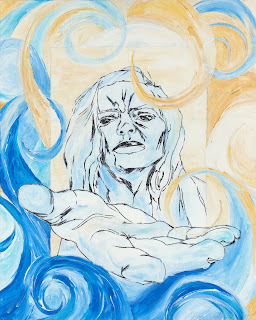
Because this lens would much rather accept Jesus’ offer of good news to the Samaritans - a people hated by the Jews and vice versa -  than to her. A woman. A Samaritan woman. A despised Samaritan woman. Of questionable moral character. Or who lacks the intellectual and theological ability to engage with Jesus in serious conversation. Both interpretations of this text that delegitimize her (and any woman, if we’re honest) as a conversation partner for Jesus and as a receiver and proclaimer of the gospel. 

So, instead, she is shamed. Not only by our patriarchy, but by hers, as well. And, perhaps, she has begun to believe this shame, too. Perhaps, that’s why she comes to the well at noon - the hottest time of the day, when no one else - no other women - would be there. Because it is so much safer - so less risky - to simply be alone. And isolated. So as not to trouble the waters. So as not to feel ashamed.

But, then, Jesus speaks to her. And in one of the longest conversations by far in the Gospels that he has with anyone, Jesus names her truth. Her woundedness and isolation. Her shame. And, in naming it, begins to unravel it.

Dr. Brene Brown is a sociologist and a researcher on shame. For six years she researched shame before she began to write about it. Why? Because, as she puts it, “shame is this horrible topic, no one wants to talk about it. It’s the best way to shut people down on an airplane. ‘What do you do?’ ‘I study shame.’ ‘Oh.’” When we begin to talk about patriarchy or whiteness. Sexism or Racism. Or privilege. She writes that when we begin to talk about these things, people get paralyzed by shame. Because “shame is the most powerful, master emotion. It’s the fear that we’re not good enough.”

But, here’s the thing. We cannot unravel those things in our lives, in our world, without addressing the shame - the shame Adam and Eve felt in those first moments after eating the apple - the shame that is at the heart of our human brokenness. Shame that tells us that we are not good enough. And shame that then drives us to wound others.

What shame in your life needs to be unraveled? Where is your woundedness? What is the thing that you spend so much energy trying to heal through so many insufficient ways? Relationships? Religion? Success? More degrees? More therapy? Working out? Busy-ness? Perfectionism? Aspects of aging? Aspects of youth? Whiteness? Othered-ness? There are a million ways we seek to isolate ourselves or to use substitutes for God to try and make sure our woundedness - our shame - is not known.

But Jesus knows. Jesus knows this deep and hidden part of us. And Jesus loves us for who we have been created to be, people in God’s image. And, then, Jesus calls us, just as he called the woman at the well, to be his apostles. At this time. In this place. In this moment of great disruption in his Church. In this moment of great disruption in our world. To do the risky work of unraveling. Faithfully. 

But, it’s hard work. This work of unraveling. And it’s difficult to find hope in the midst of it. Where can we find that hope? Where can we find Jesus in this work of unraveling?

I would suggest right here. Here, in our midst, in this space, as we have begun to unravel our own frameworks of thinking and ways of being, as we have argued and wept together, it is here. Where we have witnessed hope for the church God desires, the church God has called us to be. It is here where Jesus has been. Present in the midst of our shame and all our unraveled-ness. Knowing us. Building trust. And weaving us together into a rich tapestry of the diverse and beautiful community God has created us to be, that God hopes for us, for the whole church, for our world, and for all creation. 

For this I say, thanks be to God. Amen.


Sunday, July 9, 2017

Quenching Our Thirst

So he said, “I am Abraham’s servant. The Lord has greatly blessed my master, and he has become wealthy; he has given him flocks and herds, silver and gold, male and female slaves, camels and donkeys. And Sarah my master’s wife bore a son to my master when she was old; and he has given him all that he has. My master made me swear, saying, ‘You shall not take a wife for my son from the daughters of the Canaanites, in whose land I live; but you shall go to my father’s house, to my kindred, and get a wife for my son.’

“I came today to the spring, and said, ‘O Lord, the God of my master Abraham, if now you will only make successful the way I am going! I am standing here by the spring of water; let the young woman who comes out to draw, to whom I shall say, “Please give me a little water from your jar to drink,” and who will say to me, “Drink, and I will draw for your camels also”—let her be the woman whom the Lord has appointed for my master’s son.’

“Before I had finished speaking in my heart, there was Rebekah coming out with her water jar on her shoulder; and she went down to the spring, and drew. I said to her, ‘Please let me drink.’ She quickly let down her jar from her shoulder, and said, ‘Drink, and I will also water your camels.’ So I drank, and she also watered the camels. Then I asked her, ‘Whose daughter are you?’ She said, ‘The daughter of Bethuel, Nahor’s son, whom Milcah bore to him.’ So I put the ring on her nose, and the bracelets on her arms. Then I bowed my head and worshiped the Lord, and blessed the Lord, the God of my master Abraham, who had led me by the right way to obtain the daughter of my master’s kinsman for his son. Now then, if you will deal loyally and truly with my master, tell me; and if not, tell me, so that I may turn either to the right hand or to the left.”

And they called Rebekah, and said to her, “Will you go with this man?” She said, “I will.” So they sent away their sister Rebekah and her nurse along with Abraham’s servant and his men. And they blessed Rebekah and said to her,

“May you, our sister, become
    thousands of myriads;
may your offspring gain possession
    of the gates of their foes.”
Then Rebekah and her maids rose up, mounted the camels, and followed the man; thus the servant took Rebekah, and went his way.

Now Isaac had come from Beer-lahai-roi, and was settled in the Negeb. Isaac went out in the evening to walk in the field; and looking up, he saw camels coming. And Rebekah looked up, and when she saw Isaac, she slipped quickly from the camel, and said to the servant, “Who is the man over there, walking in the field to meet us?” The servant said, “It is my master.” So she took her veil and covered herself. And the servant told Isaac all the things that he had done. Then Isaac brought her into his mother Sarah’s tent. He took Rebekah, and she became his wife; and he loved her. So Isaac was comforted after his mother’s death.  Genesis 24:34–38, 42–49, 58–67 (NRSV)

Grace and peace to you from God, our Father, and our Lord and Savior, Jesus Christ. Amen.

I have to admit to you that, since I’ve moved to Kentucky, I’ve been a little intrigued by the bourbon culture here in this state. I don’t know if it’s only because of great marketing or what, but from the start, it has fascinated me.

So, a few months ago, when a member (who shall remain nameless) invited me to go and see the Evan-Williams Experience in downtown Louisville, I jumped at the chance. If you haven’t been there, it’s kind of a cross between a Disney-type history experience and a technical lecture of both the history of Louisville and the history and process of bourbon-making here in Kentucky.  I learned a lot and, to top it off, at the end, we participated in a bourbon tasting which, in itself, was quite educational.

One important fact that I found really interesting had to do with the limestone deposits in this area. Over 50% of the rock in Kentucky is limestone. It has a high pH, which promotes fermentation. Important for bourbon-making. It also filters out impurities, most importantly, iron, which gives liquor a bad taste. So, the presence of so much limestone in this area was perfect for the early distillers who developed bourbon. It also explains why the industry is centered here.

In the same way that limestone is commonly found here in Kentucky, it is also found in abundance in Canaan, the setting for our story today--our next chapter in the epic stories of Abraham and his family. And, just as it is here in Kentucky, where there was limestone in Canaan, there was also pure, good-tasting water. Wells were often cut out of solid limestone, sometimes with steps to descend down into them. Around the well, itself would be a brim or low wall, so nothing could fall into it, including people. And, often, near the well, were troughs, made of wood or stone, that were used to water animals.

Wells were central to life in Canaan. In a land that was arid and desert-like, they were critical to life and one’s existence. They served as a place of rest and refreshment in a dry land. Wells that were just outside a city or a village often served as a meeting place for local women, who were the ones who usually collected water for their families. It was often a stopping place for travelers who would share news. In Scripture, a number of important meetings take place at a well. 

Wells also played a significant role as images of God’s provision. A well and its water were symbols of God’s promise and God’s care. Writers in the Bible often compared the water of spring-fed wells to God’s gift of salvation for God’s people. 

It is around such a well that the action of today’s story is centered. 

But, before, we move to that action, there’s a little catch-up for us to do. 

In the period since our story from last week--the story of the near-sacrifice of Isaac--much time has passed. In the preceding chapter, we learn that Sarah is dead at age 127. Abraham was distraught. Verse 2 reads that Abraham “cried out in grief and wept” at her death. As time passed and as he began to move out of his grief, our story says that he “became older.” Perhaps it was that he was aging. Perhaps it was the loss of Sarah. Whatever it was, Abraham began to think about the next generation. In particular, he began to think of finding a wife for his son, Isaac.

He called for his oldest servant. We know that this was his most trusted servant because our story tells us that he was in charge of everything Abraham owned, which by this time was substantial, a result of God’s blessing. 

Abraham called this servant and asked him to swear an oath--to promise that a wife for Isaac would not be chosen from among the Canaanite women, but that the servant would go back to the land God had called Abraham from. The land of his father and his father’s household. Abraham wanted Isaac’s wife to come from his family, from his own clan.

When the servant expressed some hesitation, especially whether any woman would leave her family to come to Canaan, Abraham assured him that God would be faithful. That God would send a messenger ahead tp ensure that Abraham’s servant would find a wife there. Abraham also told him that if the woman refused to return, the servant would be off the hook. That he would be free of this promise.

And, so, Abraham’s servant agreed. He swore the oath by “the Lord, the God of heaven and earth.” By the God of the covenant and the creator.

The servant gathered together ten camels--only part of the herd--along with the best provisions and set out for the land of Abraham’s kin. When he got there, he went to the well outside the city where Abraham’s brother lived. 

Now, it wasn’t an accident that he ended up at a well. It had been a long, hot journey. He was thirsty. His camels, too. It was no accident he was there. It was also no accident that he arrived in the evening. Because it was in the evening that women from the city would come out to draw water. 

So, he had the camels kneel down. Kneel down and wait for women. And, then, he prayed. He prayed that God would be faithful once again with his master, Abraham. That God would once again show steadfast love and faithfulness to Abraham. And that God would guide him, Abraham’s servant, and make it happen in front of him. And in his prayer, he lays out his shrewd character test for Isaac’s potential wife. He will test her sense of hospitality--that key trait that would determine her fitness to marry into the family led by Abraham, so known for his hospitality. 

It’s a tough test, too. Because it will take much more than simple hospitality to volunteer to water ten thirsty camels, as each camel alone can drink and store up to 20-30 gallons of water.  

Even before he finished speaking his prayer to God, a young woman--our text says the was very beautiful, of marrying age, and still a virgin--appeared at the well with a jar on her shoulder. This young woman--Rebekah--then went down into the well, filled the jar, and came back up. When she returned, Abraham’s servant politely asked for a little sip, which she graciously gave. And then, even before he can ask, Rebekah empties the rest of her jar it into the watering trough. And she runs back down to the well and brings up another to continue watering the camels--a task that likely required 30 trips up and down the stairs of the well. 

All the time she was doing this, the servant stood watching, waiting, and wondering if God had answered his prayers, if this kind and hospitable and beautiful young woman would be Abraham’s kin.

The answer? Yes! She was Rebekah--granddaughter of Nahor, Abraham’s brother. A member of Abraham’s clan.

Our story continues with the return of the servant to the house of Rebekah’s mother, where the scene at the well is retold, the big question is asked, a marriage is negotiated, and, eventually, Rebekah leaves with the servant to return to Canaan. The last verses of our story tell us that, when she saw Isaac, Rebekah, literally, fell off the camel. Isaac had a similar response. He brought her to Sarah’s tent, placing her into the position as family matriarch. They were married. And our story tells us that “he loved her” and “was comforted after his mother’s death.

Faithfulness. This is the message of the story of the servant and Rebekah at the well. It is there, at the well, in the quenching of thirsts that God provides Rebekah. A new matriarch. A new wife for Isaac. A new generation in Abraham’s line. Life. Salvation.

It is the same message for us, too. Just as the well and its water were symbols of God’s promise and God’s care in Abraham’s time, so, too the water of baptism--the living water of baptism--is a symbol for us of God’s faithfulness, of God’s provision, of God’s promise. God’s covenant promise of life. Quenching our thirst through the living water that is our Lord and Savior Jesus Christ and joining us in baptism to his death and resurrection.

Life. Salvation. Thirst that is quenched. All through the faithful love of our God, the God of Abraham and the God of Isaac. 

May we praise God forever and ever! Amen.

Preached July 9, 2017 at Grace & Glory Lutheran Church, Goshen, KY.
5th Sunday after Pentecost
Readings: Genesis 24:34–38, 42–49, 58–67; Psalm 45:10-17; Romans 7:15-25a; Matthew 11:16-19, 25-30