Showing posts with label promise. Show all posts

Friday, September 11, 2026

The Storm and The Road: Beyond the Flood

Friends, welcome to a new year in the Narrative Lectionary! Over the next few months, we are doing something vital: immersing ourselves in the Hebrew Scriptures, the very Bible Jesus read and prayed. Too often, people think the God of the Old Testament is harsh and angry, while Jesus comes later to soften God up. But this story shows us one continuous arc of divine love—a God who longs for relationship and never gives up on a messy world.

Today, we jump right into a storm—not with the bright morning of creation, but with the world falling apart. We read this morning in Genesis.

6:5 The Lord saw that the wickedness of humans was great in the earth and that every inclination of the thoughts of their hearts was only evil continually. 6 And the Lord was sorry that he had made humans on the earth, and it grieved him to his heart. 7 So the Lord said, “I will blot out from the earth the humans I have created—people together with animals and creeping things and birds of the air—for I am sorry that I have made them.” 8 But Noah found favor in the sight of the Lord.   9 These are the descendants of Noah. Noah was a righteous man, blameless in his generation; Noah walked with God. 10 And Noah had three sons: Shem, Ham, and Japheth.   11 Now the earth was corrupt in God’s sight, and the earth was filled with violence. 12 And God saw that the earth was corrupt, for all flesh had corrupted its ways upon the earth. 13 And God said to Noah, “I have determined to make an end of all flesh, for the earth is filled with violence because of them; now I am going to destroy them along with the earth. 14 Make yourself an ark of cypress wood; make rooms in the ark, and cover it inside and out with pitch. 15 This is how you are to make it: the length of the ark three hundred cubits, its width fifty cubits, and its height thirty cubits. 16 Make a roof for the ark, and finish it to a cubit above, and put the door of the ark in its side; make it with lower, second, and third decks. 17 For my part, I am going to bring a flood of waters on the earth, to destroy from under heaven all flesh in which is the breath of life; everything that is on the earth shall die. 18 But I will establish my covenant with you, and you shall come into the ark, you, your sons, your wife, and your sons’ wives with you. 19 And of every living thing, of all flesh, you shall bring two of every kind into the ark, to keep them alive with you; they shall be male and female. 20 Of the birds according to their kinds and of the animals according to their kinds, of every creeping thing of the ground according to its kind, two of every kind shall come in to you, to keep them alive. 21 Also take with you every kind of food that is eaten, and store it up, and it shall serve as food for you and for them.” 22 Noah did this; he did all that God commanded him.   8:1 But God remembered Noah and all the wild animals and all the domestic animals that were with him in the ark. And God made a wind blow over the earth, and the waters subsided. 6 At the end of forty days Noah opened the window of the ark that he had made 7 and sent out the raven, and it went to and fro until the waters were dried up from the earth. 8 Then he sent out the dove from him to see if the waters had subsided from the face of the ground, 9 but the dove found no place to set its foot, and it returned to him to the ark, for the waters were still on the face of the whole earth. So he put out his hand and took it and brought it into the ark with him. 10 He waited another seven days, and again he sent out the dove from the ark, 11 and the dove came back to him in the evening, and there in its beak was a freshly plucked olive leaf; so Noah knew that the waters had subsided from the earth. 12 Then he waited another seven days and sent out the dove, and it did not return to him any more.   9:8 Then God said to Noah and to his sons with him, 9 “As for me, I am establishing my covenant with you and your descendants after you 10 and with every living creature that is with you, the birds, the domestic animals, and every animal of the earth with you, as many as came out of the ark. 11 I establish my covenant with you, that never again shall all flesh be cut off by the waters of a flood, and never again shall there be a flood to destroy the earth.” 12 God said, “This is the sign of the covenant that I make between me and you and every living creature that is with you, for all future generations: 13 I have set my bow in the clouds, and it shall be a sign of the covenant between me and the earth. 14 When I bring clouds over the earth and the bow is seen in the clouds, 15 I will remember my covenant that is between me and you and every living creature of all flesh, and the waters shall never again become a flood to destroy all flesh. 16 When the bow is in the clouds, I will see it and remember the everlasting covenant between God and every living creature of all flesh that is on the earth.” 17 God said to Noah, “This is the sign of the covenant that I have established between me and all flesh that is on the earth.”

                                                                                                  --Genesis 6:5-22; 8:1, 6-12; 9:8-17 (NRSVue)

Earlier, you talked in small groups about what it means to make a promise. As we move into our text, I invite a quick thought from your conversations: How does making a real covenant promise change the way two people relate to each other?


When we make a covenant promise, a relationship shifts from tenuousness to commitment. That same shift from uncertainty into trust is the exact shift we see in God’s heart today.


When Genesis tells us the world was filled with violence, God didn't look down with cold anger. The text says God was grieved to the heart. The Hebrew word used here ('asav) describes the agonizing pain of labor. God’s reaction isn't the fury of a judge, but the heartbreak of a parent who loves us too much to watch us destroy each other.


Then comes the turning point: God remembered Noah. In Scripture, when God remembers (zkr), it means taking compassionate action to rescue the vulnerable. God sends the ruakh—the same breath of life used in creation—to bring dry land out of the chaos.


I know many of us understand what it feels like to live in the ark. It’s that deep fatigue of surviving year after year of adaptation. When we are in survival mode, it's easy to think that just guarding the boat is the whole point. But stewardship isn't about hoarding our love or our resources out of fear; it’s trusting that God sustains the vessel so we can step onto dry land and plant fresh vineyards on a new mountain. Just like Noah.


When the storm ends, God makes a covenant. A promise. To mark this promise, God puts a rainbow in the sky. In ancient times, people saw a rainbow as a war bow—a weapon used to shoot arrows. But in this story, God takes the bow and hangs it up in the clouds, pointing it away from the earth. God disarms. God chooses mercy over punishment, promising to always treat creation with love and peace.


This promise isn't just words in the sky; it is a call for us to move past survival and start planting for the future. Today is "God's Work, Our Hands" Sunday, which fits this story perfectly. Right after service, we are jumping into three hands-on service projects. This isn't just about preserving what we have—it is us rolling up our sleeves, stepping off the ark, and planting new seeds of hope as the caring hands of a faithful God.


May we all serve today with open hands, bringing fresh life and hope to a world God loves so deeply.


Let us pray. God of promise, you sustained Noah through the storm and you sustain us today. As we use our hands to serve, move us from fear to trust, so we can plant seeds of new life in our community. Amen.


Preached Sunday, September 13, 2026, on God's Work, Our Hands Sunday, at Vista Lutheran Church, St. Louis Park, MN.



Sunday, September 18, 2022

ReMember: Abraham Forgets


Before we move into today’s reading, I’d like to transition us from last week’s story to today’s text in Genesis 12. While the move from chapter 8 in Genesis to chapter 12, today, doesn't seem like a big jump, there’s a lot that goes on in the chapters in-between.

After the story of the flood and of God’s covenant promise to Noah and his descendants, humankind didn’t really improve. In fact, in the verses immediately after God’s promise of the rainbow as an aid to God’s remembering, we have the story of Noah getting drunk. And naked. Probably not the image of the patriarch we want to keep, right?

Things don’t get better from there. There is a human inclination - a human desire - for power and control, especially to serve oneself. In the chapter that precedes today’s text, we read the story of the Tower of Babel. And of the attempt by humans to seek more and more power - to be like God. So, God mixes up their language so they can no longer easily communicate with one another. Then, God disperses them over all the earth so they can no longer together seek greater and greater power. It’s like the ultimate anti-trust action by God to ensure that humankind doesn’t become too big for its britches. 

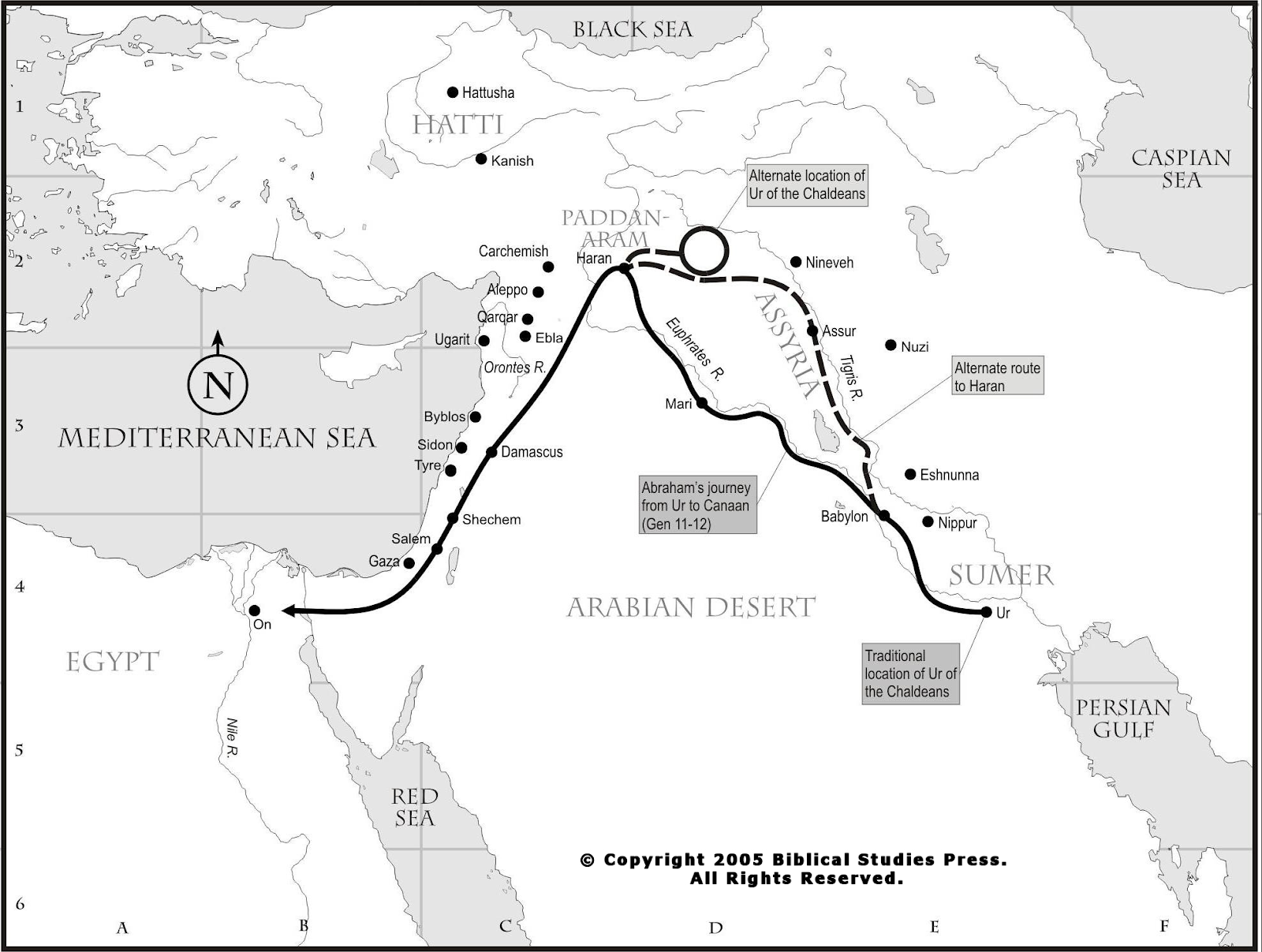
The story continues down the generations from Shem, Noah’s son, to Terah, father of Abram, who we know better as Abraham. At the end of chapter 11, we learn two things. First, that Terah lives in Ur. (Refer to the map.) 

Ur is in the same location as Babel (or Babylon). Terah decides to move from Ur to Canaan. This means traveling an ancient trade route along what is called the Fertile Crescent (Remember your western civilization history?) to get there. But, Terah never reaches Canaan. Instead he, his family, and his household settle at the top of the Fertile Crescent in Haran. Then, the second thing we learn is that Sarai is unable to have children.

So, it is here where we find Abram and Sarai - where today’s story opens in Genesis 12. In Haran. With no children.

The Lord said to Abram, “Leave your land, your family, and your father’s household for the land that I will show you. I will make of you a great nation and will bless you. I will make your name respected, and you will be a blessing.

I will bless those who bless you,
    those who curse you I will curse;
        all the families of the earth
            will be blessed because of you.”

Abram left just as the Lord told him, and Lot went with him. Now Abram was 75 years old when he left Haran. Abram took his wife Sarai, his nephew Lot, all of their possessions, and those who became members of their household in Haran; and they set out for the land of Canaan. When they arrived in Canaan, Abram traveled through the land as far as the sacred place at Shechem, at the oak of Moreh. The Canaanites lived in the land at that time. The Lord appeared to Abram and said, “I give this land to your descendants,” so Abram built an altar there to the Lord who appeared to him. From there he traveled toward the mountains east of Bethel, and pitched his tent with Bethel on the west and Ai on the east. There he built an altar to the Lord and worshipped in the Lord’s name. Then Abram set out toward the arid southern plain, making and breaking camp as he went.

When a famine struck the land, Abram went down toward Egypt to live as an immigrant since the famine was so severe in the land. Just before he arrived in Egypt, he said to his wife Sarai, “I know you are a good-looking woman. When the Egyptians see you, they will say, ‘This is his wife,’ and they will kill me but let you live. So tell them you are my sister so that they will treat me well for your sake, and I will survive because of you.”

When Abram entered Egypt, the Egyptians saw how beautiful his wife was. When Pharaoh’s princes saw her, they praised her to Pharaoh; and the woman was taken into Pharaoh’s household. Things went well for Abram because of her: he acquired flocks, cattle, male donkeys, men servants, women servants, female donkeys, and camels. Then the Lord struck Pharaoh and his household with severe plagues because of Abram’s wife Sarai.  --Gen. 12:1-17 (CEB)

It’s interesting to me that, as with Noah in last week’s story, God once more is moving from the distant - from a broader dealing with humanity - to the personal. To Abram and Sarai. 

God calls this couple through whom God promises to bless the whole earth. Abram and Sarai have one function in God’s plan. That is to be a blessing to all families of the “ground.” In most translations this phrase is translated as “families of the earth” or “people of the earth”. But this obscures a crucial aspect of this story of Abram and Sarai. The better translation is "families of the 'ground.'" The Hebrew word here, adamah, is the word first used in Genesis 2 to describe the creation of human beings from the “dust of the ground.” It’s the ground referenced in Genesis 3 to which all life will return in death. It’s the ground that literally opened its mouth to receive the blood of Abel after he was murdered by his brother, Cain, in Genesis 4 - and the ground from which Cain is cursed. In the Noah story, we read in Genesis 5, the hope that he will bring rest from this curse of the ground. But, then, in Genesis 9 it is from the ground that Noah receives wine that leads to his drunken nakedness and the breakup of his family. So, when we hear the call of Abram and Sarai to be a blessing to all families of the “ground” we understand what this is - a new attempt on the part of God to reconstitute the harmony of creation. This is a missionary call for Abram that will be echoed throughout the entire biblical narrative - including to you and to me. That, having been blessed by God in our many and unique ways, we then become a blessing to others.

So, Abram and Sarai go to the land they are promised, stopping at various points along the way to offer sacrifices of gratitude to the God who has called them. But, it is not long before a crisis comes. And the promise of God through Abram and Sarai is soon in trouble.

A famine strikes Canaan. They go south to Egypt - the bread basket of the ancient Near East. On the way, Abram does some thinking - about himself and his future. He devises a scheme to ensure his own safety by trafficking - let’s be honest here that’s what he’s doing, right? - trafficking his own wife to ensure his self-serving plan. 

Now, we first need to recognize that we live in a time and culture that is very, very distant from Abram’s. Women were viewed as property. Polygamy was common. Cousins married cousins. Spouses were not true partners - a husband was the lord and master of the wife and exercised complete control over her body. Over her responsibilities. Over her life. 

The other thing we need to know is that, further on in Genesis, we learn that Sarai really is Abram’s sister. His half-sister. So, in many respects, Abram is telling the truth here. But, remember God’s call for Abram and Sarai? To be a blessing to all the families of the ground. Abram’s actions here end up harming an innocent man - whether the man is powerful or not. Abram is not a blessing to the Pharoah. Either Abram has misheard God or simply forgotten God’s promise to preserve and protect him. His fear has gotten in the way of his trust in this promise - a promise from God of blessing. 

I wonder how many of us forget the promises of God in the midst of our own fears and worries. Wondering about our lives. Or about our loved ones’ lives. Fearing the worst. And, as a result of that fear, acting out of self-preservation, even if it harms innocent people.

Friends, God wants us to be free of fear. God wants us to truly trust that God will do what God says. The core of the relationship between God and Abram was to be blessed and to be a blessing. God remembered and honored that promise for him. 

Abram was given that promise. It has been given to us, as well. We may forget it. But, as with Abram, God did not forget him. And God has not forgotten us. Amen.

Preached Sunday, September 18, 2022, at Grace & Glory, Prospect, with Third, Louisville.
15th Sunday after Pentecost
Reading: Genesis 12:1-17

Sunday, January 2, 2022

God Provides Blessings: Reluctant Prophet

Throughout this unit, we’ve been exploring the idea that God Provides Blessings in many different ways. We’ve considered the blessings found in creation. The blessings that other people provide to us. And the blessings that we offer to other people.

Sometimes, though, we receive blessings through experiences that, perhaps, we did not want to have. Or were nervous or reluctant about.

For example, if I’d been given a preference to serve a congregation, it’s probably no surprise to you that I would have wanted to serve in a place closer to my son and daughter-in-law. But, God had a slightly different idea that I did about where I might best serve the Church. Thank God this is so, because, if not, I would never have the blessing of knowing you. Or this beautiful place. Or the many people I’ve met through my work and my life here.

Have you had an experience like this? Where you entered into it in a reluctant way? What might have happened if you’d not done this thing, however reluctantly? Perhaps, the bigger question is how has God blessed you through this experience?

Moses was a reluctant leader. Today, we’re going to hear what Moses was reluctant to do. And how, even with this, God blessed him and so many others through him anyway. We read today in three parts, beginning in Exodus, chapter 2. 

A long time passed, and the Egyptian king died. The Israelites were still groaning because of their hard work. They cried out, and their cry to be rescued from the hard work rose up to God. God heard their cry of grief, and God remembered his covenant with Abraham, Isaac, and Jacob. God looked at the Israelites, and God understood. 

It’s been a long time and generations since Jacob. 

If you remember the story of Jacob and his son, Joseph, you may recall that because of famine, Jacob, now renamed Israel, had moved with his clan to Egypt. They had settled in Goshen. Much time has passed. New pharoahs - Egyptian kings - have come and gone. Israel has grown into a large people. A nation. Fulfilling part of the covenant with Abraham. But, because of their size, they’ve become viewed as a political threat to Egypt. And were enslaved. Forced into hard labor. 

Our story tells us that they were groaning because of this enslavement. Crying out to God. Crying out to be rescued from this hard and punishing work. Do you notice the verbs that describe God’s response? God heard. God remembered. God looked. And God understood.

What might this say to us when we cry out because of our suffering? Or those who are oppressed in our world cry out? God hears. God remembers. God looks. And God understands.

Our reading continues in chapter 3.

Moses was taking care of the flock for his father-in-law Jethro, Midian’s priest. He led his flock out to the edge of the desert, and he came to God’s mountain called Horeb. The Lord’s messenger appeared to him in a flame of fire in the middle of a bush. Moses saw that the bush was in flames, but it didn’t burn up. Then Moses said to himself, Let me check out this amazing sight and find out why the bush isn’t burning up.

When the Lord saw that he was coming to look, God called to him out of the bush, “Moses, Moses!”

Moses said, “I’m here.”

Then the Lord said, “Don’t come any closer! Take off your sandals, because you are standing on holy ground.” He continued, “I am the God of your father, Abraham’s God, Isaac’s God, and Jacob’s God.” Moses hid his face because he was afraid to look at God.

Then the Lord said, “I’ve clearly seen my people oppressed in Egypt. I’ve heard their cry of injustice because of their slave masters. I know about their pain. I’ve come down to rescue them from the Egyptians in order to take them out of that land and bring them to a good and broad land, a land that’s full of milk and honey, a place where the Canaanites, the Hittites, the Amorites, the Perizzites, the Hivites, and the Jebusites all live. Now the Israelites’ cries of injustice have reached me. I’ve seen just how much the Egyptians have oppressed them. So get going. I’m sending you to Pharaoh to bring my people, the Israelites, out of Egypt.”

But Moses said to God, “Who am I to go to Pharaoh and to bring the Israelites out of Egypt?”

God said, “I’ll be with you. And this will show you that I’m the one who sent you. After you bring the people out of Egypt, you will come back here and worship God on this mountain.”

Moses is a person in between. He is Hebrew, but has grown up in the royal court - adopted by a pharaoh’s daughter. Yet, as a Hebrew, his heart remains with his people. 

Moses is a person between two worlds - a world of privilege and a world of bondage, called by God to traverse both of those worlds to accomplish God’s plan, which is to free God’s people from their oppression.

Moses is reluctant. Perhaps its because he is a person of two worlds, not belonging to either, he questions his own worth. Yet, God calls him. In an unusual way. Through a burning bush. A bush that is not consumed. How long did Moses have to look at this burning bush to notice that it wasn’t burning up? How many people before Moses passed by this bush without noticing? How often to we pass by “burning bushes” in our lives - too busy or maybe feeling too unworthy to stop and notice how God might be calling us?

Our story continues in chapter 3.

But Moses said to God, “If I now come to the Israelites and say to them, ‘The God of your ancestors has sent me to you,’ they are going to ask me, ‘What’s this God’s name?’ What am I supposed to say to them?”

God said to Moses, “I Am Who I Am. So say to the Israelites, ‘I Am has sent me to you.’” God continued, “Say to the Israelites, ‘The Lord, the God of your ancestors, Abraham’s God, Isaac’s God, and Jacob’s God, has sent me to you.’ This is my name forever; this is how all generations will remember me.

Knowing someone’s name gives us a more intimate relationship with them. This act of God - giving Moses God’s very name - is an intimate act, inviting Moses into relationship with God. Because God’s name is sacred. So sacred, in fact, that in later generations, the Hebrew people will not even speak it aloud. God’s name is so sacred that it really is not even translatable from the original Hebrew. It’s a verb, that means “to be.” It can be translated, “I Am Who I Am.” But, God will not be pinned down to any single name. This verb is open-ended. It can be translated, “I Will Be Who I Will Be.” It can be translated, “I Will Become Who I Will Become.” It’s a verb that teaches us that God is present yet ever-changing. But mostly, God’s name teaches us that God cannot be contained. That God is so expansive that any relationship with God that you or I experience is only one minute aspect of this present, ever-changing and expansive God. It also teaches us that to even begin to know God, we have to be in relationship not only with God, but with one another - sharing our own, unique experiences with God. Who is, who will be, who will become all that we need God to be. 

We conclude in chapter 4.

But Moses said to the Lord, “My Lord, I’ve never been able to speak well, not yesterday, not the day before, and certainly not now since you’ve been talking to your servant. I have a slow mouth and a thick tongue.”

Then the Lord said to him, “Who gives people the ability to speak? Who’s responsible for making them unable to speak or hard of hearing, sighted or blind? Isn’t it I, the Lord? Now go! I’ll help you speak, and I’ll teach you what you should say.”

But Moses said, “Please, my Lord, just send someone else.”

Then the Lord got angry at Moses and said, “What about your brother Aaron the Levite? I know he can speak very well. He’s on his way out to meet you now, and he’s looking forward to seeing you. Speak to him and tell him what he’s supposed to say. I’ll help both of you speak, and I’ll teach both of you what to do. Aaron will speak for you to the people. He’ll be a spokesperson for you, and you will be like God for him. Take this shepherd’s rod with you too so that you can do the signs.”

Moses. He is so reluctant. “I’m not worthy” moves to “I can’t speak well.” Notice that throughout the story God continues to accommodate his fears. His sense of unworthiness. His reluctance. I will be with you, I Am tells him. I will give you voice, I Will Be says to him. 

Then, finally, Moses gets to the end of his line of excuses and just says, “I don’t want to do this. Just send someone else.” “I will give you words to give to Aaron,” I Will Become promises him. Because, as much as Moses might protest, God has a plan for all of God’s people - a plan of rescue and redemption. A plan of freedom and salvation. A plan of hope through which God will shower on them blessing upon blessing. A plan through which God will keep God’s ancestral promises - to become a nation, to have a country, and through them to bless all nations.

You and I - we’re part of that plan. Part of that bigger story. And, though we may be reluctant prophets, just like Moses, we have the same call and the same promises. To share the news of the freedom we have in God through God coming to us in Christ Jesus. And that God will give us the words and the tools and the partners we need to help accomplish our small part of that expansive, all-encompassing plan of I Am, I Will Be, I Will Become.

Amen. Amen.

Preached October 3, 2021, at Grace & Glory, Prospect, and Third, Louisville.
Pentecost 19
Readings: Exodus 2:23-25; 3:1-15; 4:10-17; John 8:58

Thursday, August 26, 2021

Presence and Promise: The Promise of LIfe

Over these past two weeks, we’ve seen these visions of the heavenly throne room. In the first week, we had this image of God, the Creator. A God we’ve been introduced to over and over in the prophets. God, at the center of the universe, surrounded by the heavenly council and the four living creatures, who represent humanity and all of creation - all of whom are singing these songs of praise to God. Songs that we sing in our liturgy and our hymns: holy, holy, holy.

Week Two brought us the image of the Lamb. The One worthy to open the scroll in God’s hand - the master plan by which God would redeem and restore us and all creation. Once again, we heard of the praise of heaven and earth for this Lamb - Worthy is Christ the Lamb who was slain.

Today, these scenes of praise and celebration give way to threatening visions. As the Lamb begins to open the seals of the scroll, we experience a series of seven threatening visions. One of which - perhaps the most threatening vision for us of all - is the basis for the first part of today’s reading. In Revelation, chapter 6. 

Then I looked on as the Lamb opened one of the seven seals. I heard one of the four living creatures say in a voice like thunder, “Come!” So I looked, and there was a white horse. Its rider held a bow and was given a crown. And he went forth from victory to victory.

When the Lamb opened the second seal, I heard the second living creature say, “Come!” Out came another horse, fiery red. Its rider was allowed to take peace from the earth so that people would kill each other. He was given a large sword.

When he opened the third seal, I heard the third living creature say, “Come!” So I looked, and there was a black horse. Its rider held a balance for weighing in his hand. I heard what sounded like a voice from among the four living creatures. It said, “A quart of wheat for a denarion, and three quarts of barley for a denarion, but don’t damage the olive oil and the wine.”

When he opened the fourth seal, I heard the voice of the fourth living creature say, “Come!” So I looked, and there was a pale green horse. Its rider’s name was Death, and the Grave was following right behind. They were given authority over a fourth of the earth, to kill by sword, famine, disease, and the wild animals of the earth.

These are the threats that are real. They are as real for us today as they were for people in the first century. These are the things that strip away any sense of security we might have. Each of them represented by one of the four horsemen. 

The first horseman in white represents the threat of conquest. 

How secure are we as a nation? The people reading John’s Revelation lived in the most secure nation on earth. Much like we do today. They, like us, took this for granted. Yet, as we have learned in these past many months, our nation’s security can easily be undermined. It is more tenuous than we realize. Unexpected and unseen forces, whether from outside or from inside our nation’s borders continuously threaten our national security. How secure are is our nation? This is the potential threat represented by the first horsemen.

The second horseman in fiery red represents the threat of violence - the violence we do to each other. It asks the question, “How secure are you in your community or even in your own home?” This is a threat that keeps us up at night. That causes such anxiety. How do we keep ourselves or our families safe? This is the threat that leads us to trust in weapons and in security systems that often give us a false sense of security. How safe really are you and your loved ones from violence?

The third horseman in black represents the threat of food shortage or of economic hardship. Isn’t this another threat that keeps us up at night? Where will the money come from? For food, for shelter, for those basic needs to, once again, keep us safe. How secure is your family economically? We live in one of the richest countries in the world, but as we see greater and greater economic inequality and insecurity in our nation. How secure are each of us really? One or two paychecks away from financial ruin. One stock market crash away from economic failure. How secure are you and your loved ones financially?

The fourth horseman in pale green represents the threat of death. How secure is your health or your life? This is perhaps the most frightening for all of us. Whether it is a cancer diagnosis, a heart attack or a stroke or the continuing threat of the pandemic, this threat of the loss of our health or of our lives terrifies us. 

Each of these four horsemen present threats that remind us of how vulnerable we really are. Over and over again, they ask the question, “How secure are you? No, really! How secure are you and those you love?” They lead us, like the writer of Revelation before the final seal is opened, to ask this question: who can stand in the face of these threats? How can we survive?

The answer is in the second part of our reading today. From Revelation, chapter 7.

After this I looked, and there was a great crowd that no one could number. They were from every nation, tribe, people, and language. They were standing before the throne and before the Lamb. They wore white robes and held palm branches in their hands. They cried out with a loud voice:

“Victory belongs to our God
       who sits on the throne,
            and to the Lamb.”

All the angels stood in a circle around the throne, and around the elders and the four living creatures. They fell facedown before the throne and worshipped God, saying,

“Amen! Blessing and glory
        and wisdom and thanksgiving
        and honor and power and might
            be to our God forever and always. Amen.”

Then one of the elders said to me, “Who are these people wearing white robes, and where did they come from?”

I said to him, “Sir, you know.”

Then he said to me, “These people have come out of great hardship. They have washed their robes and made them white in the Lamb’s blood. This is the reason they are before God’s throne. They worship him day and night in his temple, and the one seated on the throne will shelter them. They won’t hunger or thirst anymore. No sun or scorching heat will beat down on them, because the Lamb who is in the midst of the throne will shepherd them. He will lead them to the springs of life-giving water, and God will wipe away every tear from their eyes.”
--Revelation 6:1-8; 7:9-17 (CEB)

Who can stand? Who can stand in the face of these threats? John sees who can stand: those who have been redeemed by the Lamb. You and I and believers across time. We can stand. 

It does not mean that these threats are not real. Or that they will go away. We have over this past year and a half been witness to every one of these threats. We have experienced every one of them. 

But, the promise here is that, even in the face of conquest or violence or economic hardship or illness or death - the promise we have is that of life. It is this promise that allows us to stand in the face of these threats, knowing and trusting that, ultimately, God’s purpose is one of life. No more hunger or thirst. No sun or scorching heat. No more tears. A promise for you and for me. For all people and for all time. 
Blessing and glory and wisdom and thanksgiving and honor and power and might be to our God forever and always. Amen.

Preached August 22, 2021, at Grace & Glory Lutheran, Prospect, and Third Lutheran, Louisville.
13th Sunday after Pentecost
Readings: Revelation 6:1-8; 7:9-17; John 14:1-4


Sunday, October 25, 2020

Promises Made, Promises Broken: God's House

Over these past many weeks, we have been moving through the Hebrew scriptures under the theme, Promises Made, Promises Broken. We have learned about the great promises that God has made to humanity. And ways in which humankind has made and often broken promises, both to God and to one another. 

This idea of promise - or covenant - is one of the most important themes in the Bible. The covenants in scripture are the background upon which the entire narrative of God and of God’s story of redemption are built. They’re like the backbone of the Bible. 

From Genesis on, God enters into a series of formal, covenanted relationships, one after another, in order to rescue God’s world. Understanding these divine-human relationship stories are central to our understanding who Jesus is. That for us, is pretty important, isn’t it? So, we’re going to remember, for just a few minutes, these key biblical covenants. 

We began the fall at the beginning. Creation. God made this beautiful world and placed humankind in it to care for it and to partner with God to bring more good out of it. But the humans don’t want to partner with God. They rebel and try to create a world on their own terms. It’s this broken partnership that the Bible gives as an explanation for why we’re stuck in a world of corruption and injustice and death. So God selects a small group of people and makes a new partnership with them. God’s purpose is to use this covenant relationship to renew God’s partnership with all humanity.

There are four central covenants in the Hebrew scripture through which God is forming a covenant family into which all the world will be invited. In the first covenant with Noah, God promises him, his family and all living creatures that God will never again destroy earth. No matter how evil it becomes.

In the second covenant with Abraham, God enters into a partnership with him. And promises Abraham a huge family that will inherit a promised piece of land in Canaan. And that through Abraham and his family, all humanity will be blessed. 

The third covenant is with this huge family that eventually became the nation of Israel. God rescued Israel from bondage in Egypt and promised to make them God’s treasured possession. A holy nation. Set apart. And with whom God would personally dwell in their midst and bring into the land originally promised to Abraham. God would be their God. And they would be God’s people - a kingdom of priests that would show God’s goodness and glory to all the nations. 

Today, we come to the fourth covenant. Beginning last week and continuing today, we find that Israel has entered Canaan, the promised land. Eventually, to be like the surrounding nations, they demanded a king. God appointed Saul. Yet, he fails to obey God. And so, God chooses another king for Israel. David. Son of Jesse. From the tribe of Judah. King David becomes a successful leader, overcoming Israel’s enemies. Uniting the tribes. And establishing Jerusalem as the political center of Israel, where he builds his palace - a “house of cedar.” Then, in the chapter before today’s reading, David restores the Ark of the Covenant to Jerusalem. Making it, not only the political center of Israel, but it’s religious center, as well. It is here where our story begins. In 2nd Samuel, chapter 7.  

Now when the king was settled in his house, and the Lord had given him rest from all his enemies around him, the king said to the prophet Nathan, “See now, I am living in a house of cedar, but the ark of God stays in a tent.” Nathan said to the king, “Go, do all that you have in mind; for the Lord is with you.”

But that same night the word of the Lord came to Nathan: Go and tell my servant David: Thus says the Lord: Are you the one to build me a house to live in? I have not lived in a house since the day I brought up the people of Israel from Egypt to this day, but I have been moving about in a tent and a tabernacle. Wherever I have moved about among all the people of Israel, did I ever speak a word with any of the tribal leaders of Israel, whom I commanded to shepherd my people Israel, saying, “Why have you not built me a house of cedar?” Now therefore thus you shall say to my servant David: Thus says the Lord of hosts: I took you from the pasture, from following the sheep to be prince over my people Israel; and I have been with you wherever you went, and have cut off all your enemies from before you; and I will make for you a great name, like the name of the great ones of the earth. And I will appoint a place for my people Israel and will plant them, so that they may live in their own place, and be disturbed no more; and evildoers shall afflict them no more, as formerly, from the time that I appointed judges over my people Israel; and I will give you rest from all your enemies. Moreover the Lord declares to you that the Lord will make you a house. When your days are fulfilled and you lie down with your ancestors, I will raise up your offspring after you, who shall come forth from your body, and I will establish his kingdom. He shall build a house for my name, and I will establish the throne of his kingdom forever. I will be a father to him, and he shall be a son to me. When he commits iniquity, I will punish him with a rod such as mortals use, with blows inflicted by human beings. But I will not take my steadfast love from him, as I took it from Saul, whom I put away from before you. Your house and your kingdom shall be made sure forever before me; your throne shall be established forever. In accordance with all these words and with all this vision, Nathan spoke to David. (2 Samuel 7:1-17 NRSV)

One of the first things we notice in this story is that the narrator does not refer to David by name. Instead, he is always called “the king.” This is to underscore that David - and not Saul - is now king. It also underscores his role as the leader of the nation Israel. Yet, when God speaks, beginning in verse 5, God always refers to him as, “my servant, David.” God knows him by name. 

It isn’t long before David gets a grand idea. He has a house to live in. It’s time to build a house for God. Something stable. And permanent. And secure. 

Now it’s not entirely clear here what his motivation is. Was he simply coming from a place of gratitude for all that God had done for him and for Israel? Or maybe this was a way to stay in God’s good graces? Or maybe, just maybe, it was a way for this earthly monarch to attempt to contain the heavenly monarch. To put God in a box. To control God.  

But, whatever David’s motivation is here, it is clear that he does not fully understand the nature of God’s grace. Whatever God has already done for David, God will continue to do more. To make for David a great name. To give him rest from all his enemies. And, for Israel, to plant them so they may live in their own place, secure. Where they will no longer be disturbed or afflicted by evildoers. 

But, the promises don’t stop there. It is in the next verses where God pivots on David's use of the word, “house.” Promising unconditionally to make a new kind of “house” for David. Not a dwelling place of cedar, but a dynasty. And from this dynasty, from this royal line, will come a descendant. A Messiah who will rule God’s kingdom. Forever. And ever. And ever.

As we hear this story, I’m struck by its similarities to the Reformation. One of the main catalysts for action at the time of the Reformation was the desire of the church to build a bigger and better house. It was the selling of indulgences to collect funds for this newer, bigger cathedral that set the Reformation in motion. As if God can be contained in a building. 

The story of King David. The story of the Reformation. All of these are stories of God’s great reversals. God recentering the direction of the action, putting God’s promises once again, front and center. And driving the question, “What is God doing?”

In this year 2020 with all the terrible things that have happened and the chaos that seems to surround us. As we have been pushed beyond the walls of our churches into this virtual place is this perhaps, another of God’s great reversals? God recentering us, once again, to ask the question, “What is God doing?” And, as God is once more being placed at the center, how might our own imaginations be reshaped for how we are, in fact, seeking to live out God’s will in our world today? 

What we do know, though, from the stories we have heard this fall is that God keeps God’s promises. It is this that we, as God’s people, cling to today. God keeps God’s promises. And God will find a way - a surprising new way - to be faithful. And, as with David, to shower us with grace upon grace upon grace. 

And so I end this now, where we began this morning. In Psalm 46.

God is our refuge and strength,
    a very present help in trouble.
Therefore we will not fear, though the earth should change,
    though the mountains shake in the heart of the sea;
though its waters roar and foam,
    though the mountains tremble with its tumult.
“Be still, and know that I am God!
    I am exalted among the nations,
    I am exalted in the earth.”
The Lord of hosts is with us;
    the God of Jacob is our refuge. Amen.

Preached October 25, 2020, online at Grace & Glory Lutheran Church, Goshen, KY.
Reformation Sunday
Readings: 2 Samuel 7:1-17; Luke 1:30-33

Sunday, December 22, 2019

Promises Made, Promises Kept: Against All Odds

In the days of King Herod of Judea, there was a priest named Zechariah, who belonged to the priestly order of Abijah. His wife was a descendant of Aaron, and her name was Elizabeth. Both of them were righteous before God, living blamelessly according to all the commandments and regulations of the Lord. But they had no children, because Elizabeth was barren, and both were getting on in years.

Once when he was serving as priest before God and his section was on duty, he was chosen by lot, according to the custom of the priesthood, to enter the sanctuary of the Lord and offer incense. Now at the time of the incense offering, the whole assembly of the people was praying outside. Then there appeared to him an angel of the Lord, standing at the right side of the altar of incense. When Zechariah saw him, he was terrified; and fear overwhelmed him. But the angel said to him, “Do not be afraid, Zechariah, for your prayer has been heard. Your wife Elizabeth will bear you a son, and you will name him John. You will have joy and gladness, and many will rejoice at his birth, for he will be great in the sight of the Lord. He must never drink wine or strong drink; even before his birth he will be filled with the Holy Spirit. He will turn many of the people of Israel to the Lord their God. With the spirit and power of Elijah he will go before him, to turn the hearts of parents to their children, and the disobedient to the wisdom of the righteous, to make ready a people prepared for the Lord.” Zechariah said to the angel, “How will I know that this is so? For I am an old man, and my wife is getting on in years.” The angel replied, “I am Gabriel. I stand in the presence of God, and I have been sent to speak to you and to bring you this good news. But now, because you did not believe my words, which will be fulfilled in their time, you will become mute, unable to speak, until the day these things occur.”

Meanwhile the people were waiting for Zechariah, and wondered at his delay in the sanctuary. When he did come out, he could not speak to them, and they realized that he had seen a vision in the sanctuary. He kept motioning to them and remained unable to speak. When his time of service was ended, he went to his home.

After those days his wife Elizabeth conceived, and for five months she remained in seclusion. She said, “This is what the Lord has done for me when he looked favorably on me and took away the disgrace I have endured among my people.”

Now the time came for Elizabeth to give birth, and she bore a son. Her neighbors and relatives heard that the Lord had shown his great mercy to her, and they rejoiced with her.

On the eighth day they came to circumcise the child, and they were going to name him Zechariah after his father. But his mother said, “No; he is to be called John.” They said to her, “None of your relatives has this name.” Then they began motioning to his father to find out what name he wanted to give him. He asked for a writing tablet and wrote, “His name is John.” And all of them were amazed. Immediately his mouth was opened and his tongue freed, and he began to speak, praising God. Fear came over all their neighbors, and all these things were talked about throughout the entire hill country of Judea. All who heard them pondered them and said, “What then will this child become?” For, indeed, the hand of the Lord was with him.

Then his father Zechariah was filled with the Holy Spirit and spoke this prophecy:

“Blessed be the Lord God of Israel,
    for he has looked favorably on his people and redeemed them.
He has raised up a mighty savior for us
    in the house of his servant David,
as he spoke through the mouth of his holy prophets from of old,
    that we would be saved from our enemies and from the hand of all who hate us.
Thus he has shown the mercy promised to our ancestors,
    and has remembered his holy covenant,
the oath that he swore to our ancestor Abraham,
    to grant us that we, being rescued from the hands of our enemies,
might serve him without fear, in holiness and righteousness
    before him all our days.
And you, child, will be called the prophet of the Most High;
    for you will go before the Lord to prepare his ways,
to give knowledge of salvation to his people
    by the forgiveness of their sins.
By the tender mercy of our God,
    the dawn from on high will break upon us,
to give light to those who sit in darkness and in the shadow of death,
    to guide our feet into the way of peace.”

The child grew and became strong in spirit, and he was in the wilderness until the day he appeared publicly to Israel.   --Luke 1:5-25, 57-80 (NRSV)


Grace, mercy, and peace to you from God our Father and the Word made flesh, our Lord and Savior, Jesus Christ. Amen.

It was February 1980 - the first game in the semi-final medal round of the Winter Olympics in Lake Placid, New York. The United States’ men’s hockey team was up against the team from the Soviet Union, today known as Russia. Ronald Reagan was president. It was the middle of the Cold War, the rivalry that developed after the 2nd World War between the U.S. and the Soviet Union and its allies. A rivalry that was fought on many fronts, including political, economic, military, and propaganda. 

In five of the six previous Winter Olympics, the Soviet team had won the gold medal. They were the favorites to win once more in Lake Placid. Their team consisted mostly of professional hockey players, who had extensive experience playing internationally. By contrast, the U.S. team was an all-amateur team. It was the youngest team in the tournament, the youngest team in U.S. national team history. 

By the time the two teams met in that semi-final game, both of them were undefeated in tournament play. But the Soviet team was still, by far, the favorite. 

With a capacity of 8,500, the Field House, where the game was played, was packed. The home crowd was waving U.S. flags and singing patriotic songs, such as “God Bless America.” In the moments before the U.S. team entered the rink, their coach - Herb Brooks - read this statement to his players: “You were born to be a player. You were meant to be here. This moment is yours.”

As in several previous games, the U.S. team fell behind early. But, by the end of the first period, the score was tied 2-2. By the end of the second, the Soviets were leading 3-2. In the third and final period, as the game was moving to a close, the U.S. had scored two more goals, putting them in the lead by 1. Let’s pick up the last minute of play here.

The game would come to be known as the “Miracle on Ice” and would go down in sports history. The U.S. team would win the gold medal by barely defeating Finland. But the biggest win for them - the win that was against all the odds - was the win against the team from the Soviet Union.

Against all odds. How often have you heard that phrase? When something happens that is unbelievable. Even miraculous. We say it was against all odds. 

Against all odds. I wonder if that’s what Zechariah was thinking that day. He was a priest in the priestly division of Abijah, one of 24 divisions of priests established by King David. There had been so many descendents of Aaron, that David had organized them into divisions, then into family clans. For two weeks during the year, each division was responsible to carry out all of the daily functions in the temple. Kind of similar to military reserve service. Which priests would serve was determined by chance. By a lottery held each day in the temple. All of the priests of the family clan serving that day would participate in this lottery. 

On the day of our story, Zechariah had won the lottery. Against all odds, he’d won the chance to enter the temple sanctuary to make the incense offering. A once in a lifetime experience for Zechariah. What a gift it must have been for him, at his age, to win this lottery, knowing that he was getting old. That both he and his wife, Elizabeth, were getting old.

Elizabeth, too, was a descendent of Aaron. She and Zechariah were blameless followers of God and the Jewish religion. They had done everything right. Except for one thing, as if this one thing was in their control. They had no children. No descendants to continue their ancestral line from Aaron. No children in a culture where having children was everything.

Haven’t we heard this story before? Remember Sarah and Abraham. Rachel and Jacob. Remember Ruth and her sister-in-law. And now, Elizabeth and Zechariah. Barren. Without child.

So, when Zechariah entered the sanctuary that day to make the offering, when he both saw and heard the Angel Gabriel announce that he and Elizabeth were going to have a child, it is no wonder that Zechariah questioned this. After all, it was against all the odds that they, at their advanced ages, could ever expect to conceive and have a child. After all this time, it is likely they had finally come to a place of acceptance. However painful that place might have been for them.

But, isn’t that often where God meets us. In those places of pain. Or deep disappointment. Where we’ve finally come to accept that things are the way they are. Not expecting anything to change. And, yet, God brings a change anyway. An unexpected Word. A Word of hope. That our past is not our future. 

How do we respond when that word of promise - that word against the odds - is so different than what we’ve expected or experienced. Do we, like Zechariah, question it? Do we think it’s a false promise? Or do we meet it with faith? With trust that the Word of God is true?

The word of hope given to Zechariah that day in the temple was no false Word. Soon, Elizabeth would conceive. And, then, 9 months later would give birth to a son. John. John, who would be the herald of the coming Messiah and of the in-breaking reign of God into our world. 

This story in Luke is placed in the much larger story of faith. A story that began when God called Abraham and Sarah to leave their homeland. To go to a place that God would show them - a place where God promised them also, a son, and as many descendants as the stars in the sky. By Zechariah’s time, Israel has been through wars, and captivity, exile and domination by foreign rulers. By Luke’s time, the Jewish people were living under Roman domination. But, isn’t this the entire story of God’s covenant with Israel - a covenant that begins with a promise to Abraham and Sarah that is against all odds? And a covenant that comes to fulfillment in this story in Luke - a story that also begins with a promise and a birth that is against all odds?

There may be times in our lives and in our life together as God’s people when problems mount. When it is difficult to see a way forward. When it seems as though all hope for the future has been lost. When we are at a dead end. 

But it is here, in this Word of promise, where we encounter and are encountered by a God for whom there are no dead ends. Where we experience a God who specializes in making a way in the wilderness. And who opens up our future when one doesn’t seem possible. Where we encounter a God for whom nothing is against the odds. Where we encounter a God who speaks these similar words of encouragement: You were born to be a beloved child of God! You were meant to be here! This moment is yours! 

For this we rejoice! And with Zechariah, join his song of God - our God of hope and promise: 

Because of our God’s deep compassion,
the dawn from heaven will break upon us,
to give light to those who are sitting in darkness
and in the shadow of death,
to guide us on the path of peace.

Amen.

Preached Sunday, December 22, 2019, at Grace & Glory Lutheran Church, Goshen, KY.
Advent 4
Readings: Luke 1:5-25, 57-80; Psalm 113

Sunday, December 15, 2019

Promises Made, Promises Kept: Joy and Sorrow

In the first year of King Cyrus of Persia, in order that the word of the Lord by the mouth of Jeremiah might be accomplished, the Lord stirred up the spirit of King Cyrus of Persia so that he sent a herald throughout all his kingdom, and also in a written edict declared:

“Thus says King Cyrus of Persia: The Lord, the God of heaven, has given me all the kingdoms of the earth, and he has charged me to build him a house at Jerusalem in Judah. Any of those among you who are of his people—may their God be with them!—are now permitted to go up to Jerusalem in Judah, and rebuild the house of the Lord, the God of Israel—he is the God who is in Jerusalem; and let all survivors, in whatever place they reside, be assisted by the people of their place with silver and gold, with goods and with animals, besides freewill offerings for the house of God in Jerusalem.”

When the seventh month came, and the Israelites were in the towns, the people gathered together in Jerusalem. Then Jeshua son of Jozadak, with his fellow priests, and Zerubbabel son of Shealtiel with his kin set out to build the altar of the God of Israel, to offer burnt offerings on it, as prescribed in the law of Moses the man of God. They set up the altar on its foundation, because they were in dread of the neighboring peoples, and they offered burnt offerings upon it to the Lord, morning and evening. And they kept the festival of booths, as prescribed, and offered the daily burnt offerings by number according to the ordinance, as required for each day.

When the builders laid the foundation of the temple of the Lord, the priests in their vestments were stationed to praise the Lord with trumpets, and the Levites, the sons of Asaph, with cymbals, according to the directions of King David of Israel; and they sang responsively, praising and giving thanks to the Lord,

“For he is good,
for his steadfast love endures forever toward Israel.”

And all the people responded with a great shout when they praised the Lord, because the foundation of the house of the Lord was laid. But many of the priests and Levites and heads of families, old people who had seen the first house on its foundations, wept with a loud voice when they saw this house, though many shouted aloud for joy, so that the people could not distinguish the sound of the joyful shout from the sound of the people’s weeping, for the people shouted so loudly that the sound was heard far away.  --Ezra 1:1-4; 3:1-4, 10-13 (NRSV)

Grace, mercy, and peace to you, from God our Father, and from our Lord and Savior, Jesus Christ. Amen.

As most of you know, I spent Thanksgiving week with my son and daughter-in-law in St. Paul, Minnesota. Although I was with my family and we had a wonderful time together, I still wasn’t completely home. Home for me, even after all these years of being away - home for me is Timber Lake, South Dakota.

How many of you are going home this Christmas? What are some of the things that you look forward to when you go home? 

Today’s story is a story of going home. Since September, we’ve been following the stories of the people of Israel in the Hebrew scriptures. At times, these stories have been difficult. We heard of separation and division. Of battle and loss. Of good kings and evil leaders. And, then, last week, we heard of the story of the exile of God’s people. Carried away from home by their Babylonian captors. Scattered across the empire. All of God’s people taken away from home. From the place they love, the place promised to their enslaved ancestors, the place given to Israel after the exodus. The people of God exiled.

But, today’s story is one of going home. We heard this possibility promised last week in Isaiah - that God would raise up a Messiah to return Israel to their land out of exile. We know that, from the theological perspective of Israel, this Messiah was Cyrus the Great, emperor of Persia. We heard, in our opening verses, the official proclamation of Cyrus, issued throughout the empire to all of the diasporan Jews: Go home! Go back to the land of Judah, your home. To Jerusalem. And rebuild the house of God. 

But this wasn’t all that Cyrus commanded. He also commanded those living among the dispersed Jews to send them off with silver and gold, with goods and livestock, and with other gifts for God’s house in Jerusalem. Everything they would need to return home, to restore their lives, and to begin to rebuild the temple. Our reading tells us that the whole assembly together totaled 42,360, not including the 7,337 male and female servants, the 200 male and female singers, the 736 horses, the 245 mules, the 435 camels, and the 6,720 donkeys - a total of 57,373 men, women, and beasts. What a procession this must have been as Israel went home!

It was in the seventh month after their return, that all of them gathered in Jerusalem at the temple - or what was left of the temple - this place had been the center of their religious life, where they had experienced the presence of God. They gathered around the ruins of the temple as one. Then, they rebuilt the altar on the very spot where the original had been built. And then, as one people, they worshiped God. Home. Together. Giving thanks to God for their return.

The next step for them was to rebuild the temple. They hired masons and carpenters. They bartered with neighboring people to bring cedar wood by sea. All of this had been authorized by Cyrus - this promised Hebrew Messiah. In two years time, they were ready to build. Once again, all of Israel gathered in Jerusalem to mark this new beginning. When the builders laid the foundation stone of God’s new temple, our story tells us that the priests, clothed in their vestments and carrying trumpets, and the Levites with their cymbals - all of them rose up to praise the Lord, using the very words or words similar to the psalm we spoke earlier. “God is good. God’s graciousness for Israel lasts forever.”

Now, I don’t know if you’ve ever had this experience. But, I know that when I went home for the first time after having moved and lived away for a few years in a very different place, things were not the same. Even though they may have looked the same and the people were the same, for me, things felt different. Perhaps it was because I had changed. Perhaps it was because I had experienced so much in those few short years. Isn’t that often what it’s like? That as time passes and our life happens, we change. Maybe what we remember from the past isn’t quite what it was. Maybe we’ve learned to think in a different way as a result of new experiences. Maybe we’ve gained a new understanding about life. Maybe we’ve lost things or loved ones. Or shed old ideas. For whatever reason, when we’ve returned home, thinking we would get it back, that things would be the same, it’s not. So much so that coming home doesn’t feel like coming home.

This is what was happening to many of the Israelites in our story, particularly, those who were older. Who had experienced loss and sadness. Who had felt the pain of exile. Who had known the grandeur of the previous temple and could easily see that this new temple was not like the old. That it was much less. That is wasn’t the same, but that it was very different.

And so, as the others shout with joy and thanksgiving, they weep with sadness and other bittersweet emotion. The sounds of joy and sadness intermingled. So much so that they could not be distinguished from each other. Heard at a great distance. With shouts and weeping mixed all together.

For many of us, Advent can be a very similar time of mixed emotion. As we anticipate Christmas, it’s hard not to feel somewhat bittersweet. To feel as though joy and sorrow are wrapped together. Intermingled. Almost hard to separate. Because life now is not what it was. What or whom we’ve lost will not return. What we remember in our pasts are no longer how things are. 

Nevertheless, like Israel, we are invited into this place - into worship with all of our emotion, with our joy and laughter and with our sadness and tears. That we might experience the presence of God. That we might remember God’s faithfulness. And that we might trust that God is working to make all things new.

Because this was God’s promise for Israel. This is God’s promise for us. Amen.

Preached Sunday, December 15, 2019, at Grace & Glory Lutheran Church, Goshen, KY.
Advent 3
Readings: Ezra 1:1-4; 3:1-4, 10-13; Luke 2:25-32; Psalm 102:12-22.

Monday, September 2, 2019

Rekindling Our Faith, Rekindling Our Imagination - Part 5

Now faith is the assurance of things hoped for, the conviction of things not seen. Indeed, by faith our ancestors received approval. By faith we understand that the worlds were prepared by the word of God, so that what is seen was made from things that are not visible.

By faith Abel offered to God a more acceptable sacrifice than Cain’s. Through this he received approval as righteous, God himself giving approval to his gifts; he died, but through his faith he still speaks. By faith Enoch was taken so that he did not experience death; and “he was not found, because God had taken him.” For it was attested before he was taken away that “he had pleased God.” And without faith it is impossible to please God, for whoever would approach him must believe that he exists and that he rewards those who seek him. By faith Noah, warned by God about events as yet unseen, respected the warning and built an ark to save his household; by this he condemned the world and became an heir to the righteousness that is in accordance with faith.

By faith Abraham obeyed when he was called to set out for a place that he was to receive as an inheritance; and he set out, not knowing where he was going. By faith he stayed for a time in the land he had been promised, as in a foreign land, living in tents, as did Isaac and Jacob, who were heirs with him of the same promise. For he looked forward to the city that has foundations, whose architect and builder is God. By faith he received power of procreation, even though he was too old—and Sarah herself was barren—because he considered him faithful who had promised. Therefore from one person, and this one as good as dead, descendants were born, “as many as the stars of heaven and as the innumerable grains of sand by the seashore.”

All of these died in faith without having received the promises, but from a distance they saw and greeted them. They confessed that they were strangers and foreigners on the earth, for people who speak in this way make it clear that they are seeking a homeland. If they had been thinking of the land that they had left behind, they would have had opportunity to return. But as it is, they desire a better country, that is, a heavenly one. Therefore God is not ashamed to be called their God; indeed, he has prepared a city for them.

Therefore, since we are surrounded by so great a cloud of witnesses, let us also lay aside every weight and the sin that clings so closely, and let us run with perseverance the race that is set before us, looking to Jesus the pioneer and perfecter of our faith, who for the sake of the joy that was set before him endured the cross, disregarding its shame, and has taken his seat at the right hand of the throne of God. --Hebrews 11:1-16, 12:1-2 (NRSV)


Grace and peace to you from God, our Creator, and our Lord and Savior, Jesus Christ. Amen.

Why do you have faith? Has anyone ever asked you that question? Have you ever asked yourself that question? Why do you have faith?

I mean, come on, after all, it’s not really the “in” thing anymore in our culture, is it? To have faith in God? Sure, people say they believe in God, but do they really? Church attendance is declining. Younger people are moving away from the church. Many churches - both mainline and evangelical - are struggling. Let’s be honest. We struggle, too.

So, why should we have faith? Why should you have faith?

Over these past five weeks, we’ve been immersing ourselves in the letter to the Hebrews. It’s a challenging book in scripture, full of doctrinal statements and rhetorical arguments to back up those statements. It’s a book full of images - trying the spark the imagination and faith of a congregation of mostly Hellenistic Jews. Living abroad, away from Israel. Influenced, particularly, by Greek culture. A culture that, very much like our culture, looked down on faith, viewing it as an inferior form of understanding. “Mere belief” as one Greek philosopher called it. The congregation had lost heart.  Whether it was because of persecution. Or the long wait for Jesus’ promised return. Or just the general fatigue and doubt that any community experiences over time, this congregation had lost heart. The writer assumes that unbelief has become their baseline. And asks the question, “Why should they have faith at all?” 

And in the process of asking that question, the author works to spark their imagination. To rekindle it. To help them remember why they first believed. Why they should continue to believe. Trying to not only rekindle their imagination, but to rekindle their faith. 

So, today, we come to the last of our Hebrews texts. And, likely, the most familiar to you. We often call this the “roll call of saints.” It includes the ancestors of faith whose stories we have likely heard from childhood. The saints who believed when there was no reason to believe. 

Let's take Noah, for example. Noah was called into action before the flood came. He had no weather forecasts to prove the coming rains to anyone. Called to build an ark the length of 1-½ football fields. Imagine if we began to build an ark on our property. What do you think our neighbors would say? Or think? Oh, those Lutherans! There they go again! Yet, Noah believed even when he couldn’t see the future. Even when the world was mocking him. Even when no one else believed. Noah believed. And he took steps to move into the future.

And then there’s Abraham and Sarah. If they’d lived today, they would already have been on Social Security for over 25 years. Both of them, by the time they received the child they had longed for their entire lives. Sarah, barren. Abraham, well our text says he was “good as dead.” Both of them, living into God’s promises. And, then, when they were nearing the age of 100, finally, having the child they had longed for their entire lives. And, then trusting that, from this one son, God would create a people that would number more than the stars in the sky or the grains of sand on the seashore. Were they crazy? Yet, they believed. Even when they couldn’t see the future, God summoned them forward into it. And they had faith. 

Who's on your “roll call of saints”? Who are those ancestors of faith for you - those who believed even when they couldn’t see the future? Who trusted even when they didn’t know what was to come next? Who held onto God’s promise for a future?

Just as your ancestors were called into an unseen future. Into an uncertain future. Unsure of what it would hold. Yet, trusting that God had a future for them. In the same way, throughout the letter to the Hebrews, the writer is calling the community out of despair and into hope. To trust in God’s promises. To have faith.

The Hebrews’ vision of the Christian life is like that of a race. Not a sprint, but a long distance race. More like a cross-country race. A journey of transformation moving toward a communal completion. As we run this race together, as we journey, we are cheered on. Looking up in the stands of the stadium, we see all of the ancestors of our faith who have gone before. Abel, Noah, Abraham and Sarah, Moses, Aaron, Gideon, Peter, John, Mary. My ancestors. Your ancestors. All of our ancestors in faith. 

As Hebrews describes to us, through faith, all of these ancestors conquered kingdoms, administered justice, obtained promises, shut the mouths of lions, quenched raging fire, escaped the edge of the sword, won strength out of weakness, became mighty in war, put foreign armies to flight. Were tortured. Mocked and flogged. Chained and imprisoned. Stoned to death, sawn in two. Destitute. Persecuted. Tormented. All of them for whom the world was not worthy. Though they were commended for their faith, they did not receive what was promised. 

As we run the race of faith, all of these ancestors of faith cheer us on. Because living by faith is not a concept. Living by faith is a way of life. This is what it means to have faith. To be claimed by the Word of God. To move into a future. Perhaps unseen. Perhaps uncertain. Not sure of where we will end up. But, moving forward, all the same. Into a future that we know by virtue of promise rather than by what our eyes have seen.

Because we have Jesus. Our pioneer - the one who has gone before us. Our perfector - who has shown us the way. Our great high priest - who in his “once and for all” act of sacrifice forever altered the relationship between all humanity and God. This Jesus: God’s participation, God’s own self-offering, God’s own self-giving act. God, who through this Jesus, this Word, now invites us into God’s presence, to go where only the high priest was privileged to go. And who calls us into the future. Into a life of promise. Into a life of hope. 

This is why we should have faith. Because, even though we may have experiences that may challenge our faith, that might call our faith into question, the only other option for us is despair. A life without hope. And that, sisters and brothers in Christ, is no life. 

So, take the promise. And run with it! 

Amen.

Preached September 1, 2019, at Grace & Glory Lutheran Church, Goshen, KY.
Pentecost 12
Readings: Matthew 8:5-10; Hebrews 11:1-16, 12:1-2.