Showing posts with label ground. Show all posts

Sunday, September 18, 2022

ReMember: Abraham Forgets


Before we move into today’s reading, I’d like to transition us from last week’s story to today’s text in Genesis 12. While the move from chapter 8 in Genesis to chapter 12, today, doesn't seem like a big jump, there’s a lot that goes on in the chapters in-between.

After the story of the flood and of God’s covenant promise to Noah and his descendants, humankind didn’t really improve. In fact, in the verses immediately after God’s promise of the rainbow as an aid to God’s remembering, we have the story of Noah getting drunk. And naked. Probably not the image of the patriarch we want to keep, right?

Things don’t get better from there. There is a human inclination - a human desire - for power and control, especially to serve oneself. In the chapter that precedes today’s text, we read the story of the Tower of Babel. And of the attempt by humans to seek more and more power - to be like God. So, God mixes up their language so they can no longer easily communicate with one another. Then, God disperses them over all the earth so they can no longer together seek greater and greater power. It’s like the ultimate anti-trust action by God to ensure that humankind doesn’t become too big for its britches. 

The story continues down the generations from Shem, Noah’s son, to Terah, father of Abram, who we know better as Abraham. At the end of chapter 11, we learn two things. First, that Terah lives in Ur. (Refer to the map.) 
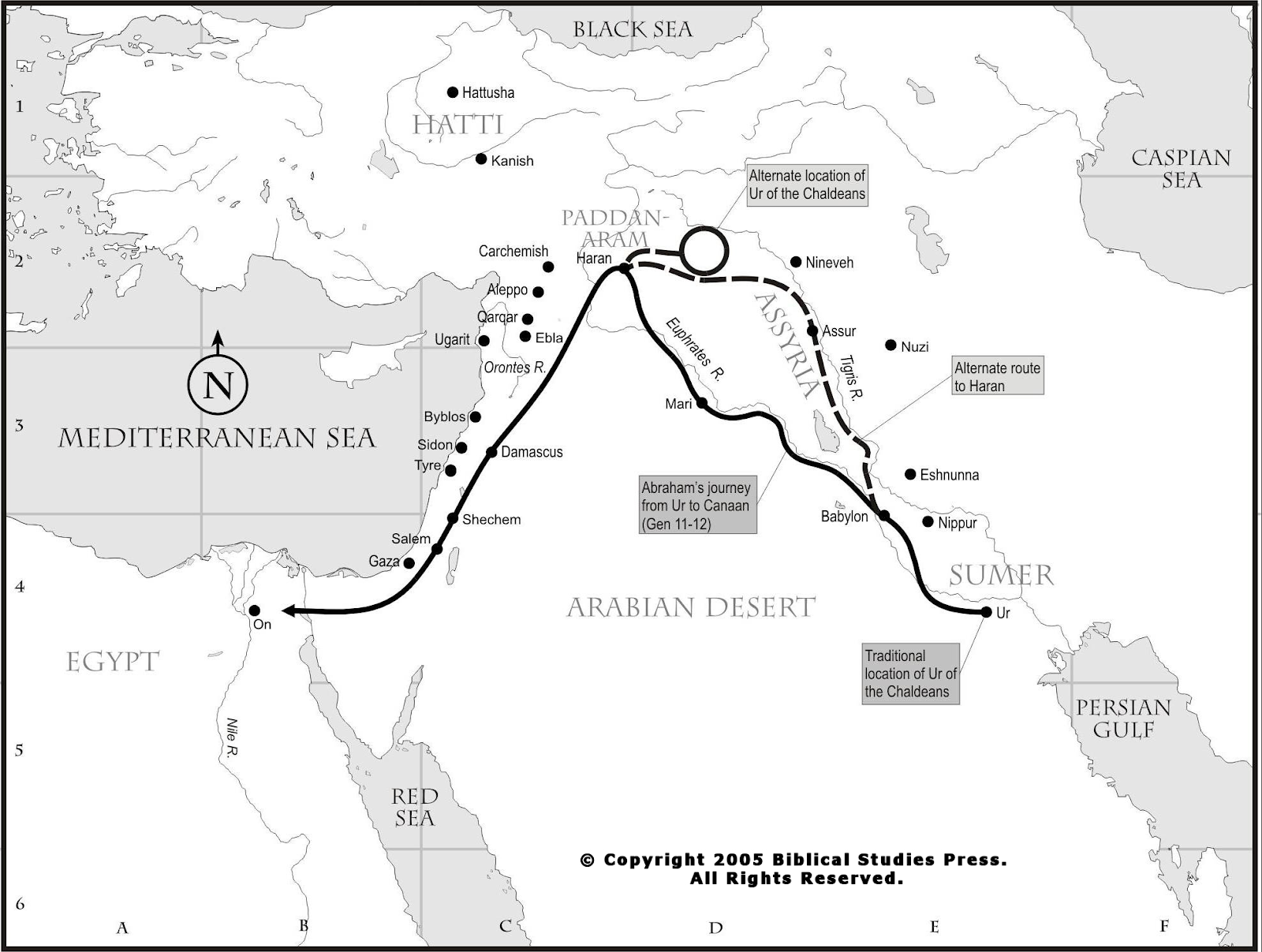
Ur is in the same location as Babel (or Babylon). Terah decides to move from Ur to Canaan. This means traveling an ancient trade route along what is called the Fertile Crescent (Remember your western civilization history?) to get there. But, Terah never reaches Canaan. Instead he, his family, and his household settle at the top of the Fertile Crescent in Haran. Then, the second thing we learn is that Sarai is unable to have children.

So, it is here where we find Abram and Sarai - where today’s story opens in Genesis 12. In Haran. With no children.

The Lord said to Abram, “Leave your land, your family, and your father’s household for the land that I will show you. I will make of you a great nation and will bless you. I will make your name respected, and you will be a blessing.

I will bless those who bless you,
    those who curse you I will curse;
        all the families of the earth
            will be blessed because of you.”

Abram left just as the Lord told him, and Lot went with him. Now Abram was 75 years old when he left Haran. Abram took his wife Sarai, his nephew Lot, all of their possessions, and those who became members of their household in Haran; and they set out for the land of Canaan. When they arrived in Canaan, Abram traveled through the land as far as the sacred place at Shechem, at the oak of Moreh. The Canaanites lived in the land at that time. The Lord appeared to Abram and said, “I give this land to your descendants,” so Abram built an altar there to the Lord who appeared to him. From there he traveled toward the mountains east of Bethel, and pitched his tent with Bethel on the west and Ai on the east. There he built an altar to the Lord and worshipped in the Lord’s name. Then Abram set out toward the arid southern plain, making and breaking camp as he went.

When a famine struck the land, Abram went down toward Egypt to live as an immigrant since the famine was so severe in the land. Just before he arrived in Egypt, he said to his wife Sarai, “I know you are a good-looking woman. When the Egyptians see you, they will say, ‘This is his wife,’ and they will kill me but let you live. So tell them you are my sister so that they will treat me well for your sake, and I will survive because of you.”

When Abram entered Egypt, the Egyptians saw how beautiful his wife was. When Pharaoh’s princes saw her, they praised her to Pharaoh; and the woman was taken into Pharaoh’s household. Things went well for Abram because of her: he acquired flocks, cattle, male donkeys, men servants, women servants, female donkeys, and camels. Then the Lord struck Pharaoh and his household with severe plagues because of Abram’s wife Sarai.  --Gen. 12:1-17 (CEB)

It’s interesting to me that, as with Noah in last week’s story, God once more is moving from the distant - from a broader dealing with humanity - to the personal. To Abram and Sarai. 

God calls this couple through whom God promises to bless the whole earth. Abram and Sarai have one function in God’s plan. That is to be a blessing to all families of the “ground.” In most translations this phrase is translated as “families of the earth” or “people of the earth”. But this obscures a crucial aspect of this story of Abram and Sarai. The better translation is "families of the 'ground.'" The Hebrew word here, adamah, is the word first used in Genesis 2 to describe the creation of human beings from the “dust of the ground.” It’s the ground referenced in Genesis 3 to which all life will return in death. It’s the ground that literally opened its mouth to receive the blood of Abel after he was murdered by his brother, Cain, in Genesis 4 - and the ground from which Cain is cursed. In the Noah story, we read in Genesis 5, the hope that he will bring rest from this curse of the ground. But, then, in Genesis 9 it is from the ground that Noah receives wine that leads to his drunken nakedness and the breakup of his family. So, when we hear the call of Abram and Sarai to be a blessing to all families of the “ground” we understand what this is - a new attempt on the part of God to reconstitute the harmony of creation. This is a missionary call for Abram that will be echoed throughout the entire biblical narrative - including to you and to me. That, having been blessed by God in our many and unique ways, we then become a blessing to others.

So, Abram and Sarai go to the land they are promised, stopping at various points along the way to offer sacrifices of gratitude to the God who has called them. But, it is not long before a crisis comes. And the promise of God through Abram and Sarai is soon in trouble.

A famine strikes Canaan. They go south to Egypt - the bread basket of the ancient Near East. On the way, Abram does some thinking - about himself and his future. He devises a scheme to ensure his own safety by trafficking - let’s be honest here that’s what he’s doing, right? - trafficking his own wife to ensure his self-serving plan. 

Now, we first need to recognize that we live in a time and culture that is very, very distant from Abram’s. Women were viewed as property. Polygamy was common. Cousins married cousins. Spouses were not true partners - a husband was the lord and master of the wife and exercised complete control over her body. Over her responsibilities. Over her life. 

The other thing we need to know is that, further on in Genesis, we learn that Sarai really is Abram’s sister. His half-sister. So, in many respects, Abram is telling the truth here. But, remember God’s call for Abram and Sarai? To be a blessing to all the families of the ground. Abram’s actions here end up harming an innocent man - whether the man is powerful or not. Abram is not a blessing to the Pharoah. Either Abram has misheard God or simply forgotten God’s promise to preserve and protect him. His fear has gotten in the way of his trust in this promise - a promise from God of blessing. 

I wonder how many of us forget the promises of God in the midst of our own fears and worries. Wondering about our lives. Or about our loved ones’ lives. Fearing the worst. And, as a result of that fear, acting out of self-preservation, even if it harms innocent people.

Friends, God wants us to be free of fear. God wants us to truly trust that God will do what God says. The core of the relationship between God and Abram was to be blessed and to be a blessing. God remembered and honored that promise for him. 

Abram was given that promise. It has been given to us, as well. We may forget it. But, as with Abram, God did not forget him. And God has not forgotten us. Amen.

Preached Sunday, September 18, 2022, at Grace & Glory, Prospect, with Third, Louisville.
15th Sunday after Pentecost
Reading: Genesis 12:1-17

Friday, March 15, 2019

Learning to Follow: The Third Pig

“Do not judge, so that you may not be judged. For with the judgment you make you will be judged, and the measure you give will be the measure you get. Why do you see the speck in your neighbor’s eye, but do not notice the log in your own eye? Or how can you say to your neighbor, ‘Let me take the speck out of your eye,’ while the log is in your own eye? You hypocrite, first take the log out of your own eye, and then you will see clearly to take the speck out of your neighbor’s eye.

“Do not give what is holy to dogs; and do not throw your pearls before swine, or they will trample them under foot and turn and maul you.

“Ask, and it will be given you; search, and you will find; knock, and the door will be opened for you. For everyone who asks receives, and everyone who searches finds, and for everyone who knocks, the door will be opened. Is there anyone among you who, if your child asks for bread, will give a stone? Or if the child asks for a fish, will give a snake? If you then, who are evil, know how to give good gifts to your children, how much more will your Father in heaven give good things to those who ask him!

“In everything do to others as you would have them do to you; for this is the law and the prophets.

“Enter through the narrow gate; for the gate is wide and the road is easy that leads to destruction, and there are many who take it. For the gate is narrow and the road is hard that leads to life, and there are few who find it. 

“Everyone then who hears these words of mine and acts on them will be like a wise man who built his house on rock. The rain fell, the floods came, and the winds blew and beat on that house, but it did not fall, because it had been founded on rock. And everyone who hears these words of mine and does not act on them will be like a foolish man who built his house on sand. The rain fell, and the floods came, and the winds blew and beat against that house, and it fell—and great was its fall!”

Now when Jesus had finished saying these things, the crowds were astounded at his teaching, for he taught them as one having authority, and not as their scribes.  Matthew 7:1-14, 24-29 (NRSV)


Grace and peace to you from God, our Creator; Christ, our Redeemer, and the Holy Spirit, our Sustainer. Amen.

It happened when I was in fifth grade. We got a new student in class. A new girl, named Audrey. Now, in most schools that’s probably not a very big deal. But, in a small town, where everyone knows everyone else, like my hometown, this didn’t happen very often.

Audrey and I disliked each other from the start. Has that ever happened to you? Whether it’s a personality thing or whatever it is, we rubbed each the wrong way from the very beginning. To make matters worse, not only did we have to spend the entire school day in the same room with each other, but, we also rode the same bus to and from school each day.

Our dislike for each other escalated throughout the first two weeks of school, reaching a climax one day in the girls’ bathroom, which was located right beside our fifth grade classroom. Audrey and I got into a shouting match over something. (I have no memory of how it started.) We grew more and more angry with each other, until, at one point, Audrey reached up her hand and slapped me across the face.

I was completely stunned. But, that didn’t stop me from reacting. I reached up my hand, then, and slapped her across the face. By this point, our teacher, Mrs. Daczewitz, had heard the shouts coming from the bathroom and she rushed in. 

Now, Mrs. Daczewitz was a very experienced teacher. By the time I reached her classroom, she had taught in our elementary school for well over 35 years. She knew that she could punish us for our behavior, which was pretty inexcusable.  But, I think, she knew that punishment wouldn’t necessarily solve the conflict between Audrey and I. So, as a consequence for our poor behavior, she mandated that, for a week beginning with the time Audrey and I got on the bus in the morning to the time we got off the bus in the afternoon, we had to spend every moment with each other. Every. Single. Moment.

You see, Mrs. Daczewitz was not only an experienced teacher, but she was also very wise. She knew that most often the things we dislike in others are the things we dislike about ourselves. So, when we meet someone who has the same qualities that we dislike in ourselves, it’s like looking in a mirror. And we don’t like it.

This week’s lesson from Matthew, chapter 7, is the last of our three lessons from the famous teaching of Jesus we call the "Sermon on the Mount." If you recall, we spent the first week talking about what God’s reign looks like. About who are the priority in God’s kingdom. And about how this reign is completely reversed from the world’s priority.

Then, last week, we talked about relationships. That God’s reign is built on relationships and, first, that it begins with our relationship with God. A relationship that is constructed on spiritual disciplines, with the most important one being that of prayer. Of talking with God. Of seeking God out. In our own, often simple words. And of listening for God.

This week, we continue that theme of relationship. Of how important relationship is in God’s reign. Particularly, today, our relationship with others. You see, God’s kingdom is made up of both vertical and horizontal relationship. Vertical - meaning our back and forth relationship with God. And horizontal. Meaning our back and forth relationship with others. 

In the first part of today’s reading, the focus is on our own self-deception. We deceive ourselves by believing that we are better than others. It’s the same kind of self-deception Audrey and I were engaged with in our own little spat. 

In the opening words of the reading, Jesus says, “Do not judge.” Warren Carter, a New Testament professor at Brite Divinity School has studied and written extensively on Matthew. He suggests that this common translation is neither accurate, nor helpful. Because, as he writes, we have to make judgments every day in our lives. We would be in trouble if we did not make judgment or discernment about various people, situations, and actions. So, when Jesus says, “Do not judge” - this is an impossible ethic for us.  In addition, in previous chapters, Jesus himself has judged things: synagogue practices, Gentile prayer, and lives that are focused on material goods. 

Carter suggests that a better translation is to use the word “condemn.” That, instead of the phrase being translated as “do not judge,” it is better translated, “do not go on condemning to hell.” It is meant to address various situations that involve other people - situations in which we have a tendency to write off others as beyond redemption. As outside of God’s grace. As people who should be confined to hell. People with whom we are in conflict. Or intolerant of because of differences, or prejudice, or disgust, or anger, and the like. Jesus’ command in this first verse forbids the arrogance of denying someone mercy. Particularly, of declaring that someone is beyond God’s mercy.

It’s easy to deceive ourselves about others with whom we are in conflict. To think we need to pluck out the splinter in someone else’s eye, when, as our text says, we have a log in our own. 

"Do unto others as we would have others do unto you," our text tells us. "Love your neighbor as yourself," Jesus will say later on in Matthew. The Golden Rule. How much do we hear this espoused in today’s world? So much that it has become an ethic to live by that is completely disconnected from its context here in the Word. Because, this Rule provides a vision of discipleship that is shaped by God’s grace in commissioning Jesus to show and to be the example of God’s saving presence. This Golden Rule cannot be disconnected from the life of Jesus. And from Jesus’ death. It is a rule that was initiated with God’s movement downward. To us. And for us. Freeing us from the guilt and shame of our sin and failure. Thereby, freeing us to love without abandon our neighbor as our self.


And then we come to pigs. You’re probably wondering what’s going on today with me and pigs. It started with this Valentine gram that came in the mail from ELCA World Hunger. “Hogs ‘n kisses.” More on that later. After this, then, it seemed that every time I turned around, I was being bombarded by pigs. Today’s reading talks about swine. This past Tuesday was the beginning of the Chinese New Year. Yep, you guessed it. It’s the Year of the Pig. Pigs all over the place. And, then, I got to the last verses of our text. The comparison of the wise builder and the foolish builder. The wise builder who builds his or her house on rock. Compared to the foolish builder, who builds on sand. So, of course, what should come to mind, but the story of “The Three Little Pigs!”

I have to admit, I had to look it up. Because, it’s been a long time since I read it. Can you help me tell the story?

It’s a story about three little pigs who decide to seek their fortune and build their houses. The first little pig built his house of...straw. The second built his house of...sticks. The third pig decided to build his house of...bricks, because he wanted to make sure his was a very strong house. When all three were finished, they were very happy.

Then, along came the wolf. He went to the first house - the one made of straw - and he huffed and he puffed and he blew the house down. Then, he went to the second house - the one made of sticks. And, again, he huffed and he puffed and he blew the house down. The wolf went to the third house - the one made of bricks. And he huffed and he puffed. And he huffed and he puffed. And he huffed and he puffed. But, he could not blow the third house down.

The moral of the story? Be like the third pig. Ground your lives in the kingdom of God, the great reversal, that is here and now, and eternal. Ground your lives in Jesus’ teachings in the Sermon on the Mount, that you may have lives of deep relationship with God. And with others. But, mostly, ground your lives in God, who is our very Rock and our Salvation, and upon whom our lives of faith should be built. Amen.

Preached February 10, 2019, at Grace & Glory Lutheran Church, Goshen, KY.
Epiphany 5.
Readings: Matthew 7:1-14, 24-29, Psalm 37:16-18.