Showing posts with label blessed. Show all posts

Sunday, September 18, 2022

ReMember: Abraham Forgets


Before we move into today’s reading, I’d like to transition us from last week’s story to today’s text in Genesis 12. While the move from chapter 8 in Genesis to chapter 12, today, doesn't seem like a big jump, there’s a lot that goes on in the chapters in-between.

After the story of the flood and of God’s covenant promise to Noah and his descendants, humankind didn’t really improve. In fact, in the verses immediately after God’s promise of the rainbow as an aid to God’s remembering, we have the story of Noah getting drunk. And naked. Probably not the image of the patriarch we want to keep, right?

Things don’t get better from there. There is a human inclination - a human desire - for power and control, especially to serve oneself. In the chapter that precedes today’s text, we read the story of the Tower of Babel. And of the attempt by humans to seek more and more power - to be like God. So, God mixes up their language so they can no longer easily communicate with one another. Then, God disperses them over all the earth so they can no longer together seek greater and greater power. It’s like the ultimate anti-trust action by God to ensure that humankind doesn’t become too big for its britches. 

The story continues down the generations from Shem, Noah’s son, to Terah, father of Abram, who we know better as Abraham. At the end of chapter 11, we learn two things. First, that Terah lives in Ur. (Refer to the map.) 
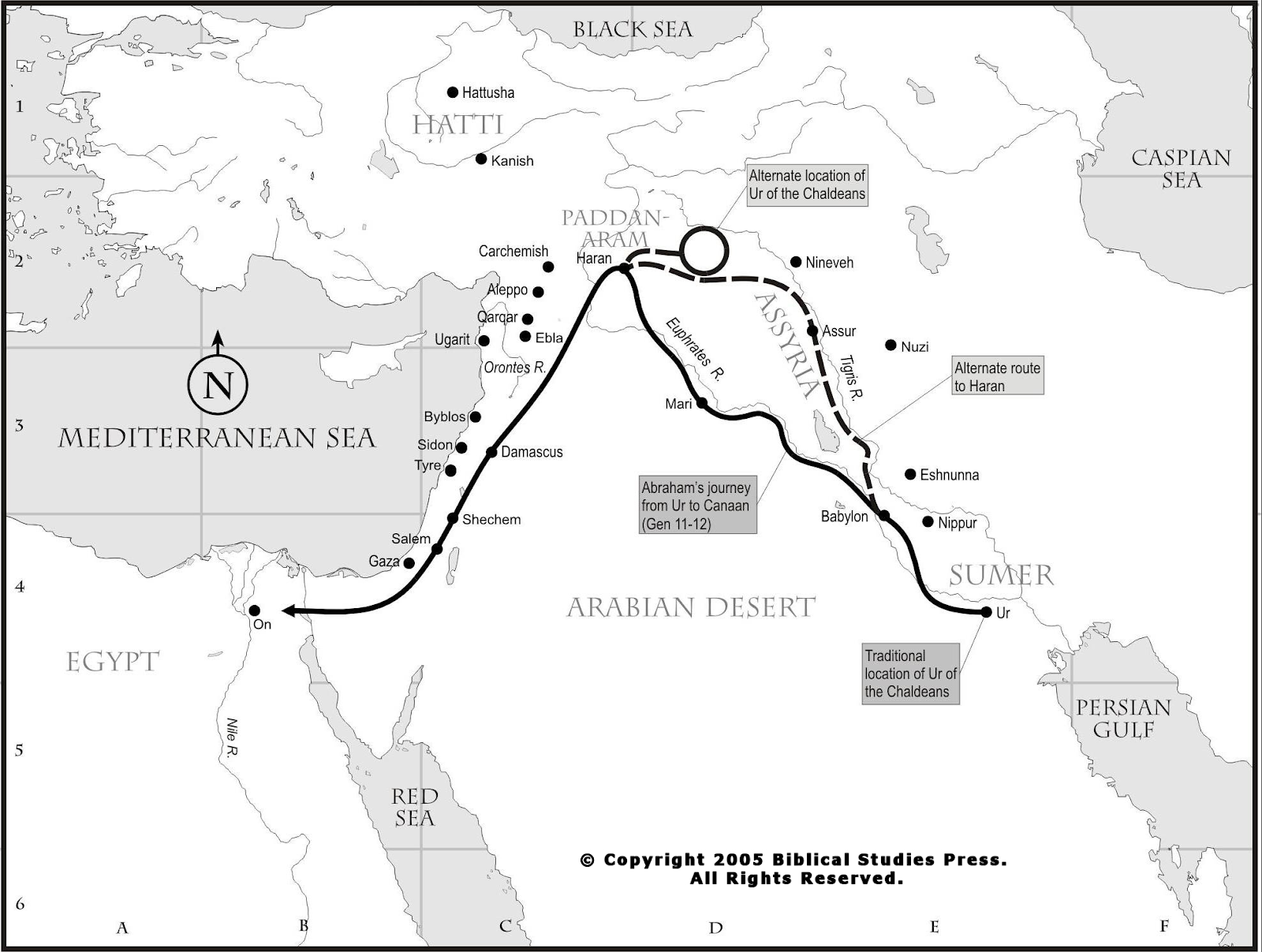
Ur is in the same location as Babel (or Babylon). Terah decides to move from Ur to Canaan. This means traveling an ancient trade route along what is called the Fertile Crescent (Remember your western civilization history?) to get there. But, Terah never reaches Canaan. Instead he, his family, and his household settle at the top of the Fertile Crescent in Haran. Then, the second thing we learn is that Sarai is unable to have children.

So, it is here where we find Abram and Sarai - where today’s story opens in Genesis 12. In Haran. With no children.

The Lord said to Abram, “Leave your land, your family, and your father’s household for the land that I will show you. I will make of you a great nation and will bless you. I will make your name respected, and you will be a blessing.

I will bless those who bless you,
    those who curse you I will curse;
        all the families of the earth
            will be blessed because of you.”

Abram left just as the Lord told him, and Lot went with him. Now Abram was 75 years old when he left Haran. Abram took his wife Sarai, his nephew Lot, all of their possessions, and those who became members of their household in Haran; and they set out for the land of Canaan. When they arrived in Canaan, Abram traveled through the land as far as the sacred place at Shechem, at the oak of Moreh. The Canaanites lived in the land at that time. The Lord appeared to Abram and said, “I give this land to your descendants,” so Abram built an altar there to the Lord who appeared to him. From there he traveled toward the mountains east of Bethel, and pitched his tent with Bethel on the west and Ai on the east. There he built an altar to the Lord and worshipped in the Lord’s name. Then Abram set out toward the arid southern plain, making and breaking camp as he went.

When a famine struck the land, Abram went down toward Egypt to live as an immigrant since the famine was so severe in the land. Just before he arrived in Egypt, he said to his wife Sarai, “I know you are a good-looking woman. When the Egyptians see you, they will say, ‘This is his wife,’ and they will kill me but let you live. So tell them you are my sister so that they will treat me well for your sake, and I will survive because of you.”

When Abram entered Egypt, the Egyptians saw how beautiful his wife was. When Pharaoh’s princes saw her, they praised her to Pharaoh; and the woman was taken into Pharaoh’s household. Things went well for Abram because of her: he acquired flocks, cattle, male donkeys, men servants, women servants, female donkeys, and camels. Then the Lord struck Pharaoh and his household with severe plagues because of Abram’s wife Sarai.  --Gen. 12:1-17 (CEB)

It’s interesting to me that, as with Noah in last week’s story, God once more is moving from the distant - from a broader dealing with humanity - to the personal. To Abram and Sarai. 

God calls this couple through whom God promises to bless the whole earth. Abram and Sarai have one function in God’s plan. That is to be a blessing to all families of the “ground.” In most translations this phrase is translated as “families of the earth” or “people of the earth”. But this obscures a crucial aspect of this story of Abram and Sarai. The better translation is "families of the 'ground.'" The Hebrew word here, adamah, is the word first used in Genesis 2 to describe the creation of human beings from the “dust of the ground.” It’s the ground referenced in Genesis 3 to which all life will return in death. It’s the ground that literally opened its mouth to receive the blood of Abel after he was murdered by his brother, Cain, in Genesis 4 - and the ground from which Cain is cursed. In the Noah story, we read in Genesis 5, the hope that he will bring rest from this curse of the ground. But, then, in Genesis 9 it is from the ground that Noah receives wine that leads to his drunken nakedness and the breakup of his family. So, when we hear the call of Abram and Sarai to be a blessing to all families of the “ground” we understand what this is - a new attempt on the part of God to reconstitute the harmony of creation. This is a missionary call for Abram that will be echoed throughout the entire biblical narrative - including to you and to me. That, having been blessed by God in our many and unique ways, we then become a blessing to others.

So, Abram and Sarai go to the land they are promised, stopping at various points along the way to offer sacrifices of gratitude to the God who has called them. But, it is not long before a crisis comes. And the promise of God through Abram and Sarai is soon in trouble.

A famine strikes Canaan. They go south to Egypt - the bread basket of the ancient Near East. On the way, Abram does some thinking - about himself and his future. He devises a scheme to ensure his own safety by trafficking - let’s be honest here that’s what he’s doing, right? - trafficking his own wife to ensure his self-serving plan. 

Now, we first need to recognize that we live in a time and culture that is very, very distant from Abram’s. Women were viewed as property. Polygamy was common. Cousins married cousins. Spouses were not true partners - a husband was the lord and master of the wife and exercised complete control over her body. Over her responsibilities. Over her life. 

The other thing we need to know is that, further on in Genesis, we learn that Sarai really is Abram’s sister. His half-sister. So, in many respects, Abram is telling the truth here. But, remember God’s call for Abram and Sarai? To be a blessing to all the families of the ground. Abram’s actions here end up harming an innocent man - whether the man is powerful or not. Abram is not a blessing to the Pharoah. Either Abram has misheard God or simply forgotten God’s promise to preserve and protect him. His fear has gotten in the way of his trust in this promise - a promise from God of blessing. 

I wonder how many of us forget the promises of God in the midst of our own fears and worries. Wondering about our lives. Or about our loved ones’ lives. Fearing the worst. And, as a result of that fear, acting out of self-preservation, even if it harms innocent people.

Friends, God wants us to be free of fear. God wants us to truly trust that God will do what God says. The core of the relationship between God and Abram was to be blessed and to be a blessing. God remembered and honored that promise for him. 

Abram was given that promise. It has been given to us, as well. We may forget it. But, as with Abram, God did not forget him. And God has not forgotten us. Amen.

Preached Sunday, September 18, 2022, at Grace & Glory, Prospect, with Third, Louisville.
15th Sunday after Pentecost
Reading: Genesis 12:1-17

Tuesday, December 22, 2020

The Hope of the Messiah: From Barren to Blessed

On this last Sunday of Advent, we move into the New Testament - the Gospel of Luke. Luke is of two books, Luke and Act, that are an attempt, as the gospel writer says at the very beginning, to set down an orderly account of the events for Theophilus, Translated “God-lover.” So that you may know the truth concerning the things that have been handed onto us by those who from the beginning were eyewitnesses and servants of the Word.

And so, today, God-lovers, we read from the holy gospel according to Luke.

In the sixth month the angel Gabriel was sent by God to a town in Galilee called Nazareth, to a virgin engaged to a man whose name was Joseph, of the house of David. The virgin’s name was Mary. And he came to her and said, “Greetings, favored one! The Lord is with you.” But she was much perplexed by his words and pondered what sort of greeting this might be. The angel said to her, “Do not be afraid, Mary, for you have found favor with God. And now, you will conceive in your womb and bear a son, and you will name him Jesus. He will be great, and will be called the Son of the Most High, and the Lord God will give to him the throne of his ancestor David. He will reign over the house of Jacob forever, and of his kingdom there will be no end.” Mary said to the angel, “How can this be, since I am a virgin?” The angel said to her, “The Holy Spirit will come upon you, and the power of the Most High will overshadow you; therefore the child to be born will be holy; he will be called Son of God. And now, your relative Elizabeth in her old age has also conceived a son; and this is the sixth month for her who was said to be barren. For nothing will be impossible with God.” Then Mary said, “Here am I, the servant of the Lord; let it be with me according to your word.” Then the angel departed from her.

In those days Mary set out and went with haste to a Judean town in the hill country, where she entered the house of Zechariah and greeted Elizabeth. When Elizabeth heard Mary’s greeting, the child leaped in her womb. And Elizabeth was filled with the Holy Spirit and exclaimed with a loud cry, “Blessed are you among women, and blessed is the fruit of your womb. And why has this happened to me, that the mother of my Lord comes to me? For as soon as I heard the sound of your greeting, the child in my womb leaped for joy. And blessed is she who believed that there would be a fulfillment of what was spoken to her by the Lord.”

And Mary said,
“My soul magnifies the Lord,
    and my spirit rejoices in God my Savior,
for he has looked with favor on the lowliness of his servant.
    Surely, from now on all generations will call me blessed;
for the Mighty One has done great things for me,
    and holy is his name.
His mercy is for those who fear him
    from generation to generation.
He has shown strength with his arm;
    he has scattered the proud in the thoughts of their hearts.
He has brought down the powerful from their thrones,
    and lifted up the lowly;
he has filled the hungry with good things,
    and sent the rich away empty.
He has helped his servant Israel,
    in remembrance of his mercy,
according to the promise he made to our ancestors,
    to Abraham and to his descendants forever.”

And Mary remained with her about three months and then returned to her home. 
--Luke 1:26-56 (NRSV)

"Barren. That’s what we both were, Mary and I. Barren. Mary, a teenager, having never known a man, a virgin, without child. Barren. And I, old. Having known a man, also without child. Barren. It is this that perhaps connected Mary and I most. Our barrenness. Our emptiness. Our disgrace - well, mostly my disgrace.

I had prayed for a child during all of my child-bearing years. Like Sarah. Like Rebecca. Like so many other women in our history, in the stories of our faith, who had prayed to God for a child as much as I prayed for a descendant for my husband, Zechariah, and I. We lived righteously before God. Followed and observed all of the Lord’s commandments and regulations. Yet, unlike Sarah and Rebecca, I remained barren. My disgrace before others.

Yet, Mary and I would not remain barren. It was nothing that we did - everything that happened was from the Lord, announced by the angel, Gabriel. God’s messenger who came, first, to my husband, and then to Mary. Announcing these miraculous births. My child, who would be another messenger of God. Of the long-promised Messiah.

But, Mary. The announcement she received was different. The angel called her “favored one.” Favored one? Mary? First named in the story without a name, but only that she was engaged to Joseph. This was the status of women in my time, connected only to the men in our lives. And only important based on our ability to bear children. Especially, to bear sons. Mary, favored? Perhaps it was this title that perplexed her. Made her wonder. Made her ask the question how she might become pregnant without having known a man. Not that she doubted the possibility. But, that she was simply curious how this was to happen. Do you notice she never asked for a sign? Unlike my husband. Unlike so many prophets called throughout the history of our people, Mary never asked for a sign. 

But, then, the angel Gabriel gave her a sign. Me. Pregnant in my old age. I was to be her sign that God would descend on her womb in the way God had descended upon the tabernacle at Sinai. And how God had descended upon my womb. Because nothing is impossible with God.

And so she came to visit me. In my sixth month, with my pregnancy showing. When I saw her I felt my unborn baby leap within me. The Holy Spirit moved me, a woman, to prophesy what had already been spoken to her. That she would be the God-bearer. The Theotokos. The one who would bear the Messiah, the fulfilment of God’s promise to King David. And to us, from across the ages. 

No longer barren, either of us. But now blessed. Mary, the Alpha, and I, the Omega. From young to old, beginning to end, both of us, blessed. Not simply vessels to bear children, but Spirit-filled, prophetic, profound people, created by God. Blessed by God. How profound this was in our time! How profound this is for your time!

How could Mary do anything other than singLike Hannah, like Miriam, like Deborah of old, how could Mary do anything other than sing of the freedom and liberation that God has done, is doing, and will continue to do in our world, through her son, Jesus? The Anointed One. Son of the Most High. Emmanuel - God with us

May you, like Mary and I, know and believe the truth concerning the things that have been handed onto you by us, who from the beginning were eyewitnesses and servants of the Word. May you, like Mary and I, know and believe that God comes to set us free, to liberate us and our world from all that holds us captive. And may you, like Mary and I, know and believe that, even in the midst of our deepest darkness, God is doing a new thing. For nothing will be impossible with God. Amen."


Sunday, January 27, 2019

Learning to Follow: The Great Reversal

When Jesus saw the crowds, he went up the mountain; and after he sat down, his disciples came to him. Then he began to speak, and taught them, saying:

“Blessed are the poor in spirit, for theirs is the kingdom of heaven.

“Blessed are those who mourn, for they will be comforted.

“Blessed are the meek, for they will inherit the earth.

“Blessed are those who hunger and thirst for righteousness, for they will be filled.

“Blessed are the merciful, for they will receive mercy.

“Blessed are the pure in heart, for they will see God.

“Blessed are the peacemakers, for they will be called children of God.

“Blessed are those who are persecuted for righteousness’ sake, for theirs is the kingdom of heaven.

“Blessed are you when people revile you and persecute you and utter all kinds of evil against you falsely on my account. Rejoice and be glad, for your reward is great in heaven, for in the same way they persecuted the prophets who were before you.

“You are the salt of the earth; but if salt has lost its taste, how can its saltiness be restored? It is no longer good for anything, but is thrown out and trampled under foot.

“You are the light of the world. A city built on a hill cannot be hid. No one after lighting a lamp puts it under the bushel basket, but on the lampstand, and it gives light to all in the house. In the same way, let your light shine before others, so that they may see your good works and give glory to your Father in heaven.

“Do not think that I have come to abolish the law or the prophets; I have come not to abolish but to fulfill. For truly I tell you, until heaven and earth pass away, not one letter, not one stroke of a letter, will pass from the law until all is accomplished. Therefore, whoever breaks one of the least of these commandments, and teaches others to do the same, will be called least in the kingdom of heaven; but whoever does them and teaches them will be called great in the kingdom of heaven. For I tell you, unless your righteousness exceeds that of the scribes and Pharisees, you will never enter the kingdom of heaven. Matthew 5:1-20 (NRSV)

Grace and peace to you from the Holy Trinity: God, the Creator; God, the Redeemer; and God, the Sustainer. Amen.

Over the past few weeks, we’ve been in the first few chapters of Matthew, focusing on how Jesus is the fulfillment of God’s promise. At the very end of last week’s reading, if you heard it, we listened to Jesus speak his first words of public ministry. They are the same words we heard John the Baptist speak. “Repent! [Or change your hearts and minds!] For the kingdom of heaven has come near.”

Today’s lesson begins with Jesus going up to a mountain top. Sitting down. To teach. A common way of teaching in his time. In Matthew, this is the beginning of three full chapters of teaching by Jesus. It’s what we call the Sermon on the Mount. 

Now, most scholars agree that Jesus was probably not on a mountain when he spoke these words. Again, as we’ve seen before, the author is deliberately making a connection for the Matthew audience. Drawing a line for them between Jesus and Israel and, especially, helping them see that Jesus is the fulfillment of Israel. So, just as Moses shared the law with Israel from the mountain - from Mount Sinai - so, too, the writer of Matthew places Jesus on a mountain to, share the law with his followers. Just like Moses.

Now, we know who the followers of Moses were, right? Israel. But, who were the followers of Jesus? If we back up a few more in chapter 4, we see who they are beginning with verse 23. “Jesus traveled throughout Galilee, teaching in their synagogues. He announced the good news of the kingdom and healed every disease and sickness among the people. News about him spread throughout Syria. People brought to him all those who had various kinds of diseases, those in pain, those possessed by demons, those with epilepsy, and those who were paralyzed, and he healed them. Large crowds followed him from Galilee, the Decapolis, Jerusalem, Judea, and from the areas beyond the Jordan River.”

So, the first thing we note from this text is place. That Jesus was in Galilee. He was not in Judea, which was where Jerusalem was. Instead he was in an area that was far north. An area that had historically been the most devastated because it was near the northern border. In an area that had a long history with empire and oppression. An area that had first fallen to the Babylonians, then to the Assyrians and, then, by Jesus’ time, to the Romans. It was an area on the margins. 

The second thing we note is the activity of Jesus. He announces the good news of the kingdom of heaven. But, this is not the good news of a kingdom that is far into the future or in an afterlife, but it is the good news of a kingdom that is being experienced now. That is being lived out now. The good news pronounced by Jesus is connected with activity in the here and now. With the healing of every disease and sickness among the people.

The last thing we note in this text is about the crowd that was following him. This was not a crowd that was made up of the elite: the wealthy, the powerful, the successful. But it was a crowd of people who were diseased, in pain, with mental health issues and epilepsy, and with paralysis and the friends and families who were supporting them. Who were bringing them to be healed by Jesus. It was a crowd of people on the margins. 

So, Jesus’ ministry in Matthew is one of good news bringing healing in the present time to a marginal people in a marginal place. 

Then, we turn to chapter 5 and our reading today. Which begins with the Beatitudes. It is in these statements, each beginning with the words “Blessed are” that we begin to understand what the priorities are for Jesus in the kingdom of God.

To help us better understand this, I have a little activity that I need 3 volunteers for. I need each of you to go to the back of the sanctuary by the front doors. Then, when I say “go,” I want you to run forward as fast as you can to give me a “high five.” Ready? On your mark. Get set. Go.

The person who was in last place is our winner today. Is that a surprise for you? How is this different from what you expected? 

Thanks to all of you for your participation. 

Do you see what just happened? The world has trained us to believe that only the fastest, the smartest, and the best will be the winners. But, this is not so in God’s kingdom. So often we look at this list - at the Beatitudes - as a “to do” list for us. If we will be poor in spirit, we will have the kingdom. If we mourn, we will be comforted. If we are meek, we will inherit the earth. And on and on. 

But, that’s not what Jesus intends. Instead, what Jesus intends is the exact opposite. It’s what we call the great reversal. The radical nature of the gospel. The scandal of the good news. Jesus teaches that those who are poor in spirit, that those who mourn or are meek, that those who hunger and thirst for righteousness, that those who are merciful or pure in heart, or who are peacemakers, or who are persecuted and reviled - that all of these people are the priority in God’s kingdom. Jesus isn’t calling us to go and get persecuted, but to honor those who are. As we do this. As we honor and lift up these qualities, we will be transformed. We will realign our own priorities with those of God. We will follow Jesus’ command to repent. To change our hearts. To be transformed.

But, that’s not all. Because this is not the end of our lesson today. Matthew goes on to talk about two things: salt and light.

What does salt do? Yes, it gives flavor to food. It’s a preservative. Before the days of refrigeration, it was the only real way to preserve food. In Jesus’ time, though, salt had a different function. Palestinians in the first century placed flat plates of salt on the bottom of their earthen ovens to activate the fire. Salt was a catalyst that caused the fuel to burn. So, in other words, salt provided the spark for the fire. 

Then, what about light? What does light do? It helps lead us. It guides us in the darkness. Yes, these things. And, have you been in a dark movie theatre and your phone screen turns on? It’s is really hard to hide light. 

So, what is Jesus telling us today in this two-part text? He is telling us that the priority of God's kingdom begins on the margins. That, it consists of people, broken like us, who have been healed and made God’s disciples by grace. But that the discipleship doesn’t end there. It doesn’t end with healing and with salvation, with simply sitting and waiting for that eternal, heavenly kingdom. It exists in the here and now, just as Jesus taught. With us, as his followers, being salt in the the world. Being the spark that gets the fire burning. And being light - not light that is hidden - but light that shines brightly and can be seen for miles.

You see, discipleship is intended to turn our lives upside down, just as God’s kingdom is one of great reversals. Discipleship is intended to change us completely in how we plan our days - both in what we do and in how we do it. This is what it means to be a follower of Jesus in the here and now. It is to be a leader. To be the salt and the light. To guide the world to a deeper understanding of God's kingdom - a kingdom of great reversals. A kingdom of the here and now. A kingdom for all eternity.

May God guide us in our transformation - in our great reversal - that we might be more fully the salt and light for the kingdom of God. Amen.

Preached January 27, 2019, at Grace & Glory Lutheran Church, Goshen, KY.
Epiphany 3
Readings: Matthew 5:1-20, Psalm 1:1-3

Sunday, November 6, 2016

Claiming LIfe


Then he looked up at his disciples and said:
“Blessed are you who are poor,
for yours is the kingdom of God.
“Blessed are you who are hungry now,
for you will be filled.
“Blessed are you who weep now,
for you will laugh.

“Blessed are you when people hate you, and when they exclude you, revile you, and defame you on account of the Son of Man. Rejoice in that day and leap for joy, for surely your reward is great in heaven; for that is what their ancestors did to the prophets.

“But woe to you who are rich,
for you have received your consolation.
“Woe to you who are full now,
for you will be hungry.
“Woe to you who are laughing now,
for you will mourn and weep.
“Woe to you when all speak well of you, 
for that is what their ancestors did to the false prophets.

“But I say to you that listen, Love your enemies, do good to those who hate you, bless those who curse you, pray for those who abuse you. If anyone strikes you on the cheek, offer the other also; and from anyone who takes away your coat do not withhold even your shirt. Give to everyone who begs from you; and if anyone takes away your goods, do not ask for them again. Do to others as you would have them do to you. (Luke 6:20-31 NRSV.)


Grace and peace to you from God our Father and our Lord Jesus Christ. Amen.

This past summer, as I was nearing the end of my internship and the end of my studies at Luther Seminary, I took a break from reading non-fiction. For nearly five years, it has seemed to me that the only books I’ve read have been those related to school, whether they were about theology, faith formation, church administration, missional leadership, or pastoral care--or any other topic a seminary student needs to know about in order to be a pastor. Or at least to be a beginning pastor.

So, I decided to read through the entire Harry Potter series.

Now I’m sure that I’m probably the only person alive in our world today who, by 2016, had not read any of these remarkable books by author J. K. Rowling. Unless, of course, some of you choose to admit that, too. 

So, over about 6 weeks, I delved into the world of wizardry and Harry Potter. 

The books were fascinating and magical. Frightening, at times. Funny, at others. It was completely worth it and, if you haven’t read them, I really encourage you to do so.

Now, I’m not going to preach on Harry Potter today. But, as I read through our lessons today and, particularly, the lesson from Daniel, about his vision of the four beasts, I couldn't help but think of the Dementors, those foul creatures from the Potter series. They are described as infesting the darkest, filthiest places; glorying in decay and despair; draining peace, hope and happiness out of the air around them. Get too near one and every good feeling, every happy memory will be sucked out of you.

No wonder Daniel’s spirit was troubled within him. And the vision in his head terrified him. 

This seems like a bizarre text for today, doesn’t it?  On this All Saints Day, a day when we remember all those in the faith who have gone before us, who have moved from the Church Militant to the Church Triumphant, those whom we have loved and who have loved us and who, most importantly, have been examples of faith for us, examples of believing in God and trusting in God’s faithfulness. On this All Saints Sunday, this Daniel text just doesn’t seem like a good fit.

Oh, but it is!

In order to understand why it is so appropriate for us today, we have to understand the nature of this text. This portion of Daniel, along with the book of Revelation, is what we call apocalyptic literature. If you’ve ever read any part of Revelation, it can be a terrifying book. I had a parishioner last year who asked me why this book was in the Bible, sharing that it terrified her so much she never read it. 

The function of this type of literature may be unfamiliar to us. It is crisis literature. It is literature written to encourage, to give hope and support in a time of crisis. In Jesus’ day, these passages from Daniel 7 were so widely read at the time, that there grew to be what we might call a Daniel 7 cult. It is from this text that we first hear the term “son of Man.” It is also one of the first anti-empire texts in scripture. 

The beasts in this text represent empires. Empires that, like the Dementors, are sub-human. That drain the life out of our world. They seek to amass great wealth and power and, in the process, destroy our planet, destroy the poor, destroy peace.

It is in response to these destructive, Dementor-like empires that the “son of Man” comes. Here, in Daniel 7 we first hear that term--son of Man. Here in Daniel 7 we also hear the first anti-empire texts in scripture.  Read Daniel 7:13b-14. 

Daniel, troubled and terrified, seeks to understand his vision. In the interpretation, beginning with v. 17, notice that singular son of Man becomes plural. Look at verse 18. No longer does it read the “holy one of the Most High,” but the “holy ones of the Most High.” The saints of the Most High.

One individual sent by God stands up to the powers of empire. In Christ, God breaks into these destructive empires to establish God’s kingdom--a kingdom of justice and peace, a kingdom of love and forgiveness, a kingdom of hope and healing, a kingdom in the fullness of God in Christ.

The inbreaking begins with Christ’s coming. It continues through the work of the holy ones of the Most High--the saints we honor and remember here today. Some of them we read about in Scripture. Some became known across the world. But most, like the saints we remember today, were those who were not famous, not known. But they carried on the work of God’s kingdom. They shared their faith and gave us a glimpse of God’s kingdom so that we, too, might be called the saints of God, members of the body of Christ, the holy ones of the Most High.

We, saints, are citizens of a different kingdom than that of the empires of the world. It is this kingdom that Jesus describes today in our Gospel text. 

It is a kingdom where true power is not shown in dominance, but in service to others. It is a kingdom that calculates worth based on a different standard. Where those with wealth stop working for the systems--the empires--that exploit the poor, instead of continuing to build more wealth. Where those with power, turn away from amassing more of that power to stand in solidarity with the poor and powerless and to seek to change the systems that continue to oppress them.  Where God continues to lift up people who, under the world’s standards, have no business being lifted up. In this kingdom, God continues to lift them up--the poor, the hungry, the grief-stricken--and says to them, “These are the ones who are blessed. These are my people.” 

It’s been a difficult election year in our nation, hasn’t it? It seems as though we have experienced--endured might be a better word--endured one of the ugliest elections in years. One of the most painful parts for me especially has been the insults and recriminations that have flown back and forth between political candidates and their followers, the daily barrage of hostility, cruelty, dismissiveness of “others”, whether women, Catholics, Mexicans, Asians, losers, Republicans, Democrats, Independents, Russians, or Syrians. I have to admit that I, too, have gotten caught up in the back and forth, in the ugliness of this election.

All of this--the insults, the recriminations, the name-calling, the hatred--all of it comes out of fear. It is the same fear that drives us to build walls to keep immigrants out. The same fear that drives us to create economic structures to wall in our profits and project our jobs. The same fear that causes us to protect ourselves and to keep what is ours. It is a fear that divides us and keeps us from experiencing the fullness of life in God’s kingdom and with each other. It is this division that Jesus warns us against in our text today. A division that, like the Dementors, destroys life and sucks away every happy memory, every shred of hope.

In a recent essay, Willie James Jennings, a theologian who graduated from my alma mater, Fuller Seminary, calls on all Americans and, particularly, Christians to “claim the power of life together precisely at the site of threat and fear. Our faith places us inside the actions of a God who faces our dangers and yet refuses to yield to fear. God offers life and invites us to gather courage there, making it a place where God creates community.”

Yielding to fear destroys community. Our Christian faith claims the power of life together precisely at the site of threat and fear.

This is exactly what Jesus’ disciples did in the first century. In the midst of a Roman empire that sought to destroy them, they claimed life right at the point of threat and fear, spreading the Good News throughout the Roman empire and beyond. 

In the same way, Luther claimed life at the point of threat and fear as he stood up to challenge the authority of an empirical church that had lost its way, spreading the Good News throughout the Western world.  

Over and over and over again, we have story after story of saints, known and unknown, who, in the midst of threat and fear, stood up and claimed life--showing the world and us how to imagine better, how to hope once again, and how to acknowledge that our lives and our needs, our safety and shalom are all in God’s hands.

So stand with this whole communion of saints today and claim life. Claim the gift of life that is yours through the death of our Savior Jesus Christ. And then dare to imagine and to engage the world in God’s name. Amen.


Preached on All Saints Sunday, November 6, 2016, at Good Shepherd Lutheran Church, Bastrop, TX.
Texts: Daniel 7:1-3, 15-18; Psalm 149; Ephesians 1:11-23; Luke 6:20-31.
Credit for ideas to WorkingPreacher.org