Showing posts with label Abram. Show all posts

Sunday, September 18, 2022

ReMember: Abraham Forgets


Before we move into today’s reading, I’d like to transition us from last week’s story to today’s text in Genesis 12. While the move from chapter 8 in Genesis to chapter 12, today, doesn't seem like a big jump, there’s a lot that goes on in the chapters in-between.

After the story of the flood and of God’s covenant promise to Noah and his descendants, humankind didn’t really improve. In fact, in the verses immediately after God’s promise of the rainbow as an aid to God’s remembering, we have the story of Noah getting drunk. And naked. Probably not the image of the patriarch we want to keep, right?

Things don’t get better from there. There is a human inclination - a human desire - for power and control, especially to serve oneself. In the chapter that precedes today’s text, we read the story of the Tower of Babel. And of the attempt by humans to seek more and more power - to be like God. So, God mixes up their language so they can no longer easily communicate with one another. Then, God disperses them over all the earth so they can no longer together seek greater and greater power. It’s like the ultimate anti-trust action by God to ensure that humankind doesn’t become too big for its britches. 

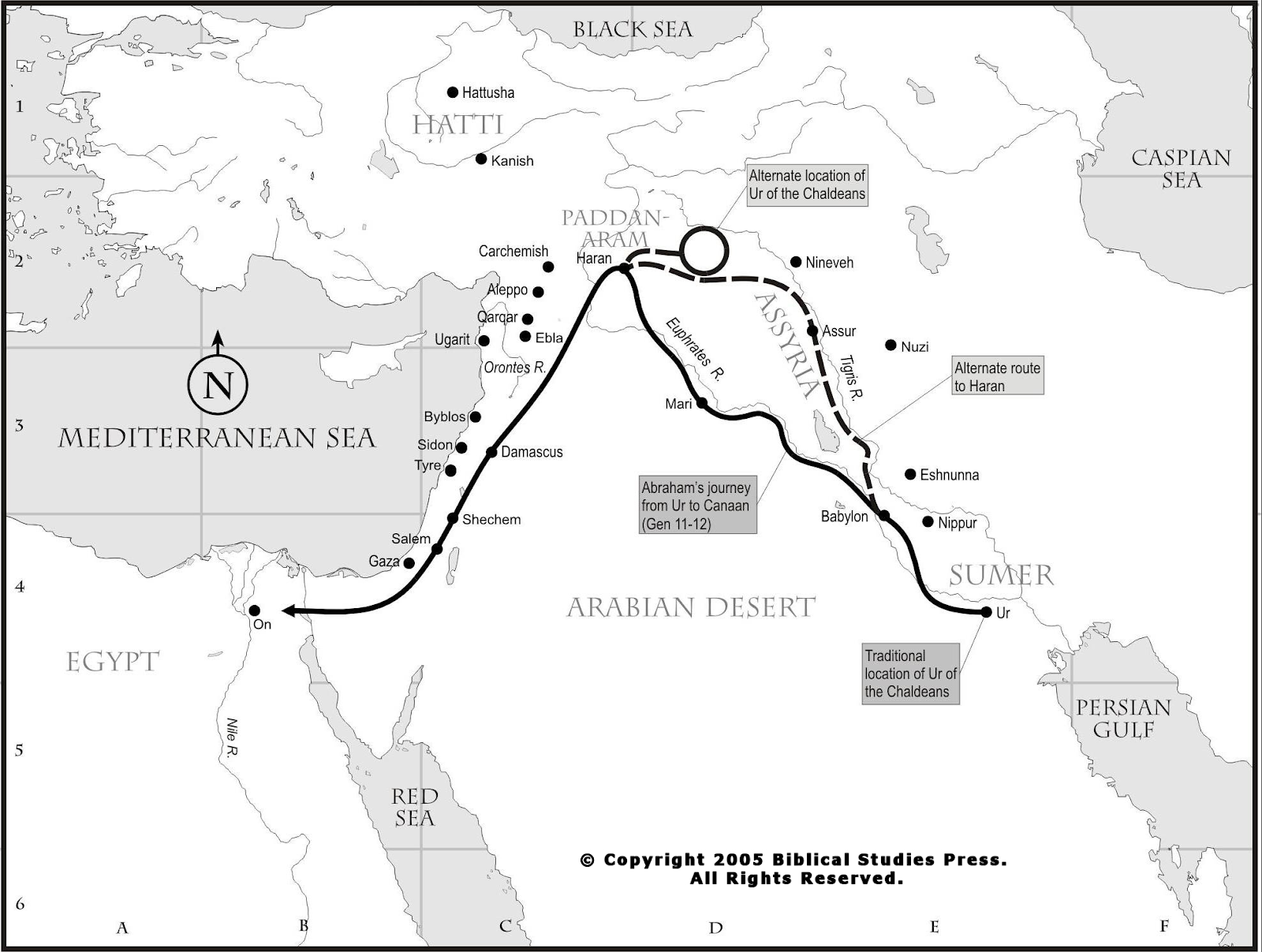
The story continues down the generations from Shem, Noah’s son, to Terah, father of Abram, who we know better as Abraham. At the end of chapter 11, we learn two things. First, that Terah lives in Ur. (Refer to the map.) 

Ur is in the same location as Babel (or Babylon). Terah decides to move from Ur to Canaan. This means traveling an ancient trade route along what is called the Fertile Crescent (Remember your western civilization history?) to get there. But, Terah never reaches Canaan. Instead he, his family, and his household settle at the top of the Fertile Crescent in Haran. Then, the second thing we learn is that Sarai is unable to have children.

So, it is here where we find Abram and Sarai - where today’s story opens in Genesis 12. In Haran. With no children.

The Lord said to Abram, “Leave your land, your family, and your father’s household for the land that I will show you. I will make of you a great nation and will bless you. I will make your name respected, and you will be a blessing.

I will bless those who bless you,
    those who curse you I will curse;
        all the families of the earth
            will be blessed because of you.”

Abram left just as the Lord told him, and Lot went with him. Now Abram was 75 years old when he left Haran. Abram took his wife Sarai, his nephew Lot, all of their possessions, and those who became members of their household in Haran; and they set out for the land of Canaan. When they arrived in Canaan, Abram traveled through the land as far as the sacred place at Shechem, at the oak of Moreh. The Canaanites lived in the land at that time. The Lord appeared to Abram and said, “I give this land to your descendants,” so Abram built an altar there to the Lord who appeared to him. From there he traveled toward the mountains east of Bethel, and pitched his tent with Bethel on the west and Ai on the east. There he built an altar to the Lord and worshipped in the Lord’s name. Then Abram set out toward the arid southern plain, making and breaking camp as he went.

When a famine struck the land, Abram went down toward Egypt to live as an immigrant since the famine was so severe in the land. Just before he arrived in Egypt, he said to his wife Sarai, “I know you are a good-looking woman. When the Egyptians see you, they will say, ‘This is his wife,’ and they will kill me but let you live. So tell them you are my sister so that they will treat me well for your sake, and I will survive because of you.”

When Abram entered Egypt, the Egyptians saw how beautiful his wife was. When Pharaoh’s princes saw her, they praised her to Pharaoh; and the woman was taken into Pharaoh’s household. Things went well for Abram because of her: he acquired flocks, cattle, male donkeys, men servants, women servants, female donkeys, and camels. Then the Lord struck Pharaoh and his household with severe plagues because of Abram’s wife Sarai.  --Gen. 12:1-17 (CEB)

It’s interesting to me that, as with Noah in last week’s story, God once more is moving from the distant - from a broader dealing with humanity - to the personal. To Abram and Sarai. 

God calls this couple through whom God promises to bless the whole earth. Abram and Sarai have one function in God’s plan. That is to be a blessing to all families of the “ground.” In most translations this phrase is translated as “families of the earth” or “people of the earth”. But this obscures a crucial aspect of this story of Abram and Sarai. The better translation is "families of the 'ground.'" The Hebrew word here, adamah, is the word first used in Genesis 2 to describe the creation of human beings from the “dust of the ground.” It’s the ground referenced in Genesis 3 to which all life will return in death. It’s the ground that literally opened its mouth to receive the blood of Abel after he was murdered by his brother, Cain, in Genesis 4 - and the ground from which Cain is cursed. In the Noah story, we read in Genesis 5, the hope that he will bring rest from this curse of the ground. But, then, in Genesis 9 it is from the ground that Noah receives wine that leads to his drunken nakedness and the breakup of his family. So, when we hear the call of Abram and Sarai to be a blessing to all families of the “ground” we understand what this is - a new attempt on the part of God to reconstitute the harmony of creation. This is a missionary call for Abram that will be echoed throughout the entire biblical narrative - including to you and to me. That, having been blessed by God in our many and unique ways, we then become a blessing to others.

So, Abram and Sarai go to the land they are promised, stopping at various points along the way to offer sacrifices of gratitude to the God who has called them. But, it is not long before a crisis comes. And the promise of God through Abram and Sarai is soon in trouble.

A famine strikes Canaan. They go south to Egypt - the bread basket of the ancient Near East. On the way, Abram does some thinking - about himself and his future. He devises a scheme to ensure his own safety by trafficking - let’s be honest here that’s what he’s doing, right? - trafficking his own wife to ensure his self-serving plan. 

Now, we first need to recognize that we live in a time and culture that is very, very distant from Abram’s. Women were viewed as property. Polygamy was common. Cousins married cousins. Spouses were not true partners - a husband was the lord and master of the wife and exercised complete control over her body. Over her responsibilities. Over her life. 

The other thing we need to know is that, further on in Genesis, we learn that Sarai really is Abram’s sister. His half-sister. So, in many respects, Abram is telling the truth here. But, remember God’s call for Abram and Sarai? To be a blessing to all the families of the ground. Abram’s actions here end up harming an innocent man - whether the man is powerful or not. Abram is not a blessing to the Pharoah. Either Abram has misheard God or simply forgotten God’s promise to preserve and protect him. His fear has gotten in the way of his trust in this promise - a promise from God of blessing. 

I wonder how many of us forget the promises of God in the midst of our own fears and worries. Wondering about our lives. Or about our loved ones’ lives. Fearing the worst. And, as a result of that fear, acting out of self-preservation, even if it harms innocent people.

Friends, God wants us to be free of fear. God wants us to truly trust that God will do what God says. The core of the relationship between God and Abram was to be blessed and to be a blessing. God remembered and honored that promise for him. 

Abram was given that promise. It has been given to us, as well. We may forget it. But, as with Abram, God did not forget him. And God has not forgotten us. Amen.

Preached Sunday, September 18, 2022, at Grace & Glory, Prospect, with Third, Louisville.
15th Sunday after Pentecost
Reading: Genesis 12:1-17

Wednesday, September 23, 2020

Promises Made, Promises Broken: Do Not Fear!

Our theme for this entire year is about how God is revealed in story. Today’s zooms in on the story from last week, moving from Adam and Eve, our distant ancestors, to today’s story, which focuses on two people with whom God forges a relationship. It’s a story that shows us that, no matter how often we break our promises to God, God continues to make and keep promises to bless and to care for God’s people. It is this theme of promises made and promises broken that we will be considering over the next several weeks. 

Today, our story is from the book of Genesis, chapter 15.

After these things the word of the LORD came to Abram in a vision, "Do not be afraid, Abram, I am your shield; your reward shall be very great." But Abram said, "O Lord GOD, what will you give me? For I continue childless, and the heir of my house is Eliezer of Damascus." And Abram said, "You have given me no offspring, and so a slave born in my house is to be my heir." But the word of the LORD came to him, "This man shall not be your heir; no one but your very own issue shall be your heir." He brought him outside and said, "Look toward heaven and count the stars, if you are able to count them." Then he said to him, "So shall your descendants be." And he believed the LORD; and the LORD reckoned it to him as righteousness. --Genesis 15:1-6 (NRSV)

If you’ve seen the news over the past 24-48 hours, then you know about the passing of Supreme Court Justice Ruth Bader Ginsburg. Over these past few years, her popularity has soared in our country, particularly among younger women. The Notorious RBG, she became known as. Graduating first in her class at Columbia Law. And who, unable to find work as a young female lawyer, moved into education, eventually teaching law at her alma mater. But, it was her legal work on behalf of women for which she is most known, a formidable advocate for gender equality and women’s rights - losing only 1 of 5 arguments before the Supreme Court. And an advocate without whom I would most likely not be here with you today as an ordained member of the clergy.

On Friday night after I found out she had died, I went onto Twitter to see what was being said about her and about her legacy. I was particularly struck by two tweets, coming just a couple of hours apart. 

The first from a woman named Ruth Franklin, who wrote that there is a tradition in Judaism that if a person dies on Rosh Hashanah - which is the Jewish New Year and the first of the high holy days set out in Leviticus, a time of solemn reflection and repentance that concludes with Yom Kippur, the holiest day of the year...if a person dies on Rosh Hashanah, as did Justice Ginsburg, they are known as a tzaddik, a person of great righteousness. 

And then there was the second tweet. From Nina Totenburg, a reporter for public radio who has covered the courts in our country for decades. She wrote this. "There is a Jewish teaching that says that those who die just before the Jewish new year are the ones God has held back until the last moment because they were needed most & were the most righteous. And so it was that RBG died as the sun was settling last night marking the beginning of Rosh Hashanah."

So, there’s this. A tzaddik. A person of great righteousness, one of the most needed and most righteous. And, then, there’s this. From our story today: Abraham believed the LORD; and the LORD reckoned it to him as righteousness. Or, in Hebrew, tzedakah.

Do you see the connection between these two words? Tzaddik and tzedakah. One the noun. The person - the righteous person. The other the act of righteousness, of being righteous. The verb. Both related to the word, righteousness.

We often confuse this word righteousness. We have been too impacted by pietistic and moralistic movements in Christianity that connect this word righteousness with right and wrong. That to be righteous is about being a good person. Or not. 

In the Hebrew scriptures, though, the term, righteousness, is a term of relationship and of justice. To be a righteous person is to be a person who abides by the claims that their relationship makes on them. To do all that is needed to remain in the relationship. And if one fails in this, to be restored back into relationship - because that’s what justice is about, about always being restored back into the relationship. With one another. And, particularly, with God. 

In Abram’s case, he is judged righteous in relation to his covenant with God. 

We first hear of this covenant - this promise - in Genesis 12. God calls Abram to pick up his entire family and household. To leave his homeland. And to move to a land that God had promised to Abram and his wife Sarai. It was there that God promised to bless him. To make of him a great nation. To make his name great so that he could be a blessing. This was the promise God made to Abram. And to Sarai.

But, by today’s reading in chapter 15, years have passed. Abram and Sarai have no heir. No way to become this great nation promised by God. They become discouraged. Fearful that God will not keep God’s promise. They begin to take things into their own hands, preparing to name their servant as their heir. It is here where God steps in. “Do not be afraid,” God says to Abram. “I am your shield. Your protector.”

And, then, God tells Abram to look to the skies. To count the stars, if you can. So, shall your descendants be.
 

Aren’t we just like Abram and Sarai? We, who are the heirs of that promise. Living in the time between the first and second coming of the Messiah, long promised, not only to Israel, but to us, as well. We who wait for God’s kingdom to come on earth in all its fullness. And its truth. And justice. And righteousness. It’s easy to become discouraged. Particularly, this year. When it feels as though every time we turn on the television, or open a newspaper, or check our phones, it’s just one more thing. One more devastating thing. How easy it is to lose all hope! How easy it is to sink into despair! 

“Do not fear,” God says to Abram. And to us. “Do not fear! Look to the skies. See its broad expanse. Trust that my vision is broader than the narrow horizon of your limited human eyesight. Trust in me and in my promises, even when it seems that they and you are in jeopardy. Have faith! Know that I am your shield. Your great protector. Believe that your reward will be great!"

May we, like Abram, have faith. May we trust in God’s promises despite all evidence to the contrary. And may we lean into the future - into God’s future - with hope. That we, too, may be judged righteous, faithful in our relationship with the Creator. May God grant this. Amen.  

Preached Sunday, September 20, 2020, online at Grace & Glory Lutheran Church, Goshen, KY.
Pentecost 16
Readings: Genesis 15:1-6; Galatians 3:6-9; Psalm 105:1-15


Sunday, October 14, 2018

God's Promises Bring Hope: Trust and Blessing

Grace to you and peace from God our Father and the Lord Jesus Christ. Amen.

Who here has seen the classic musical, The Sound of Music? Anyone remember how old they were when they saw it? I was seven years old. My great aunt Lottie took me to see it. She loved musicals and wanted to share her love of them with me.

Do you remember the opening scene? Well, in case you don’t or if you’ve never seen it, I have a treat today for you. Let's watch.

Now, why do you think I would play this opening scene to introduce today’s story? Anyone have an idea? 

Our story today about Abram is a turning point in the book of Genesis. Before this chapter, Chapter 9, we have all those familiar stories that make up what scholars call the “primeval history”--Creation, The Fall, Cain and Abel, and Noah and the Flood, which we heard last week. But, beginning this week, the focus narrows. Instead of stories about cosmic beginnings, we focus in on one couple, Abram and Sarai. So, just like the opening scene in The Sound of Music, where we begin way up high and have a wide-angled view of the Austrian Alps,  we see this tiny figure on top of one of the mountains, and then the camera pulls us in and zooms into this person who then fills the entire frame. With today’s story, we now have zoomed in on a closeup of Abram. And of Sarai, his wife. 

As we began worship today, we talked about the incredible trust in God that Abram must have had. I invited you to think about people in your lives that you trust, what it might feel like if you had no one you could trust, and, then, to wonder if someone asked you to pick up and move, whether you would. Like Abram.

I wonder how Abram felt. Perhaps a little scared? I wonder if he had hopes, too? One of the things we will hear today is how God’s promises bring hope to Abram. 

Do you have hopes in your life? Perhaps they’re hopes for the future. Or for your family. Or for something else. What are your hopes? 

Today, as we hear the story, we’re going to journey right along with Abram. We begin in Genesis, chapter 12. 

The Lord said to Abram, “Leave your land, your family, and your father’s household for the land that I will show you. 2 I will make of you a great nation and will bless you. I will make your name respected, and you will be a blessing.

3 I will bless those who bless you,
    those who curse you I will curse;
        all the families of the earth
            will be blessed because of you.”

4 Abram left just as the Lord told him, and Lot went with him. Now Abram was 75 years old when he left Haran. 

Do you, first of all, notice that there doesn’t seem to be anything special about Abram? In last week’s story about Noah, we read that he was a righteous man, blameless in his generation. And that “Noah walked with God.” But, there’s nothing like this in the first verses of our story today about Abram. 

Hmmm...something for us to think about.

Back to our story, we’re on this journey today with Abram. What do you do when you’re preparing to go on a journey? You plan your trip. Pack your bags. What are some of the things that you pack when you go on a journey? Yes, you might take clothing, toiletries, shoes, maybe a book to read along the way. All of these are things that we might pack in our suitcase as we prepare to go on our journey. 

But what if the journey you were taking meant you were leaving everything behind that was familiar to you and never returning? We heard in the opening verse that God told Abram to leave behind his land, his family, and his father’s household, which also meant leaving behind his entire inheritance. Everything and everyone Abram knew--God asked him to leave it all behind.

What might that feel like? Leaving your entire, familiar life behind? Oh, and do you remember hearing that Abram was 75 years old when God called him? Any of you 75-year-olds out there ready to leave everything behind and follow God’s call? Just like Abraham?

We continue our reading at verse 5. Abram took his wife Sarai, his nephew Lot, all of their possessions, and those who became members of their household in Haran; and they set out for the land of Canaan. 

Now Abram had already moved once, from Ur to Haran. He had traveled there with his father Terah and his nephew, Lot, many years before. They had originally planned to travel all the way to Canaan. But, when they arrived in Haran, they decided to settle there. By the time of our story today, they’ve already been living in Haran for many, many years. But, Haran is where the journey with Abraham begins today. 

Pretend that you are taking your family members and others sitting around you. We’ll leave Haran and head south.  Okay, this is Canaan, land of milk and honey. Oh, but, we’re not staying here! 

Verse 6. When they arrived in Canaan, Abram traveled through the land as far as the sacred place at Shechem, at the oak of Moreh. The Canaanites lived in the land at that time. Abraham passed through the land of Canaan and kept going to Shechem, to the oak at Moreh. 

It is here, at the Oak of Moreh, that God appears to Abraham!  Verse 7. The Lord appeared to Abram and said, “I give this land to your descendants,” so Abram built an altar there to the Lord who appeared to him. 

What do you think it would be like to have God appear to you? What would God look like? What would God sound like? What else might be happening if God appeared? Would the earth itself react, say, through the weather? Or what about the animals? How would they react? 

It was after God appeared that God then said to Abraham, “I give this land to your descendants.” In response, Abraham built an altar to God here in this place, knowing that the land would belong to his descendants. Now Abram’s altar was probably made of big rocks. 

Next Abraham and his family moved on to the hill country east of Bethel. Let’s read verse eight and see what happened here.  Verse 8. From there he traveled toward the mountains east of Bethel, and pitched his tent with Bethel on the west and Ai on the east. There he built an altar to the Lord and worshipped in the Lord’s name. 

Abraham pitched his tent, so let’s plan to stay for awhile, too. In this place, then, with Bethel on the west and Ai on the east, Abraham built another altar! And, then, after leaving everything familiar behind and moving to this new and unfamiliar place, Abraham worshipped God. 

And our story ends with verse 9:  Then Abram set out toward the arid southern plain, making and breaking camp as he went.

That was quite the journey. Let’s “unpack” it a little bit. 

In our story last week, we heard that this God of Israel was not like all of the other gods. Rather than destroying the entire world, this God chose to preserve life. But God is now on the hook. God needs to show that he truly isn’t like all the other gods. 

And so, God picks a man. Abram. No one special. Just someone who is pretty ordinary. Like you and I. God calls this man to pickup his family and move across an entire country. Leaving everything behind. Knowing that he will probably never see his father or the rest of his family ever again.

It takes some serious trust, doesn’t? For Abraham to do exactly what God calls him to do? I wonder if you and I would be like Abram. Trusting. Never questioning.

I belong to a few closed clergy groups on Facebook. A few days ago a pastor in San Antonio posted in the group. “Help!” she posted. “I’m trying to make a point in my sermon! Can you help me think of people who felt they weren’t worthy. Or aren’t capable of God’s call for them?” Within 30 minutes, there were 40 posts. The first several listed people in Scripture who had resisted God’s call: Amos, David, Mary, Paul, Samuel, Gideon, Isaiah, Jonah, Jacob, Jeremiah…. And, then, someone asked the question, “Did YOU immediately answer God’s call?” What followed then was post after post from pastors saying, “No, I didn’t.” 

How is your journey like Abraham’s? How are his travels similar to the path you have been on with God so far? Maybe they’re not the same. Maybe you’re still resisting. If you are, you’re not alone. But, God selects us in grace, as ordinary as we might be. As resistant as we might be. And God calls us onto a journey. In our baptism, God called and continues to call us. Onto a journey. A journey of trust. A journey of blessing.

Yes, blessing. Because we know this story of Abram. God made a promise with Abram and his barren wife, Sarai. A three-fold promise. Of descendants. Of land. And of blessing. That they would be blessed so that they might be a blessing to others. It was this promise--this covenant--from God that gave them hope.

Trust and blessing. That’s the story of God’s call to Abram and Sarai. Where is God calling you? No matter where, God promises to be with us. It is in those promises, fulfilled in Christ, where we find our hope.

Let us pray: God, thank you for giving each of us a journey and for guiding us on our way. Thank you for blessing us to be a blessing to others. Amen.

Preached Sunday, September 16, 2018, at Grace & Glory Lutheran Church, Goshen, KY.
Pentecost 17
Readings: Matt. 28:19-20; Gen. 12:1-9