Showing posts with label empire. Show all posts

Sunday, January 8, 2023

From Generation to Generation: We Keep Seeking

Today, we formally move into the Gospel of Matthew, where we will spend the remainder of the spring. Matthew is one of three synoptic gospels. (Know what the other two are?) The word synoptic comes from the Greek, which means “to see together.” The three synoptic Gospels do seem to tell the story of Jesus from the same basic perspective, especially when we compare them to John’s Gospel. In the Synoptics, Jesus tells parables. In John, he does not. In the Synoptics, the cleansing of the temple happens near the end of Jesus’ story and precipitates Jesus’ arrest. In John, this story is near the beginning of his ministry. The list of contrasts could continue, but the point is that the synoptics share common language and stories and their placement across large stretches of text. 

Nevertheless, there are differences between the synoptic Gospels. Each of them presents different and distinct pictures of Jesus to different and distinct audiences. It is important for us to understand each of these gospels on their own unique terms. Because, when we do, they present a richer and much more complex picture of God coming to us in Jesus.

The Gospel of Matthew revolves around the five major speeches of Jesus. It reveals the character of Jesus by what he says. In this gospel, written to a Jewish audience, Jesus is depicted as the new Moses who has come, not to destroy the law, but to fulfill it. The structure of Matthew is intended to reflect the books of Moses. The five major discourses of Jesus correspond to the five books of Moses. Through them, Jesus is depicted as the new Moses who has come to complete Israel’s story of redemption. Through many quotes from the Hebrew scriptures - the Old Testament - the writer of this gospel seeks to tie Jesus’ story to Israel’s story. 

We should not think of Matthew as only a “Jewish Gospel.” In today's story, the place of non-Jews in the  history of salvation is present from the beginning of the gospel to the very end.

But, enough theology! Our Gospel reading today is from the second chapter of Matthew and includes a portion that we often choose not to read for reasons that will become evident. 

After Jesus was born in Bethlehem in the territory of Judea during the rule of King Herod, magi came from the east to Jerusalem. They asked, “Where is the newborn king of the Jews? We’ve seen his star in the east, and we’ve come to honor him.”

When King Herod heard this, he was troubled, and everyone in Jerusalem was troubled with him. He gathered all the chief priests and the legal experts and asked them where the Christ was to be born. They said, “In Bethlehem of Judea, for this is what the prophet wrote:

You, Bethlehem, land of Judah,
        by no means are you least among the rulers of Judah,
            because from you will come one who governs,
            who will shepherd my people Israel.”

Then Herod secretly called for the magi and found out from them the time when the star had first appeared. He sent them to Bethlehem, saying, “Go and search carefully for the child. When you’ve found him, report to me so that I too may go and honor him.” When they heard the king, they went; and look, the star they had seen in the east went ahead of them until it stood over the place where the child was. When they saw the star, they were filled with joy. They entered the house and saw the child with Mary his mother. Falling to their knees, they honored him. Then they opened their treasure chests and presented him with gifts of gold, frankincense, and myrrh. Because they were warned in a dream not to return to Herod, they went back to their own country by another route.

When the magi had departed, an angel from the Lord appeared to Joseph in a dream and said, “Get up. Take the child and his mother and escape to Egypt. Stay there until I tell you, for Herod will soon search for the child in order to kill him.” Joseph got up and, during the night, took the child and his mother to Egypt. He stayed there until Herod died. This fulfilled what the Lord had spoken through the prophet: I have called my son out of Egypt.

When Herod knew the magi had fooled him, he grew very angry. He sent soldiers to kill all the children in Bethlehem and in all the surrounding territory who were two years old and younger, according to the time that he had learned from the magi. This fulfilled the word spoken through Jeremiah the prophet:

A voice was heard in Ramah,
    weeping and much grieving.
        Rachel weeping for her children,
            and she did not want to be comforted,
                because they were no more.

After King Herod died, an angel from the Lord appeared in a dream to Joseph in Egypt. “Get up,” the angel said, “and take the child and his mother and go to the land of Israel. Those who were trying to kill the child are dead.” Joseph got up, took the child and his mother, and went to the land of Israel. But when he heard that Archelaus ruled over Judea in place of his father Herod, Joseph was afraid to go there. Having been warned in a dream, he went to the area of Galilee. He settled in a city called Nazareth so that what was spoken through the prophets might be fulfilled: He will be called a Nazarene. --Matthew 2:1-23 (CEB)

Grace, mercy and peace to you from God our Creator and from our Lord and Savior, God-with-us, Jesus Christ. Amen.

As we begin this new year, I’m curious. Did you make New Year’s resolutions? Or, alternatively, intentions for the new year - which is the current trend - to move away from goal-setting to identifying intentions for how we want to be or to feel or to live in the new year? Did you? (I’ll admit that I have set several intentions for this year.)

Another question? In setting resolutions or intentions, did you consult your astrological forecast for the year? How do your planets align? Did you know that Mercury is currently in retrograde? For those of you who are not up on your astrology, Mercury is the planet that rules communication in all forms--listening, writing, reading and so on--as well as activities related to communication, like negotiations and contracts. A few times a year, the planet Mercury appears to reverse direction - to go retrograde. And although this is an illusion caused by the position of Earth in relation to Mercury - it only looks like the planet is moving backward - that when it “reverses” course, astrologers tell us that this time that Mercury is retrograde is often a time associated with confusion, with delay, and with frustration. Mercury has been in retrograde since December 28th and will continue to be in “reverse” motion through January 18th.

Hmmm. It makes one wonder if this - and other astrological signs and wonders - are true. In our world of science and rational thought, there are many reasons to dismiss this practice. Justifiably so. But, for the magi in today’s story, Gentile astrologers from Persia or Babylon, following the planets and using the stars for guidance like sailors of old was not unusual. In fact, the stars, and one star in particular, were symbols of direction and knowledge for the magi - a manifestation of God’s guidance, providing light for the way. A sign of hope and vision for humanity. Leading them to the small village of Bethlehem of Judea, which becomes for them the center of human aspirations and dreams. 

We have added so much to this story over the generations. Giving the magi names: Melchior, Gaspar, and Balthazar. Spiritualizing the gifts they brought - gold, a symbol of royalty; frankincense, a symbol of the divine; and myrrh, an ointment used to embalm, a symbol of death. 

Yet, we really know little about the magi. Were there three of them? We don’t know. Were they all men? We don’t know. Were they astrologers? Perhaps, based on how the word magi is used in other parts of scripture and in other texts from this time. What we do know about them is that they were seekers. Ones coming from a far away land, Gentiles. Moving beyond reason to intuition. Beyond science to faith. Trusting the journey even though they did not know where they were going. Trusting a wisdom beyond their own to take them where they needed to go. Yet, their wisdom was a wondering, wandering kind of wisdom that would bring them to a place of awe and wonder and worship. Offering homage to the wider and more wonderful Wisdom of God. 

But this traditional story that is so lovely and wondrous - told from generation to generation on this Epiphany Sunday - is only part of the story. The full story is so much more complex - as complex as the symbolic aspects we give to the three gifts of the magi, including that of myrrh, which, again, symbolizes death.
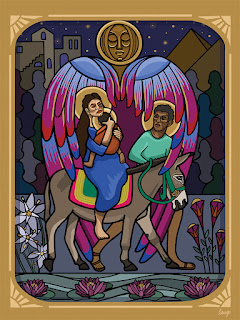
Because shortly after the magi leave to return to their distant land, death prevails. The empires of this world - reflected in Herod, himself titled “king of the Jews” - will not give up power or their way of being so easily. Scripture tells us that both Herod and the people of Jerusalem were “troubled.” This is the same word to describe how Mary felt when the Angel Gabriel first appeared to her to tell her of her participation in the divine plan. Consider her response to this news. And then compare it to Herod’s. Threatened by the news of a child born who is the long-awaited and true “king of the Jews,” his response is to order the slaughter of children under the age of 2. Babies. Killed in order to hold onto his power. And that of the empire.

We’ve seen this conflict of dominions before. This fight between good and evil. God and Satan. As readers of Genesis and Exodus, it is impossible for us to dismiss the parallels and the connection to the story of Moses and Israel’s exodus where the dominion of the Pharaoh collides with the dominion of God. That results in costly plagues for Egypt and a dramatic exodus for Israel in a way that shows God’s steadfast love - God’s hesed - for Israel.

Yet, God’s steadfast love, God’s desire and ability to rescue Israel, does not mean God keeps Israel completely out of danger and away from the risk of death. Israel was constantly jeopardized by the destructive and oppressive policies of the Pharaoh. Just as Joseph and Mary and the young Jesus were jeopardized by the destructive actions of Herod. 

And, while we may think things have changed, they have not. In so many ways, our human situation has changed very little from Pharaoh to Herod to us. Matthew’s Gospel calls us to discern God’s will in the midst of currently conflicting powers and dominions. To find our way through. To seek God in the midst of the darkness. To be witness to and people of the light. Whatever the cost. However foreign it may feel. As we, like the gentle and Gentile magi follow a star to Bethlehem to find and worship the true king. Trusting in faith that, even through the times fraught with danger and trouble, God will lead us through.

This is the revelation of scripture. The revelation of God. That God continues to break into our world. To intervene in a way that does not erase the danger, the risks, or the death inherent in life as we know it. But that reveals God’s presence and activity even in the midst of the darkness. God’s dominion will clash with and triumph over Herod’s, whose days will be numbered.

May we continue to seek God even in the midst of our darkest hours. And may we live deeply into our faith, trusting that God will abide with us and lead us, like the magi, to such a place of wonder and awe that our only response will be to fall to our knees. And worship Jesus. King of the Jews. Promised One. God-with-us. Always. Amen.

Preached January 8, 2023, at Grace & Glory, Prospect, with Third, Louisville.
Epiphany Sunday
Reading: Matthew 2:1-23

Sunday, May 29, 2022

Living in Hope: A Posture of Christ

If, then, there is any comfort in Christ, any consolation from love, any partnership in the Spirit, any tender affection and sympathy, make my joy complete: be of the same mind, having the same love, being in full accord and of one mind. Do nothing from selfish ambition or empty conceit, but in humility regard others as better than yourselves. Let each of you look not to your own interests but to the interests of others. Let the same mind be in you that was in Christ Jesus,

who, though he existed in the form of God,
    did not regard equality with God
    as something to be grasped,
but emptied himself,
    taking the form of a slave,
    assuming human likeness.
And being found in appearance as a human,
    he humbled himself
    and became obedient to the point of death—
    even death on a cross.
Therefore God exalted him even more highly
    and gave him the name
    that is above every other name,
so that at the name given to Jesus
    every knee should bend,
    in heaven and on earth and under the earth,
and every tongue should confess
    that Jesus Christ is Lord,
    to the glory of God the Father.

Therefore, my beloved, just as you have always obeyed me, not only in my presence but much more now in my absence, work on your own salvation with fear and trembling, for it is God who is at work in you, enabling you both to will and to work for his good pleasure.
--Philippians 4:1-13 (NRSV)

Grace, mercy and peace to you, from God our Father, and from our Lord and Savior, Jesus Christ. Amen.

Like Pr. Elisa last week, I’ve struggled writing this sermon this week. In the midst of all that has happened this week, which we will get to, it’s been one tiny little phrase in the center of this text that has troubled me much. It’s this phrase in verse 7. A reference to Christ emptying himself, specifically “taking the form of a slave, being born in human likeness.”

If you were here last week and you heard Pr. Elisa’s sermon, one of the theological terms she talked about, one that I’ve mentioned before, too, is the term imago Dei. It’s a theological understanding, based on the creation account in Genesis, that we believe that each person, every human being, is created in the image of God. 

So, what - and this what I struggled with - what does it mean then when we lay this idea beside verse 7 in today’s text where, being born in human likeness meant - at least for Christ - becoming enslaved. What happened to the part about human likeness imaged from the face of God?

So that, among other things, has been my struggle this week. And, by default, it’s yours today, too. Whether you like it or not!

To try to understand this, we need to step back from this small part to look at the whole. These verses are the oldest expression in all of Christian scripture of who Christ is. We teach about this piece of poetry as another proof text of our understanding of the incarnation - of Christ moving from a place of equality with God to that of the human condition. Emptying himself to suffering and death, then to resurrection and restoration. It’s the heart of the Gospel - the heart of the Easter story for us who, on this seventh Easter Sunday, are now returning full circle back to that first Easter Sunday. It’s the heart of who we understand this Christ to be. 

But that’s really only part of the story of these verses. We know the social and political context of the Roman Empire at the time this letter was written. Those who ran the Roman Empire put up stone monuments to celebrate its power. These images reflect Roman emperors holding female figures by the hair, women with anguished faces and twisted bodies. They were not just simple statues celebrating emperors who were considered “sons of God,” but statues that celebrated the empire’s power over the people - men and women alike - that it had enslaved. 

This hymn in verses six to eleven is a rejection of this kind of power. It celebrates Christ as one who is in the form of God and equal to God. And, if we look at verse 6, which reads that Christ did not “regard equality with God as something to be exploited” - the Greek word for exploited is much harsher than our English translation. It means rape and robbery. In other words, this divine power that Christ held did not include the right to dominate. Or to subdue people. And, in fact, this Christ hymn argues that Jesus took on the form of a slave - of one raped and robbed and exploited. And that he was executed on the cross as a criminal - enslaved by empire. 

Domination. Conquest. Exploitation. All of these are contrary to divine power. The death and resurrection of Jesus rejects our human displays of power and violence by taking on the form of those who were the recipients of such power and violence. To show us a different way than violence, fear and death. A way of humility. Of self-giving. Of being open to the cries of those who are enslaved.

Which brings me to this week. 

It began on Sunday. Even as we carried the previous week’s events of Buffalo and Laguna Woods and, here in Louisville, the incident with the Christian Academy...even as we carried these events into the week, on Sunday we learned of decades of the abuse, particularly of women, in the Southern Baptist Convention. Decades during which their abusers were preserved and protected. And the voices of these women silenced. And, in the silencing, abused over and over and over again. Perhaps there is a reason God appears to be dismantling the Church (capital C) as we know it.

Then, Tuesday came. And with it, another mass shooting, the 214th mass shooting of the year here in the US. There have been 2 more since then. This, as you well know, was another shooting in an elementary school: 19 children and 2 teachers, each of whom we named today as we began worship. 

Do we hear their cries? Do we hear the cries of the voiceless in our world? The people who are enslaved by human displays of power and violence at any cost? Do we hear their cries? When will we begin to listen? And to act? 

This hymn, perhaps written by Paul, is not a theological statement, but an ethical statement of how we, who have been saved by Christ, are called to act on behalf of those who have been enslaved by the human condition - the desire for power and domination at all costs. To hear their cries. To listen to their voices. To reject the simple binaries of good and bad, or who’s right or who’s wrong. To experience and take on the posture of Christ. And then, to act. To become in practice what we already are in Christ. 

To act is what Paul means at the end of today’s text, when he speaks of the need for us to work on our own salvation with fear and trembling, to continue the work already begun in us by God. And, then, "to will and to work for God’s good pleasure" in a posture of Christ.

Because, if we are all in truth created in the image of God then every child gunned down in Texas is my child. And your child. Every person of color killed is my sister or brother. And your sister or brother. And every grieving family is my family. And your family. Because we are all connected, one to the other, created by God, part of the human family that God created in God’s image. And God’s good pleasure is that we act on behalf of our family. Our human family.

Let the same mind be in you that was in Christ Jesus,
who, though he existed in the form of God,
    did not regard equality with God
    as something to be grasped,
but emptied himself,
    taking the form of a slave,
    assuming human likeness.
And being found in appearance as a human,
    he humbled himself
    and became obedient to the point of death—
    even death on a cross.
Therefore God exalted him even more highly
    and gave him the name
    that is above every other name,
so that at the name given to Jesus
    every knee should bend,
    in heaven and on earth and under the earth,
and every tongue should confess
    that Jesus Christ is Lord,
    to the glory of God the Father. Amen.


Preached May 29, 2022, at Grace & Glory, Prospect, with Third, Louisville, and New Goshen Presbyterian, Prospect.
Seventh Sunday of Easter
Readings: Philippians 2:1-13, Luke 6:43-45


Sunday, January 5, 2020

God's Kingdom Announced: Calling and Conflict

In the time of King Herod, after Jesus was born in Bethlehem of Judea, wise men from the East came to Jerusalem, asking, “Where is the child who has been born king of the Jews? For we observed his star at its rising, and have come to pay him homage.” When King Herod heard this, he was frightened, and all Jerusalem with him; and calling together all the chief priests and scribes of the people, he inquired of them where the Messiah was to be born. They told him, “In Bethlehem of Judea; for so it has been written by the prophet:

‘And you, Bethlehem, in the land of Judah,
    are by no means least among the rulers of Judah;
for from you shall come a ruler
    who is to shepherd my people Israel.’”

Then Herod secretly called for the wise men and learned from them the exact time when the star had appeared. Then he sent them to Bethlehem, saying, “Go and search diligently for the child; and when you have found him, bring me word so that I may also go and pay him homage.” When they had heard the king, they set out; and there, ahead of them, went the star that they had seen at its rising, until it stopped over the place where the child was. When they saw that the star had stopped, they were overwhelmed with joy. On entering the house, they saw the child with Mary his mother; and they knelt down and paid him homage. Then, opening their treasure chests, they offered him gifts of gold, frankincense, and myrrh. And having been warned in a dream not to return to Herod, they left for their own country by another road. 
--Matthew 2:1-12 (NRSV)

Grace, mercy, and peace to you from God our Father and from our Lord and Savior, Jesus Christ. Amen.

I need to begin today with an apology. If you believe that there were three wise men, then, I apologize to you. If you believe that their names were Balthazar, Caspar, and Melchior, then, I apologize to you. If you believe this is a lovely story about kings from a foreign land who have come to pay homage to Jesus and be converted, then, I apologize to you. I apologize to you, because I am about to burst your bubble around the romanticized and sanitized version of this story that has been perpetuated upon us. (I’m well aware of the irony of the church blessing we just did with our children and our use of some of the romanticized elements from this story.) 

So, what do we have here in this story?

First, we have the magi. There has been much speculation who these magi were and where they were from. Current scholarship places their origin from Persia. Present day Iran. (The irony of this story on this very day also does not escape me.)

It is believed that these magi were followers of Zorastrianism, which was a predecessor religion to Islam. They were pre-Muslim. They were also astrologers. Our Matthew text portrays them as men. However, it is well known that in these caravans both women and men were present. Both women and men were practitioners of this religion. It’s a reminder for us, once again that, in these times in which scripture was written down, male voices had privilege and predominance.

So, have I burst a few bubble for you, so far?

We know that this was not a short trip that the magi were on. There were weeks and months between the different elements of the nativity story. We know in the very next verses - verses that have conveniently been left out of today’s lectionary because they are so horrendous - that, by the time the magi reach Bethlehem, a likely 2 years has passed since Jesus’ birth. Along the way, there has been a detour to Jerusalem. Because, while these astrologers have discerned that the star will lead them to a new king, they know little else. So, they, naturally, travel to the place where kings reside in Israel. To Jerusalem. To inquire about who this king might be and where he might be found.

Enter Herod. Our text reads that, when the magi made their inquiry and Herod heard it, he was frightened. As was all of Jerusalem. Frightened. Because a new king is a threat to Herod’s power. It may be a threat to those in Jerusalem, who reside in this seat of power. It may also simply be the fear that arises from among the people because they know of Herod’s empirical ways.  They know how he responds when he feels threatened. How he responds when someone tells him that he is not the center of the universe. They have experienced the pain of living under imperial rule. Perhaps the people of Jerusalem live in as unstable times as we are living in at this very moment. 

Herod inquires of his scholars and theologians. Who is this king? Where is he to be born? Do you find it as interesting as I do that these people in Herod’s own court know the answers to the questions he asks. And yet, they have not sought this new king. Instead, it is foreigners, coming from a different religious tradition who are seeking this king. 

Herod shares the information and then sends them on their way. But before he does, he asks them. No, truthfully, he orders them to return once they have found him so that Herod can go and pay homage. Likely story. We can see through Herod. Because we know the Herods of this world. This is not a Herod who will bow down to another king and pay him homage. This is a Herod who, in the very next verses, will order the slaughter of innocent children 2 years old and younger. 

This Herod is very different from these foreign astrologers. They go on their way and, as they leave Jerusalem, once again see the star that leads them to Bethlehem. To the young Jesus. In their joy and then in their humility they kneel down and worship him. Bringing gifts - gifts that seem so appropriate. Gold, meant for kings. Frankincense, used by priests. And myrrh, an embalming oil and symbol of death.

Then, they return home by another way. Transformed. And disregarding Herod’s order.

This story, this story of the journey of the magi reminds us of many things. It reminds us, first, that we do not have exclusive claim to the revelation of God. This revelation is given to and can come from persons well beyond our ethnic and our religious boundaries. God is generous with revelation and with salvation. God calls us into places of discomfort to encounter others with different experiences and beliefs. To discover and to grow from these encounters, trusting that through them God is further revealing godself to us. I have a dear friend - a dear friend who is Wiccan - who tells me that each of our different religious and faith traditions give us a broader understanding of who God is. This God who we want to keep in a neat little box, because that is so much easier and less disruptive for us.

This story also reminds us that God is at work in the world despite the existence of true evil. There is no guarantee for us that bad and evil things will not happen. But God promises that we will not walk through these dark valleys alone. God is not naive about the evils of the world. We should not be either. And we should not, in our privilege and our ability to read and then close the newspaper and put it neatly away - we should not understand that our life of faith is to be a comfortable life. We should understand that we are called by God to places of discomfort. To times of confronting evil. To challenge the powers that seek violence, instead of love and understanding. That divide instead of uniting.

And, finally, this story reminds us that the birth of Jesus Christ is of cosmic and astronomical importance for all people. It is good news for all who wish to participate in God’s kingdom - a kingdom of radically inclusive love and grace. And bad news for those who desire power over and against others.

It is these characteristics of love and grace that are the mark of a believer of God. One who puts God at one’s center. Who seeks God daily and weekly so that God is at the center of our lives, rather than our own self. A believer of God is one who is called to places of conflict and discomfort, to speak out and to challenge leaders that do not follow God’s kingdom - those who don't seek justice. Those who don't seek mercy. Those who seek to walk humbly with God. It is the mark of a believer to seek others out - others with different beliefs and experiences - that, they might be transformed. And, mostly, that we might be transformed. It is a mark of a believer of God, a believer who has been freed by God, to live into radical grace and love. These are our markers. Markers of lives of calling and lives of conflict. Who we are to be as we live out the kingdom of God.

So, I’m sorry this morning. I’m sorry if I’ve burst any bubbles you might have had about this story. But, it’s in the bubble-burst version where we find the real truth. Where we find God.

Amen.

Preached January 5, 2020, at Grace & Glory Lutheran Church, Goshen, KY.
Epiphany of Our Lord
Readings: Psalm 72:1-7, 10-14; Ephesians 3:1-12; Matthew 2:1-12

Sunday, November 6, 2016

Claiming LIfe


Then he looked up at his disciples and said:
“Blessed are you who are poor,
for yours is the kingdom of God.
“Blessed are you who are hungry now,
for you will be filled.
“Blessed are you who weep now,
for you will laugh.

“Blessed are you when people hate you, and when they exclude you, revile you, and defame you on account of the Son of Man. Rejoice in that day and leap for joy, for surely your reward is great in heaven; for that is what their ancestors did to the prophets.

“But woe to you who are rich,
for you have received your consolation.
“Woe to you who are full now,
for you will be hungry.
“Woe to you who are laughing now,
for you will mourn and weep.
“Woe to you when all speak well of you, 
for that is what their ancestors did to the false prophets.

“But I say to you that listen, Love your enemies, do good to those who hate you, bless those who curse you, pray for those who abuse you. If anyone strikes you on the cheek, offer the other also; and from anyone who takes away your coat do not withhold even your shirt. Give to everyone who begs from you; and if anyone takes away your goods, do not ask for them again. Do to others as you would have them do to you. (Luke 6:20-31 NRSV.)


Grace and peace to you from God our Father and our Lord Jesus Christ. Amen.

This past summer, as I was nearing the end of my internship and the end of my studies at Luther Seminary, I took a break from reading non-fiction. For nearly five years, it has seemed to me that the only books I’ve read have been those related to school, whether they were about theology, faith formation, church administration, missional leadership, or pastoral care--or any other topic a seminary student needs to know about in order to be a pastor. Or at least to be a beginning pastor.

So, I decided to read through the entire Harry Potter series.

Now I’m sure that I’m probably the only person alive in our world today who, by 2016, had not read any of these remarkable books by author J. K. Rowling. Unless, of course, some of you choose to admit that, too. 

So, over about 6 weeks, I delved into the world of wizardry and Harry Potter. 

The books were fascinating and magical. Frightening, at times. Funny, at others. It was completely worth it and, if you haven’t read them, I really encourage you to do so.

Now, I’m not going to preach on Harry Potter today. But, as I read through our lessons today and, particularly, the lesson from Daniel, about his vision of the four beasts, I couldn't help but think of the Dementors, those foul creatures from the Potter series. They are described as infesting the darkest, filthiest places; glorying in decay and despair; draining peace, hope and happiness out of the air around them. Get too near one and every good feeling, every happy memory will be sucked out of you.

No wonder Daniel’s spirit was troubled within him. And the vision in his head terrified him. 

This seems like a bizarre text for today, doesn’t it?  On this All Saints Day, a day when we remember all those in the faith who have gone before us, who have moved from the Church Militant to the Church Triumphant, those whom we have loved and who have loved us and who, most importantly, have been examples of faith for us, examples of believing in God and trusting in God’s faithfulness. On this All Saints Sunday, this Daniel text just doesn’t seem like a good fit.

Oh, but it is!

In order to understand why it is so appropriate for us today, we have to understand the nature of this text. This portion of Daniel, along with the book of Revelation, is what we call apocalyptic literature. If you’ve ever read any part of Revelation, it can be a terrifying book. I had a parishioner last year who asked me why this book was in the Bible, sharing that it terrified her so much she never read it. 

The function of this type of literature may be unfamiliar to us. It is crisis literature. It is literature written to encourage, to give hope and support in a time of crisis. In Jesus’ day, these passages from Daniel 7 were so widely read at the time, that there grew to be what we might call a Daniel 7 cult. It is from this text that we first hear the term “son of Man.” It is also one of the first anti-empire texts in scripture. 

The beasts in this text represent empires. Empires that, like the Dementors, are sub-human. That drain the life out of our world. They seek to amass great wealth and power and, in the process, destroy our planet, destroy the poor, destroy peace.

It is in response to these destructive, Dementor-like empires that the “son of Man” comes. Here, in Daniel 7 we first hear that term--son of Man. Here in Daniel 7 we also hear the first anti-empire texts in scripture.  Read Daniel 7:13b-14. 

Daniel, troubled and terrified, seeks to understand his vision. In the interpretation, beginning with v. 17, notice that singular son of Man becomes plural. Look at verse 18. No longer does it read the “holy one of the Most High,” but the “holy ones of the Most High.” The saints of the Most High.

One individual sent by God stands up to the powers of empire. In Christ, God breaks into these destructive empires to establish God’s kingdom--a kingdom of justice and peace, a kingdom of love and forgiveness, a kingdom of hope and healing, a kingdom in the fullness of God in Christ.

The inbreaking begins with Christ’s coming. It continues through the work of the holy ones of the Most High--the saints we honor and remember here today. Some of them we read about in Scripture. Some became known across the world. But most, like the saints we remember today, were those who were not famous, not known. But they carried on the work of God’s kingdom. They shared their faith and gave us a glimpse of God’s kingdom so that we, too, might be called the saints of God, members of the body of Christ, the holy ones of the Most High.

We, saints, are citizens of a different kingdom than that of the empires of the world. It is this kingdom that Jesus describes today in our Gospel text. 

It is a kingdom where true power is not shown in dominance, but in service to others. It is a kingdom that calculates worth based on a different standard. Where those with wealth stop working for the systems--the empires--that exploit the poor, instead of continuing to build more wealth. Where those with power, turn away from amassing more of that power to stand in solidarity with the poor and powerless and to seek to change the systems that continue to oppress them.  Where God continues to lift up people who, under the world’s standards, have no business being lifted up. In this kingdom, God continues to lift them up--the poor, the hungry, the grief-stricken--and says to them, “These are the ones who are blessed. These are my people.” 

It’s been a difficult election year in our nation, hasn’t it? It seems as though we have experienced--endured might be a better word--endured one of the ugliest elections in years. One of the most painful parts for me especially has been the insults and recriminations that have flown back and forth between political candidates and their followers, the daily barrage of hostility, cruelty, dismissiveness of “others”, whether women, Catholics, Mexicans, Asians, losers, Republicans, Democrats, Independents, Russians, or Syrians. I have to admit that I, too, have gotten caught up in the back and forth, in the ugliness of this election.

All of this--the insults, the recriminations, the name-calling, the hatred--all of it comes out of fear. It is the same fear that drives us to build walls to keep immigrants out. The same fear that drives us to create economic structures to wall in our profits and project our jobs. The same fear that causes us to protect ourselves and to keep what is ours. It is a fear that divides us and keeps us from experiencing the fullness of life in God’s kingdom and with each other. It is this division that Jesus warns us against in our text today. A division that, like the Dementors, destroys life and sucks away every happy memory, every shred of hope.

In a recent essay, Willie James Jennings, a theologian who graduated from my alma mater, Fuller Seminary, calls on all Americans and, particularly, Christians to “claim the power of life together precisely at the site of threat and fear. Our faith places us inside the actions of a God who faces our dangers and yet refuses to yield to fear. God offers life and invites us to gather courage there, making it a place where God creates community.”

Yielding to fear destroys community. Our Christian faith claims the power of life together precisely at the site of threat and fear.

This is exactly what Jesus’ disciples did in the first century. In the midst of a Roman empire that sought to destroy them, they claimed life right at the point of threat and fear, spreading the Good News throughout the Roman empire and beyond. 

In the same way, Luther claimed life at the point of threat and fear as he stood up to challenge the authority of an empirical church that had lost its way, spreading the Good News throughout the Western world.  

Over and over and over again, we have story after story of saints, known and unknown, who, in the midst of threat and fear, stood up and claimed life--showing the world and us how to imagine better, how to hope once again, and how to acknowledge that our lives and our needs, our safety and shalom are all in God’s hands.

So stand with this whole communion of saints today and claim life. Claim the gift of life that is yours through the death of our Savior Jesus Christ. And then dare to imagine and to engage the world in God’s name. Amen.


Preached on All Saints Sunday, November 6, 2016, at Good Shepherd Lutheran Church, Bastrop, TX.
Texts: Daniel 7:1-3, 15-18; Psalm 149; Ephesians 1:11-23; Luke 6:20-31.
Credit for ideas to WorkingPreacher.org. 


Sunday, April 24, 2016

Choose Love

When Judas was gone, Jesus said, "Now the Human One has been glorified, and God has been glorified in him. If God has been glorified in him, God will also glorify the Human One in himself and will glorify him immediately. Little children, I'm with you for a little while longer. You will look for me--but, just as I told the Jewish leaders, I also tell you now--'Where I'm going, you can't come.'

I give you a new commandment: Love each other. Just as I have loved you, so you also must love each other. This is how everyone will know that you are my disciples, when you love each other. (John 13:31-35 CEB)

Love. That's our main topic today. Love.

Isn't love what the resurrection is all about? It seems so simple, doesn't it? Resurrection is love. Love is resurrection. No matter how you slice it, when you are talking Christ's resurrection, you are talking love.

And, today, in our lessons for this fifth Sunday of Easter, we are not only talking love. We are being told to "choose love."

If I were to go around this room today and ask you whether or not you choose love, I would dare say that everyone of you would answer, "Yes."  "Absolutely, positively, yes!" This is a warm, loving congregation. It is who we are. Besides, after all, who wouldn't choose love?

But, do we? Choosing love can be really hard. Choosing love can make us vulnerable. It can feel like we're taking too much of a chance sometimes, can't it? It can expose us to the possibility that our love might not be reciprocated. It might be a waste of our time, especially if we give it expecting something in return and don't get anything back. Choosing love can hurt, especially if the person we want to love doesn't see us as worthy of their love.

Yet, if we are truly the resurrection people we claim to be...if we, as the church, truly seek to be a partner with the Spirit at work in our world making all things new, then the only right choice for us is love. Our only choice is to be on the side of God and to be part of God's new creation and to choose love.

And, if we truly choose love, then our only other choice is to turn toward God and away from the influence of the world. To be in the world, but not of the world. To work toward a new way of living, a "new heaven and a new earth." Toward a place where God will come down and dwell with us.  A place transformed by God into something fully beyond our wildest imagination. To work toward the new Jerusalem instead of the global empire in which we currently life.

This new Jerusalem spoken of in our Revelation text today isn't some eternal place up in the heavens paved with golden streets. Unlike most of what we've heard in contemporary culture, this isn't a rapture; this new Jerusalem isn't a place for us to escape to from our current world--a place away from this messed up world to which God will rescue us.

No.  This new Jerusalem that God is creating is right here, right now. It's happening in our presence. In this very moment. Here and now the Spirit is at work in our world, creating a new world where every human being and all of creation might experience the joy and goodness and fullness of God's love.

And our job, as the church, is to walk alongside the Spirit--to partner with God in ways that allow God's power and Christ's love to be experienced in the world. Our job is to be involved in making God's dream come true in this world. Our job is to choose love.

But, once again, it's not easy to choose love, is it? To treat all people with love? To treat people as if they are no different from us, regardless of race or religion or class or gender or age or sexual orientation or political persuasion. It's not always easy to set aside the biases and prejudices that are so deeply ingrained in us, is it? Or to even recognize that we have bias and prejudice in the first place.

It's hard for us today. It was hard for the early church, too.  Look at our Acts reading. Hear the Jerusalem council grilling Peter as to why he was baptizing those Gentiles--those unclean Gentiles. It is hard for all of us, past and present to choose love.

This past week, as I drove home from my vacation in Texas, I listened to an audiobook. The name of the book was "Blink: The Power of Thinking Without Thinking." I've wanted to read it for a long time, so I decided I would use my driving time efficiently and listen to it instead.

In it, the author Malcolm Gladwell, presents research on what is called the "adaptive unconscious." Our adaptive unconscious is our ability to use limited information from a very brief experience to come to a rapid conclusion--like when you reach a quick, gut-level decision about something or someone. He argues that a decision like this--one reached quickly and with limited data--is often better than one that is reached with much more information or a longer period of time.

Yet, there is also a dark side to our adaptive unconscious. Prejudices and biases operate at this same level, even in someone who doesn't consciously exhibit such behavior. To test whether or not one has unconscious bias, readers of his book are invited to take a test on a Harvard University website.

So, when I got home on Tuesday, I took one of several possible tests--a test to measure any implicit bias I might have toward African-Americans.

Now keep in mind that, although I grew up in very white South Dakota, our ranch was situated between two reservations--the Cheyenne and the Sioux. In Los Angeles, I lived in a very diverse area. Within 10-12 blocks from my house lived immigrants from Korea, El Salvador, the Philippines, Mexico, as well as African-Americans. There was a large Muslim mosque only a few blocks from my house and a Jewish temple within a quarter of a mile.

For ten years, I worked for an organization with a leadership that was predominantly African-American. For many years, I worked with undocumented workers, primarily from Mexico and Central America. I worked for three years along the Texas-Mexico border. I have many close friends who are Hispanic and Filipino and African American.

So, although I knew I might have some unconscious bias, I thought my test results might be okay.

Well, I was stunned!  The data compiled from my test suggested a "strong automatic preference for European American compared to African American." It was the highest level of unconscious bias possible on the test.

You see, it is hard to "choose love." Even when we consciously do choose it, trying to treat others with dignity and respect and as no different from us, our unconscious biases and prejudices creep in.  "Them." "Those people." "They." Not "us" or "we."

The only way for us to begin to put an end to making "us and them" distinctions is to begin to recognize and admit our biases and their impact on our relationships with those who are different from us. Racism, sexism, classism, ageism, heterosexism, and other biased behaviors and thinking are not godly. They are motivated by fear of the other and not by a love of humanity. They are not the result of choosing love.

And, yet, in spite of us...in spite of even our unconscious bias and prejudice, God continues to work in our world. God, who created this world and all living and life-giving things in it, continues to disrupt and overturn the walls and the barriers we create between each other or any bias and prejudice we may have.

"See, I am making all things new." This is our promise. It is a promise that is trustworthy and true. It is a promise for a new world--a world where God will dwell among us, where God will wipe every tear away, where there will be no more death or mourning or crying or pain. And where those who are thirsty will receive water as a gift from the spring of the water of life.

Let us working alongside the Holy Spirit, then. Let us seek to overcome our unconscious biases and prejudices.  Let us choose love.

Amen.

Preached April 24, 2016, at Chatfield Lutheran Church.

Saturday, March 26, 2016

Dropping the Facade

Luke 19:29-40 (NRSV).  When he had come near Bethphage and Bethany, at the place called the Mount of Olives, he sent two of the disciples, saying, “Go into the village ahead of you, and as you enter it you will find tied there a colt that has never been ridden. Untie it and bring it here. If anyone asks you, ‘Why are you untying it?’ just say this, ‘The Lord needs it.’” So those who were sent departed and found it as he had told them. As they were untying the colt, its owners asked them, “Why are you untying the colt?” They said, “The Lord needs it.” Then they brought it to Jesus; and after throwing their cloaks on the colt, they set Jesus on it. As he rode along, people kept spreading their cloaks on the road. As he was now approaching the path down from the Mount of Olives, the whole multitude of the disciples began to praise God joyfully with a loud voice for all the deeds of power that they had seen,saying,
“Blessed is the king
    who comes in the name of the Lord!
Peace in heaven,
    and glory in the highest heaven!”
Some of the Pharisees in the crowd said to him, “Teacher, order your disciples to stop.” He answered, “I tell you, if these were silent, the stones would shout out.”


Wait a minute.  Hang on just a second, before I get started.  I want to take a picture.  I want to take a selfie for my Facebook page.  Pastor Mark, will you come up and take a picture with me so I can post it?   Cool.  A picture of me and my supervisor!  But wait.  You’ve gotta make a selfie face. 

Hey, I have an even better idea. How about all of you??  What about the entire congregation? What if I stand up here and turn around and all of you can smile and wave and be in my selfie?  Ready?  Make the selfie face!  Perfect.

Now, let me post these pictures on my home page. 

Great.  Now everyone can see how great my internship is going--that I have a great relationship with my supervisor and with the congregation.  They’ll think I’m doing really well and that I’ll be a really great pastor.

Now everyone can see what a success I am! Because that’s what everyone expects, right?  That’s what the world expects, what our culture demands.  That we should all be successful, be the best, be number one.  Pull yourself up by your bootstraps!  Be the winner!

And, it’s not only us as individuals, but our country, too.  That we should be the best and the biggest and the most powerful in the world.  We hear it everyday on the news, don’t we?  “Make America great again!”  Losers don’t count, especially in this season of March Madness.  Who, after all, cares about the team that lost in the NCAA championship game last year?  Gotta be a winner.  Not a loser.

The situation wasn’t much different in New Testament times.  Both of our texts for today are set in the midst of a similar setting--the Roman empire.  In the previous hundred years, this powerful empire had grown dramatically and was experiencing a period of unprecedented political stability and prosperity--a time called the “Pax Romana.”  The Romans believed they had brought about a “golden age” for all of humanity. 

It was a time when social standing was everything--that the most admired were those who were strong and self-reliant, the ones who “pulled themselves up by their bootstraps” regardless of their humble beginnings.  Humility was a flaw.  To be successful in this world meant that you did what it took to get ahead. 

But, even though some enjoyed this time of peace and prosperity, it had come at a price to many others.  The empire generated deep feelings of hatred and contempt among those it had conquered--in particular, the Jews.  As one ancient historian wrote: “The Romans rob, they slaughter, they plunder--and they call it ‘empire.’ Where they make a waste-land, they call it ‘peace.’”

Under the empire, Israel had been subjected to many burdens placed upon them, both financial and political.  They grew increasingly angry and frustrated. It is no wonder that their hope for the Messiah translated into a desire for a powerful king who would free them from hated Roman rule.

Could Jesus have been that kind of king? Yes.  There’s no doubt. But this wasn’t the plan.  This wasn’t God’s plan.

Instead, in our Philippians text today, in the words that come from a hymn in the early church, we read that “he emptied himself by taking the form of a slave and by becoming like human beings” and then “he humbled himself by becoming obedient to the point of death, even death on a cross.” 

He emptied himself.  He humbled himself.  Jesus came to earth completely vulnerable.  Empty.  Humble.  Vulnerable. 

Over this Lenten season, in our Wednesday worship and in the Sunday morning adult forum, we’ve been exploring the history and ritual of the Easter Vigil service.  We’ve connected this ancient ritual to our understanding of our worship today--an understanding that is deeply grounded in the teachings of Luther’s Small Catechism.  Over and over, we’ve explored in different ways the themes of death and resurrection that are present in both the Easter Vigil service and in our own worship today.  Themes of loss and gain, brokenness and wholeness, dying and rising. 

I’ve challenged many of you to be vulnerable as Jesus was--to look into places of death, brokenness, and loss in your own lives and to identify where God has been or may still be at work, transforming those dark places into new places, places of beauty and light. 

And I’ve challenged some of you, in particular, confirmation students and mentors, to be vulnerable enough to share these really hard things with each other.  It is not easy.  I know that.  It is not easy to drop the facade.  To drop the Facebook facade that everything is perfect.

It is not easy for us.  It was not easy for Jesus. 

As we begin our Holy Week journey today on Palm Sunday, there is much joy and celebration.  With the early disciples, we celebrate Jesus’ kingly entrance into Jerusalem.  With those disciples, we also journey through the rest of Holy Week, knowing, perhaps better than they did at the time, what lay at the end--that Christ would humble himself and take on our brokenness and that of the whole world.  To be a king in a way that the world did not then and does not now understand.  A king who was fully humble.  Fully open.  Fully vulnerable.  

There is a hymn in our hymnal, which we’ll sing more fully this week.  However, the opening verse reads like this:

Will you let me be your servant,
Let me be as Christ to you?
Pray that I may have the grace
To let you be my servant, too. 

When we go against our culture, which tells us to be strong and self-reliant. When we are like Christ and we drop the facade...when are fully vulnerable with each other, open and honest, sharing all of our heartache and brokenness, well, we are being Christ to each other.  And, as we know from that early Easter morning, that when we are vulnerable just as Christ was vulnerable, well, amazing things happen.  This we know. And on this, we rest secure.

May God grant you a blessed Holy Week as we enter it in all vulnerability, learning more about our Savior and, in turn, more about ourselves.  Amen.

(Preached on Palm Sunday, March 20, 2016.)