Showing posts with label Jerusalem. Show all posts

Sunday, January 8, 2023

From Generation to Generation: We Keep Seeking

Today, we formally move into the Gospel of Matthew, where we will spend the remainder of the spring. Matthew is one of three synoptic gospels. (Know what the other two are?) The word synoptic comes from the Greek, which means “to see together.” The three synoptic Gospels do seem to tell the story of Jesus from the same basic perspective, especially when we compare them to John’s Gospel. In the Synoptics, Jesus tells parables. In John, he does not. In the Synoptics, the cleansing of the temple happens near the end of Jesus’ story and precipitates Jesus’ arrest. In John, this story is near the beginning of his ministry. The list of contrasts could continue, but the point is that the synoptics share common language and stories and their placement across large stretches of text. 

Nevertheless, there are differences between the synoptic Gospels. Each of them presents different and distinct pictures of Jesus to different and distinct audiences. It is important for us to understand each of these gospels on their own unique terms. Because, when we do, they present a richer and much more complex picture of God coming to us in Jesus.

The Gospel of Matthew revolves around the five major speeches of Jesus. It reveals the character of Jesus by what he says. In this gospel, written to a Jewish audience, Jesus is depicted as the new Moses who has come, not to destroy the law, but to fulfill it. The structure of Matthew is intended to reflect the books of Moses. The five major discourses of Jesus correspond to the five books of Moses. Through them, Jesus is depicted as the new Moses who has come to complete Israel’s story of redemption. Through many quotes from the Hebrew scriptures - the Old Testament - the writer of this gospel seeks to tie Jesus’ story to Israel’s story. 

We should not think of Matthew as only a “Jewish Gospel.” In today's story, the place of non-Jews in the  history of salvation is present from the beginning of the gospel to the very end.

But, enough theology! Our Gospel reading today is from the second chapter of Matthew and includes a portion that we often choose not to read for reasons that will become evident. 

After Jesus was born in Bethlehem in the territory of Judea during the rule of King Herod, magi came from the east to Jerusalem. They asked, “Where is the newborn king of the Jews? We’ve seen his star in the east, and we’ve come to honor him.”

When King Herod heard this, he was troubled, and everyone in Jerusalem was troubled with him. He gathered all the chief priests and the legal experts and asked them where the Christ was to be born. They said, “In Bethlehem of Judea, for this is what the prophet wrote:

You, Bethlehem, land of Judah,
        by no means are you least among the rulers of Judah,
            because from you will come one who governs,
            who will shepherd my people Israel.”

Then Herod secretly called for the magi and found out from them the time when the star had first appeared. He sent them to Bethlehem, saying, “Go and search carefully for the child. When you’ve found him, report to me so that I too may go and honor him.” When they heard the king, they went; and look, the star they had seen in the east went ahead of them until it stood over the place where the child was. When they saw the star, they were filled with joy. They entered the house and saw the child with Mary his mother. Falling to their knees, they honored him. Then they opened their treasure chests and presented him with gifts of gold, frankincense, and myrrh. Because they were warned in a dream not to return to Herod, they went back to their own country by another route.

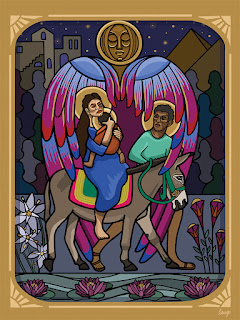
When the magi had departed, an angel from the Lord appeared to Joseph in a dream and said, “Get up. Take the child and his mother and escape to Egypt. Stay there until I tell you, for Herod will soon search for the child in order to kill him.” Joseph got up and, during the night, took the child and his mother to Egypt. He stayed there until Herod died. This fulfilled what the Lord had spoken through the prophet: I have called my son out of Egypt.

When Herod knew the magi had fooled him, he grew very angry. He sent soldiers to kill all the children in Bethlehem and in all the surrounding territory who were two years old and younger, according to the time that he had learned from the magi. This fulfilled the word spoken through Jeremiah the prophet:

A voice was heard in Ramah,
    weeping and much grieving.
        Rachel weeping for her children,
            and she did not want to be comforted,
                because they were no more.

After King Herod died, an angel from the Lord appeared in a dream to Joseph in Egypt. “Get up,” the angel said, “and take the child and his mother and go to the land of Israel. Those who were trying to kill the child are dead.” Joseph got up, took the child and his mother, and went to the land of Israel. But when he heard that Archelaus ruled over Judea in place of his father Herod, Joseph was afraid to go there. Having been warned in a dream, he went to the area of Galilee. He settled in a city called Nazareth so that what was spoken through the prophets might be fulfilled: He will be called a Nazarene. --Matthew 2:1-23 (CEB)

Grace, mercy and peace to you from God our Creator and from our Lord and Savior, God-with-us, Jesus Christ. Amen.

As we begin this new year, I’m curious. Did you make New Year’s resolutions? Or, alternatively, intentions for the new year - which is the current trend - to move away from goal-setting to identifying intentions for how we want to be or to feel or to live in the new year? Did you? (I’ll admit that I have set several intentions for this year.)

Another question? In setting resolutions or intentions, did you consult your astrological forecast for the year? How do your planets align? Did you know that Mercury is currently in retrograde? For those of you who are not up on your astrology, Mercury is the planet that rules communication in all forms--listening, writing, reading and so on--as well as activities related to communication, like negotiations and contracts. A few times a year, the planet Mercury appears to reverse direction - to go retrograde. And although this is an illusion caused by the position of Earth in relation to Mercury - it only looks like the planet is moving backward - that when it “reverses” course, astrologers tell us that this time that Mercury is retrograde is often a time associated with confusion, with delay, and with frustration. Mercury has been in retrograde since December 28th and will continue to be in “reverse” motion through January 18th.

Hmmm. It makes one wonder if this - and other astrological signs and wonders - are true. In our world of science and rational thought, there are many reasons to dismiss this practice. Justifiably so. But, for the magi in today’s story, Gentile astrologers from Persia or Babylon, following the planets and using the stars for guidance like sailors of old was not unusual. In fact, the stars, and one star in particular, were symbols of direction and knowledge for the magi - a manifestation of God’s guidance, providing light for the way. A sign of hope and vision for humanity. Leading them to the small village of Bethlehem of Judea, which becomes for them the center of human aspirations and dreams. 

We have added so much to this story over the generations. Giving the magi names: Melchior, Gaspar, and Balthazar. Spiritualizing the gifts they brought - gold, a symbol of royalty; frankincense, a symbol of the divine; and myrrh, an ointment used to embalm, a symbol of death. 

Yet, we really know little about the magi. Were there three of them? We don’t know. Were they all men? We don’t know. Were they astrologers? Perhaps, based on how the word magi is used in other parts of scripture and in other texts from this time. What we do know about them is that they were seekers. Ones coming from a far away land, Gentiles. Moving beyond reason to intuition. Beyond science to faith. Trusting the journey even though they did not know where they were going. Trusting a wisdom beyond their own to take them where they needed to go. Yet, their wisdom was a wondering, wandering kind of wisdom that would bring them to a place of awe and wonder and worship. Offering homage to the wider and more wonderful Wisdom of God. 

But this traditional story that is so lovely and wondrous - told from generation to generation on this Epiphany Sunday - is only part of the story. The full story is so much more complex - as complex as the symbolic aspects we give to the three gifts of the magi, including that of myrrh, which, again, symbolizes death.
Because shortly after the magi leave to return to their distant land, death prevails. The empires of this world - reflected in Herod, himself titled “king of the Jews” - will not give up power or their way of being so easily. Scripture tells us that both Herod and the people of Jerusalem were “troubled.” This is the same word to describe how Mary felt when the Angel Gabriel first appeared to her to tell her of her participation in the divine plan. Consider her response to this news. And then compare it to Herod’s. Threatened by the news of a child born who is the long-awaited and true “king of the Jews,” his response is to order the slaughter of children under the age of 2. Babies. Killed in order to hold onto his power. And that of the empire.

We’ve seen this conflict of dominions before. This fight between good and evil. God and Satan. As readers of Genesis and Exodus, it is impossible for us to dismiss the parallels and the connection to the story of Moses and Israel’s exodus where the dominion of the Pharaoh collides with the dominion of God. That results in costly plagues for Egypt and a dramatic exodus for Israel in a way that shows God’s steadfast love - God’s hesed - for Israel.

Yet, God’s steadfast love, God’s desire and ability to rescue Israel, does not mean God keeps Israel completely out of danger and away from the risk of death. Israel was constantly jeopardized by the destructive and oppressive policies of the Pharaoh. Just as Joseph and Mary and the young Jesus were jeopardized by the destructive actions of Herod. 

And, while we may think things have changed, they have not. In so many ways, our human situation has changed very little from Pharaoh to Herod to us. Matthew’s Gospel calls us to discern God’s will in the midst of currently conflicting powers and dominions. To find our way through. To seek God in the midst of the darkness. To be witness to and people of the light. Whatever the cost. However foreign it may feel. As we, like the gentle and Gentile magi follow a star to Bethlehem to find and worship the true king. Trusting in faith that, even through the times fraught with danger and trouble, God will lead us through.

This is the revelation of scripture. The revelation of God. That God continues to break into our world. To intervene in a way that does not erase the danger, the risks, or the death inherent in life as we know it. But that reveals God’s presence and activity even in the midst of the darkness. God’s dominion will clash with and triumph over Herod’s, whose days will be numbered.

May we continue to seek God even in the midst of our darkest hours. And may we live deeply into our faith, trusting that God will abide with us and lead us, like the magi, to such a place of wonder and awe that our only response will be to fall to our knees. And worship Jesus. King of the Jews. Promised One. God-with-us. Always. Amen.

Preached January 8, 2023, at Grace & Glory, Prospect, with Third, Louisville.
Epiphany Sunday
Reading: Matthew 2:1-23

Tuesday, March 30, 2021

Journey to the Cross: A Different Kind of King

The journey of Jesus to the cross is nearing its end. It has been a long journey, from Galilee in the north, detouring through Samaria, to Jerusalem. Nine chapters of Luke’s narrative that culminate in chapter 19, with the story of Jesus’ triumphal entry into this city that is the heart and soul of the Jewish people. His entry is timed with the festival of the Passover, a time when believers from across Judea would travel to the city, to the temple, to offer sacrifices and remember this important historical action by God to free God’s people from bondage.

It’s no wonder, then, that the large crowd of disciples that Jesus had gathered along the way were so excited. Because they knew the ancient promise of the Messiah. The ancestor of King David. Son of David, long promised by God, who would free them from this new bondage through Roman occupation. Who promised to restore Israel once again.

The symbolism of Jesus’ entry in Jerusalem, riding a donkey over a path strewn with cloaks and branches, was not lost on those who were witnesses to this event. This was exactly how Israel’s kings would enter the city. It was exactly how the prophet Zechariah had foretold the entry of God’s future ruler. “Lo, your king comes to you; triumphant and victorious is he, humble and riding on a donkey, on a colt, the foal of a donkey.”

The people were certain this Jesus, this Nazarene, was he. The Christ. The Messiah. 
But, here’s the problem. We heard a hint of this problem near the end of the processional gospel we listened to earlier, when the Pharisees want the people once again to “Shush!” The problem is that the people do not understand the nature of this promised king, thinking that he will be a conqueror. One who will come with authority. One who will dominate. One who will overthrow Rome. Because that is what kings do, right? That is what great leaders do, right? That is what this Messiah will do, right?

There is a political implication to Jesus’ entry into Jerusalem. It’s why the Pharisees want Jesus to tell the crowd to be quiet. They understand that this is a politically charged situation. That Jesus’ disciples and, eventually, Jesus himself must be silenced. Because to do otherwise would mean rebellion. The Pharisees are trying to walk a fine political line between open rebellion and complete capitulation before Roman authorities. The response Jesus gives them is paradoxical. He does not want to claim the kingdom his disciples understand or desire. Yet, he accepts their acclamation, justified as it is, yet recognizing that in the coming week he will define for them his kingdom by his example.

Which brings us to the last portion of today’s text in chapter 19. A scene that is found only in the gospel of Luke. Beginning at verse 41.

As he came near and saw the city, he wept over it, saying, “If you, even you, had only recognized on this day the things that make for peace! But now they are hidden from your eyes. Indeed, the days will come upon you, when your enemies will set up ramparts around you and surround you, and hem you in on every side. They will crush you to the ground, you and your children within you, and they will not leave within you one stone upon another; because you did not recognize the time of your visitation from God.”

If you, even you, Jerusalem, had only recognized on this day the things that make for peace. 

Jesus knows that, in spite of the welcome he has received, things will not go well for him in Jerusalem. Because, Jerusalem and its people. Because Jerusalem, its people, and all of the believers do not understand who Jesus is. What the peace is that he is ushering in. And what this peace will bring. 

Because, they desire a different kind of peace. One that does not last for eternity. It is a peace that comes out of rebellion and war. Domination and victory. It is no different than our present attempts at peace. We trust the peace of weapons and armaments - that comes from violence. We trust the peace of vigilance and self-protection, the peace of isolation from those we fear. We find it difficult to practice the peace of trusting one another. The peace of generosity and abundance. The peace of love. Jesus, who wept over Jerusalem that day still weeps over us. Our cities. Our nations.

But, the reign of this king, this Messiah-king, is a reign of freedom from our ways of violence and all else that keeps us in captivity. It is a universal reign of freedom. Release to the captives. Recovery of sight to the blind. Good news to the poor. Wholeness and abundance for all people.

This king’s crown is a crown of thorns. His throne, a splintered wooden cross. His exaltation, not coming in a horse-drawn chariot amidst the cheer of the crowd, but in being raised upon a cross amidst the jeers and ridicule of the masses. Through his death and resurrection, this king, who refuses to be an earthly king, makes his royal entry by way of a cross and an empty tomb. For this kind of king, even if all people - and we - were silent, the very stones themselves would cry out.

Thanks be to God for this kind of king. Amen.

Preached March 28, 2021, online with Grace & Glory and Third Lutheran churches, Goshen/Louisville, KY.
Palm-Passion Sunday
Readings: Luke 19:29-44; Psalm 118:19-23

Sunday, February 23, 2020

The Power of the Kingdom: Who Are You?

Grace and peace to you from God our Father and our Lord and Savior, Jesus Christ. Amen.

Welcome to Transfiguration Sunday and to the end of the Epiphany season! 

Several weeks ago, we talked about the meaning of this word, epiphany. Anyone want to venture a definition? An epiphany can be an idea, a new thought, perhaps even a new understanding. The season of Epiphany is quite similar. It’s a season of revelation, of stories that tell us who Jesus is.

If you think all the way back to early January, when we first moved into the gospel of Mark, do you remember how the gospel opened? “The beginning of the good news of Jesus Christ, the Son of God.” Soon after, at Jesus’ baptism, we heard the voice from heaven speaking directly to Jesus - “You are my Son, the Beloved,” confirming that this Jesus is the Christ, the Anointed One, the Messiah long promised. We know this, but, so far only the demons have been able to figure it out, too. The disciples just don’t seem to get it.

This is likely why, in the story just before today’s reading, we witness Jesus healing a blind man. Twice. Because the first time, it doesn’t take. At least not fully. Like the blind man, the disciples are beginning to see, but not clearly. At least, not yet.

Then, we come to the first part of today’s lesson. From Mark, chapter 8. 

Jesus went on with his disciples to the villages of Caesarea Philippi; and on the way he asked his disciples, “Who do people say that I am?” And they answered him, “John the Baptist; and others, Elijah; and still others, one of the prophets.” He asked them, “But who do you say that I am?” Peter answered him, “You are the Messiah.” And he sternly ordered them not to tell anyone about him.

Then he began to teach them that the Son of Man must undergo great suffering, and be rejected by the elders, the chief priests, and the scribes, and be killed, and after three days rise again. He said all this quite openly. And Peter took him aside and began to rebuke him. But turning and looking at his disciples, he rebuked Peter and said, “Get behind me, Satan! For you are setting your mind not on divine things but on human things.” --Mark 8:27-33 (NRSV)

This portion of our reading, often called the “Confession of Peter,” is the literary hinge for the Gospel of Mark. It’s both an ending to the first half of the Gospel and an introduction to the second half.  We are transitioning from Galilee in the north in the first half to Jerusalem in the south in the second. After today’s story, we will begin this journey to the south. To Jerusalem. And to what awaits Jesus there. 

But it has been in Galilee where the main question that Jesus is being asked is “Who are you?” Soon the question will change to “Why are you here?” But, before this happens, Jesus is about to give the disciples a little quiz. To decide how good their sight is. Or isn’t.

“Who do people say that I am?” Jesus asks them.  Immediately, Peter jumps in with a response. “You are the Christ,” he says. We might applaud and cheer him for getting it so right. Except he has gotten it so wrong. Because, Peter doesn’t see. He doesn’t understand who this Jesus is. He has in his mind the traditional picture of the Messiah, of the Christ - a political figure who would wield power and authority and who would free the Jewish people from Roman occupation, restoring the line of King David. This is who Peter understands Jesus to be. It is a picture that he and many others have created in their minds as to what this Messiah will be like, adopting their own idea, rather than God’s idea. An image that is perhaps intensified by the fact that they are in Caesarea Philippi, named in honor of Emperor Augustus Caesar, and the seat of power for the Roman government in this region. 

Thus, we can easily understand why Peter, even after all the time spent with Jesus, would still believe that this was who Jesus was. Because it was this Messiah that fit who Peter was and what he really wanted. Peter and so many others.

Don’t we do the same thing? We fashion Jesus out of who we are and what we want in a savior. Maybe it’s a savior to swoop down and save us when we are done something foolish or made a bad choice. A savior of convenience, who we quickly forget then when things are better. 

Or maybe we try to co-opt Jesus for our own political ends. With both the political left and right in our country trying to claim (or reclaim) Jesus as their own. Each creating an image of the Jesus they want and then co-opting him for their own purposes. To defend their actions. To support a position. To  justify a cause.

Who are you? The answer to that question will identify what your Jesus looks like. Because chances are you, as I, have created Jesus in your image, for your own needs, and as you want him to be.
Just as Jesus did with Peter, he does with us. Rebuking us for thinking human thoughts instead of God’s thoughts.

Who is Jesus? What does it take to be his disciple? We, like Peter and the rest of the disciples, soon find this out. 

He called the crowd with his disciples, and said to them, “If any want to become my followers, let them deny themselves and take up their cross and follow me. For those who want to save their life will lose it, and those who lose their life for my sake, and for the sake of the gospel, will save it. For what will it profit them to gain the whole world and forfeit their life? Indeed, what can they give in return for their life? Those who are ashamed of me and of my words in this adulterous and sinful generation, of them the Son of Man will also be ashamed when he comes in the glory of his Father with the holy angels.” And he said to them, “Truly I tell you, there are some standing here who will not taste death until they see that the kingdom of God has come with power.” --Mark 8:34-9:1 (NRSV)

Jesus tells us to take up our cross. To take up our instrument of death and follow him. Because, to be Jesus’ disciple means we must lose our lives. Our selves. And, particularly, our image of the Messiah as we want him to be. 

One wonders what Peter was thinking after all this. After his picture of who the Messiah was, of who Jesus was had been blown to smithereens. But, soon after, we find ourselves with him and other disciples in a mountaintop experience. 

Six days later, Jesus took with him Peter and James and John, and led them up a high mountain apart, by themselves. And he was transfigured before them, and his clothes became dazzling white, such as no one on earth could bleach them. And there appeared to them Elijah with Moses, who were talking with Jesus. Then Peter said to Jesus, “Rabbi, it is good for us to be here; let us make three dwellings, one for you, one for Moses, and one for Elijah.” He did not know what to say, for they were terrified. Then a cloud overshadowed them, and from the cloud there came a voice, “This is my Son, the Beloved; listen to him!” Suddenly when they looked around, they saw no one with them any more, but only Jesus. --Mark 9:2-8 (NRSV)

If Peter had been confused before, think of how he felt now. As they watched Jesus transfigured. Saw his face glowing. His clothing turning bright. Witnessing the appearance of Elijah - that great prophet. And Moses - that great law giver. Jesus, surrounded symbolically by the “Law and the Prophets.” And the fulfillment of them. And then that voice from heaven. This time speaking directly to them. This is my Son. Listen to him! It’s no wonder Peter wanted to stay there. To bask in that experience for a little bit. To build a few tents and just camp out there. Because the words Jesus had spoken a few days before, about taking up one’s instrument of death, had stuck with him. Perhaps, terrified him a bit. Here, on the mountain top, he felt safe and secure, basking in the light of Jesus, the very Son of God. 

Sisters and brothers, just as our story today is a literary hinge in the Gospel of Mark, so this Transfiguration Sunday is a hinge between Epiphany and Lent. Between the revelation of who Jesus is and the answer to the question of why he has come. It’s tempting for us to want to stay here, on the mountaintop, where it feels safe and secure. Where we are centered. Where we, like Peter, bask in the glory of God. 

But, this is not who we have been called to be. Instead, we are called down off the mountain, into the messiness and grittiness of our daily lives. Into our communities. Freed as we are to be in service to this place. And, knowing that, as we journey, Jesus accompanies us as he did Peter and the disciples. Teaching us who he is, why he came, and reminding us who we are. Every step of every day for the rest of our lives, into all eternity.

May we bask in the light of our Savior this day. But, may we then gladly go out to be in service to all the world. Amen. 

Preached February 23, 2020, at Grace & Glory Lutheran Church, Goshen, KY.
The Transfiguration of Our Lord
Readings: Mark 8:27-9:8; Malachi 4:4-6; Psalm 27:1-4

Sunday, November 24, 2019

Our Sin, God's Faithfulness: Who is Your King?

Grace and peace to you from God, our Creator, our Redeemer, and our Sustainer. Amen.

At the beginning of worship this morning, we talked about discoveries. About finding things during excavations. Things that have been hidden for a time. Have you ever put something in a “safe place” and then forgotten where that something was? How many of you have ever bought Christmas presents weeks or months ahead of time, put them somewhere in your home, and, then, when it comes time to wrap and give them, can no longer find them? Welcome to my world!

Our story today is a story of discovery. For the past few weeks, we’ve been reading in the prophets. Today, we are turning to second Kings, chapters 22 and 23. For the first several minutes today, we’re going to work our way through the text, section by section. Let’s begin our discovery by reading at verse 1. 

Josiah was eight years old when he began to reign; he reigned thirty-one years in Jerusalem. His mother’s name was Jedidah daughter of Adaiah of Bozkath. He did what was right in the sight of the Lord, and walked in all the way of his father David; he did not turn aside to the right or to the left. --2 Kings 22:1-2 (NRSV)

Our story is set during the reign of King Josiah. We are about 100 years after the setting of last week’s reading in Isaiah, around 620 BC, in the southern kingdom. Josiah has just become king, at the ripe age of 8 years old. The northern kingdom has fallen. Although Assyria has already begun to encroach into Judah, Jerusalem still stands. Josiah’s reign happens about 35 years before the Assyrian empire will collapse and the Babylonians will come from the south and defeat and capture Jerusalem, and exile the Jewish people from their homeland. We are near the end, near the catastrophic failure of the line of King David. About 586 BC.

We’ve talked before about these historical texts in the Hebrew scripture, that they are theological histories. Each of these stories has elements from actual history, but they are not written for historical purposes, but for theological reasons. They present clear theologies, clear understandings of the way the world works or is supposed to work. There is a lot of what we might call confirmation bias - finding evidence of God in history. It’s often what we like to do in our own lives, when we look at something in our own histories and believe we can seek the hand of God at work. 

These books from Joshua through Kings are called Deuteronomistic histories - histories that are read through the lens of Deuteronomy - the book in the Torah that gave Israel an understanding of what an ideal king should be, even before there were any kings. In these first verses, King Josiah begins his reign as an 8 year old. Verse 2 says that he did “what was right in the sight of the Lord.” That he did not “turn aside to the right or to the left.” This is direct language from Deuteronomy about what a good king should look like. There are only three kings in scripture described in this way: David, Hezekiah, and Josiah.

The book of Chronicles in two parts is a companion to the book of Kings. It expands in areas where Kings doesn’t. So, if we turn to 2nd Chronicles, chapter 34, we read what it looks like for a king to do what is right in the sight of God, to not turn aside to the right or to the left. Chronicles tells us that, in Josiah’s eighth year, he began to seek God. At 12, he began to purge Judah and Jerusalem of the “high places,” the shrines where people would go to worship the Baals, which, as I mentioned last week, were representative of all the gods that the people had begun to worship. All of the other gods except for the true God. Josiah not only purged the “high places,” but removed the incense altars, the sacred poles, the carved and cast images and the priests that had distracted the people from the true God. All of the cultural artifacts that had pulled them away from God.

This is what a good leader does. A good leader turns to God and then works to turn his or her people to God.

We read on. 

In the eighteenth year of King Josiah, the king sent Shaphan son of Azaliah, son of Meshullam, the secretary, to the house of the Lord, saying, “Go up to the high priest Hilkiah, and have him count the entire sum of the money that has been brought into the house of the Lord, which the keepers of the threshold have collected from the people; let it be given into the hand of the workers who have the oversight of the house of the Lord; let them give it to the workers who are at the house of the Lord, repairing the house, that is, to the carpenters, to the builders, to the masons; and let them use it to buy timber and quarried stone to repair the house. But no accounting shall be asked from them for the money that is delivered into their hand, for they deal honestly.”

The high priest Hilkiah said to Shaphan the secretary, “I have found the book of the law in the house of the Lord.” When Hilkiah gave the book to Shaphan, he read it. Then Shaphan the secretary came to the king, and reported to the king, “Your servants have emptied out the money that was found in the house, and have delivered it into the hand of the workers who have oversight of the house of the Lord.” Shaphan the secretary informed the king, “The priest Hilkiah has given me a book.” Shaphan then read it aloud to the king. --2 Kings 22:3-10 (NRSV)

Part of Josiah’s reform was to begin restoration of the temple in Jerusalem, which had fallen into disrepair. We get a true sense of Josiah’s leadership and of his people here. That Josiah trusted them to do the right things. To live in upright and honest ways because this was how he lived and how he led them. There was no need to double-check the work of the temple workers, because they could be trusted. Just as their leader could be trusted.

It is in the midst of the temple repair that a discovery is made. The book of the law. The Torah. Which included in it, the book of Deuteronomy - this guide book for how a king should lead. Josiah asks that this newly-discovered book be read aloud to him.

When the king heard the words of the book of the law, he tore his clothes. Then the king commanded the priest Hilkiah, Ahikam son of Shaphan, Achbor son of Micaiah, Shaphan the secretary, and the king’s servant Asaiah, saying, “Go, inquire of the Lord for me, for the people, and for all Judah, concerning the words of this book that has been found; for great is the wrath of the Lord that is kindled against us, because our ancestors did not obey the words of this book, to do according to all that is written concerning us.” --2 Kings 22:11-13 (NRSV) 

When Josiah hears the words, he tears his clothes. In the Jewish tradition, this represents that something very bad has happened. So, he sends his advisors to go to God’s prophet to inquire of God. One must wonder if this is our first step when something bad has happened to us. Or the first place our leaders turn. Do we seek God’s guidance first?

So the priest Hilkiah, Ahikam, Achbor, Shaphan, and Asaiah went to the prophetess Huldah the wife of Shallum son of Tikvah, son of Harhas, keeper of the wardrobe; she resided in Jerusalem in the Second Quarter, where they consulted her. She declared to them, “Thus says the Lord, the God of Israel: Tell the man who sent you to me, Thus says the Lord, I will indeed bring disaster on this place and on its inhabitants—all the words of the book that the king of Judah has read. Because they have abandoned me and have made offerings to other gods, so that they have provoked me to anger with all the work of their hands, therefore my wrath will be kindled against this place, and it will not be quenched. But as to the king of Judah, who sent you to inquire of the Lord, thus shall you say to him, Thus says the Lord, the God of Israel: Regarding the words that you have heard, because your heart was penitent, and you humbled yourself before the Lord, when you heard how I spoke against this place, and against its inhabitants, that they should become a desolation and a curse, and because you have torn your clothes and wept before me, I also have heard you, says the Lord. Therefore, I will gather you to your ancestors, and you shall be gathered to your grave in peace; your eyes shall not see all the disaster that I will bring on this place.” They took the message back to the king. --2 Kings 22:14-20 (NRSV) 

If Josiah thought he had heard bad news before, this news is so much worse. “You’ll be okay for right now, but the future for your country will be no more.” It is news that God will not change God’s plan even though the people have turned back and re-committed themselves to God. Or that they are now walking in God’s ways. The prophetess Huldah does not have hopeful words for the kingdom of Judah. Because choices have consequences.

Then the king directed that all the elders of Judah and Jerusalem should be gathered to him. The king went up to the house of the Lord, and with him went all the people of Judah, all the inhabitants of Jerusalem, the priests, the prophets, and all the people, both small and great; he read in their hearing all the words of the book of the covenant that had been found in the house of the Lord. The king stood by the pillar and made a covenant before the Lord, to follow the Lord, keeping his commandments, his decrees, and his statutes, with all his heart and all his soul, to perform the words of this covenant that were written in this book. All the people joined in the covenant. --2 Kings 23:1-3 (NRSV) 

So what does Josiah do with the information that Jerusalem will be doomed? He gathers everyone together. All Jerusalem. And he reads all of the discovered scroll - the Torah or the instruction - to them. Publicly. All of it. Following the command found in Deuteronomy 31, that the king will command everyone to assemble and read the words. To re-commit themselves to the covenant. And so, with Josiah knowing the eventual doom that will come to Jerusalem, he reads scripture to them. And then he, knowing their fate but not telling the people their fate, will, with them, re-commit. And by the end of chapter 23, we find a king and a people who are fully in. Who have shed the artifacts of culture that have pulled them away. And who have committed themselves to God once again. This is the highest point for God’s people since King David.

This is a hard text. What are we to do with this story? What sense of it are we to make for ourselves? We, who are on the other side of history from this text? Knowing the eventual destruction of Jerusalem, the exile of the people, the loss of the temple - their religious center?

Friends, our choices today have consequences. If not for us, then for future generations. There are any number of issues I might point out here: climate change; the growing gap between rich and poor; our selfish focus in the church on individual salvation rather than the shalom, the wholeness of the entire community; a government we have elected that, day after day, we learn is more and more corrupt, whether you watch Fox News or MSNBC. All of our choices have consequences. If not immediate, then in the future. 

What are we to do in the midst of this, in this unknown times, wondering if our own future destruction is only years away? King Josiah helps us in this respect. Even when it seems there is no hope, we turn to the Word. It is here in reading scripture that we are pointed back to God. Where, in the Word made manifest in the form of a baby king, we find hope for the future. A promised future - God’s promised future - of peace. Where all are fed, where all are restored to community, where creation is made whole, where only justice and righteousness reign.

And so as we wait for that future of the reign of Christ, we live as people of God, shedding the artifacts and things that distract us from God. Following God’s command, first given in Deuteronomy, then expanded by our King and Savior Jesus Christ, through whom all of us have been freed. “You shall love the Lord your God with all your heart, and with all your soul, and with all your might. And your neighbor as yourself.” Amen.

Preached November 24, 2019, at Grace & Glory Lutheran Church, Goshen, KY.
Christ the King Sunday
Readings: 2 Kings 22:1-20, 23:1-3; Luke 24:30-32, Psalm 105:1-6 

Sunday, May 5, 2019

God's Greatest Promise: Known At the Table

On the first day of Unleavened Bread the disciples came to Jesus, saying, “Where do you want us to make the preparations for you to eat the Passover?” He said, “Go into the city to a certain man, and say to him, ‘The Teacher says, My time is near; I will keep the Passover at your house with my disciples.’” So the disciples did as Jesus had directed them, and they prepared the Passover meal.

When it was evening, he took his place with the twelve; and while they were eating, he said, “Truly I tell you, one of you will betray me.” And they became greatly distressed and began to say to him one after another, “Surely not I, Lord?” He answered, “The one who has dipped his hand into the bowl with me will betray me. The Son of Man goes as it is written of him, but woe to that one by whom the Son of Man is betrayed! It would have been better for that one not to have been born.” Judas, who betrayed him, said, “Surely not I, Rabbi?” He replied, “You have said so.”

While they were eating, Jesus took a loaf of bread, and after blessing it he broke it, gave it to the disciples, and said, “Take, eat; this is my body.” Then he took a cup, and after giving thanks he gave it to them, saying, “Drink from it, all of you; for this is my blood of the covenant, which is poured out for many for the forgiveness of sins. I tell you, I will never again drink of this fruit of the vine until that day when I drink it new with you in my Father’s kingdom.” Matthew 26:17-30 (NRSV)

Grace and peace to you from God, our Creator, and from our Lord and Savior, Jesus Christ. Amen.

I don’t know about your families, but in mine, the best place to hear things was at our dinner table. Whether it was at the end of a day, catching up on what was going on in our lives. Whether it was in our weekly Sunday dinner at the home of either my grandparents or my great aunt and uncle. Whether it was lingering at the table after a meal at our family reunion. It was at the table where we heard the news. Where we listened to the stories of our family. Where we learned who we were.

I’m sure it was not that different with Jesus and his disciples that Passover evening. After all, they’d been living closely with each other for three years. They’d traveled together throughout the rural areas of Galilee and, then, Judea. Learning from each other. Watching Jesus interact with people. Healing them. Granting forgiveness. Feeding thousands. They’d eaten many meals together. They’d also eaten the Passover meal together. Twice.

I wonder, though, if this meal didn’t feel a little different for them. This was the first time they were celebrating the Passover meal in Jerusalem. They came to Jesus and asked him where they should make preparations for this meal. I wonder how surprised they must have been when Jesus told them that everything was already prepared. And that, as they followed Jesus’ instruction, everything simply fell into place. 

I wonder, too, how distressing it must have felt to all the disciples when they heard Jesus’ prediction of how one of them would betray them. (The word in Greek really means “hand him over.”) Did they know then that it would be Judas who would hand Jesus over to the authorities? Did they know also know then that, by the end of the Passover celebration, all of them would have denied their relationship with Jesus?

I wonder if they knew the significance of that meal. When Jesus took the loaf of bread into his hands and blessed it, were they reminded of the thousands that had been fed that day with just a few loaves of bread and a few fish? Did it remind them of God’s promise to care for them, to give them their daily bread? To give them everything they needed to live?

When Jesus gave it to them (the Greek uses the same word here as that used to describe Judas’ betrayal - to “hand over”). When Jesus handed over the bread and wine to them, did they also know that Jesus was handing over his body? And his blood? 

And, then, when Jesus used the word “covenant,” were they reminded of the blood covenant that God had made with Israel at the base of Mount Sinai? How Moses had taken sacrificial blood and sprinkled it on the people as a reminder of their mutual covenant with God? A covenant that they broke time and time again? A covenant that was never broken by God? Did the disciples understand that, in this meal, Jesus was initiating a new covenant? A new promise that would be not only for Israel, but for the Gentiles? The ethnos, in Greek? For all the nations?

As they sat around the table that Passover night, reliving a tradition maintained over centuries, a tradition that was intended to remind them of God’s action in freeing them from bondage, did they fully know what was soon to happen and how it would change everything? I wonder.

Sisters and brothers, tonight, we, too, sit around a table, some 2,000 years after that first meal. We, however, have the benefit of hindsight. We know the ending to the story. How even though we, just like those first disciples, have betrayed Jesus in one way or another in our lives, how we have “handed him over” in much the same way. Yet, how, in this meal, Jesus hands over to us his body. And his blood. In this bread and wine. Given for you. For me. For all people. 

It is here, around the table, where we learn who we are as God’s children. What depth of love God must have for us that God would hand God’s only son over? For us? 

One can only wonder. Amen.

Preached April 18, 2019, at Grace & Glory Lutheran Church, Goshen, KY.
Maundy Thursday
Readings: Matthew 26:17-30, Psalm 116:12-15.


Tuesday, December 11, 2018

God's Plan for Peace: Peace in Troubled Times

Assyria’s King Sennacherib marched against all of Judah’s fortified cities and captured them in the fourteenth year of King Hezekiah. Assyria’s king sent his field commander from Lachish, together with a large army, to King Hezekiah at Jerusalem. He stood at the water channel of the Upper Pool, which is on the road to the field where clothes are washed. Hilkiah’s son Eliakim, who was the palace administrator, Shebna the secretary, and Asaph’s son Joah the recorder went out to them.

Then the field commander stood up and shouted in Hebrew at the top of his voice: “Listen to the message of the great king, Assyria’s king. The king says this: Don’t let Hezekiah lie to you. He won’t be able to rescue you. Don’t let Hezekiah persuade you to trust the Lord by saying, ‘The Lord will certainly rescue us. This city won’t be handed over to Assyria’s king.’

“Don’t listen to Hezekiah, because this is what Assyria’s king says: Surrender to me and come out. Then each of you will eat from your own vine and fig tree and drink water from your own well until I come to take you to a land just like your land. It will be a land of grain and new wine, a land of bread and vineyards. Don’t let Hezekiah fool you by saying, ‘The Lord will rescue us.’ Did any of the other gods of the nations save their lands from the power of Assyria’s king? Where are the gods of Hamath and Arpad? Where are the gods of Sepharvaim? Did they rescue Samaria from my power? Which one of the gods from those countries has rescued their land from my power? Will the Lord save Jerusalem from my power?”

When King Hezekiah heard this, he ripped his clothes, covered himself with mourning clothes, and went to the Lord’s temple. He sent Eliakim the palace administrator, Shebna the secretary, and the senior priests to the prophet Isaiah, Amoz’s son. They were all wearing mourning clothes. They said to him, “Hezekiah says this: Today is a day of distress, punishment, and humiliation. It’s as if children are ready to be born, but there’s no strength to see it through. Perhaps the Lord your God heard all the words of the field commander who was sent by his master, Assyria’s king. He insulted the living God! Perhaps he will punish him for the words that the Lord your God has heard. Offer up a prayer for those few people who still survive.”

When King Hezekiah’s servants got to Isaiah, Isaiah said to them, “Say this to your master: The Lord says this: Don’t be afraid at the words you heard, which the officers of Assyria’s king have used to insult me. I’m about to mislead him, so when he hears a rumor, he’ll go back to his own country. Then I’ll have him cut down by the sword in his own land.”

This is what Isaiah, Amoz’s son, saw concerning Judah and Jerusalem.

In the days to come
    the mountain of the Lord’s house
    will be the highest of the mountains.
    It will be lifted above the hills;
        peoples will stream to it.
Many nations will go and say,
“Come, let’s go up to the Lord’s mountain,
    to the house of Jacob’s God
        so that he may teach us his ways
        and we may walk in God’s paths.”
Instruction will come from Zion;
    the Lord’s word from Jerusalem.
God will judge between the nations,
    and settle disputes of mighty nations.
Then they will beat their swords into iron plows
    and their spears into pruning tools.
Nation will not take up sword against nation;
    they will no longer learn how to make war.  Isaiah 36:1-3, 13-20; 37:1-7; 2:1-4 (CEB)


Grace and peace to you from God our Father and from our Lord and Savior, Jesus Christ. Amen.

Last week, we began the first of three weeks talking about peace. More specifically, talking about God’s plan for peace and how we, as God’s people, are called to be participants in that plan. It’s easy, I think, to work towards peace when times are good. When economies are good. When relationships with others are good. When our lives are going well.

What happens, though, when everything seems to be falling apart? How are we to be peacemakers in the midst of conflict? Or challenge? Or difficulty? When things feel completely hopeless?

It is that context where we find Jerusalem in today’s story. We’ve been talking over the past few weeks about the advance of the Assyrian empire. Last week, in our text from Micah, we learned that the northern kingdom of Israel had fallen into the hands of the empire. And how the empire’s army had continued to advance into Judah and to get ever closer to Jerusalem. Jerusalem had been able to withstand the reach of the empire by paying tribute to the Assyrians. Paying them off. Buying their freedom. 

As our story opens today, Jerusalem is surrounded by the Assyrian army. They have ravaged Judah - knocking off fortified city after city. Forty-six of them in all. People from the villages surrounding Jerusalem have fled to Jerusalem. It has become overcrowded. Resources are stretched. Food is scarce. Water, too. The temple treasury has been depleted by tribute demanded by the Assyrian king, Sennacherib. Even the treasure of Judah’s king - King Hezekiah - has been depleted. The city is under siege.  

At the command of his emperor, the Assyrian field commander approaches the city. Hezekiah sends out three of his high officials to meet him. But, the Assyrian field commander isn’t really interested in talking to them. His plan is to sow distrust. Rather than speaking to Hezekiah’s emissaries, he goes directly to the people. He speaks in Hebrew - their language - to the men watching from on top of the city’s walls.  “Don’t let Hezekiah lie to you,” he says. “He won’t be able to rescue you. Don’t let Hezekiah persuade you to trust the LORD by saying, ‘The LORD will certainly rescue us.’”

He goes on to call for their surrender. For peace and an end to the battle. With promises of food and drink. It’s a clever tactic. A strategic attempt to win over their “hearts and minds.” What are they to do?

We know - and they know, too - that peace isn’t found by surrendering to a superior force to avoid conflict. True peace is God’s shalom - part of the fabric of God’s kingdom. It is an essential part of God’s promise and God’s plan for us and for the world. In the Isaiah 2 passage, we heard a description of what that true peace means. It means putting down swords and spears and other instruments of war. And re-fashioning them into farming tools. So, that the earth might be cultivated and flourish. And bring forth fullness and life for everyone, not just the few in power. 

But, this is not the peace that the Assyrian commander is offering. He is, instead, offering appeasement. Giving up to his demands simply to avoid conflict. This is a misguided kind of peace, because it ensures that the powerful are still in control. And that injustice and oppression will continue.

What are they to do? Hezekiah shows them. And us. He turns to Isaiah, God’s prophet. Asking him to pray for God’s help. Because his trust is not misplaced. Hezekiah’s trust is not in his own abilities or in the promises of his Assyrian enemies. Hezekiah’s trust is in God. It is a well-placed trust. God delivers Jerusalem from the Assyrian army.

This story is intended to give us a glimpse into God’s vision of peace. A glimpse into what God’s kingdom is to look like. A kingdom initiated with Jesus. A kingdom that God has promised will, one day, come into fruition. A kingdom of peace. And fullness. And flourishing. A kingdom of shalom. God’s desired kingdom of shalom

If you’ve been paying attention this week to the news, you might have heard the growing count of lives lost in the fire in northern California. The growing number of people missing. The growing number of homes and other structures destroyed. In one story, a pastor there told of an experience he had with one of five people staying in his office - a young 21-year-old man, who fled with only the clothes he was wearing. When this pastor took him to the local KMart to purchase clothing items that he couldn’t get at Goodwill, the young man turned to him and asked, “Are you sure you want to spend this money on me?” 

In times like this, when it seems like all hope is lost, when people’s sense of worth has been beaten up whether by natural or manmade disaster or by other challenges, how do we, as God’s people, begin to help our neighbors, whether they be next door or across the world...how do we help them begin to experience shalom? To find a sense of hope in God’s promise - promises of peace, of fullness, of flourishing for all people. In the midst of challenge, of war, of injustice, of devastation, and of uncertainty, where is hope to be found? (Read Wangari’s Trees of Peace.)

Small steps. Hope is found in the small things. In the planting of nine seedlings that would turn into a reforestation movement across Africa. In taking someone shopping in KMart, someone who has lost everything, so that they might begin to find hope and belief in their future. Or to give out 144 turkeys to those who might otherwise not have been able to afford to share Thanksgiving dinner with their families, so that they, too, might have a taste of the abundance of God’s kingdom. Hope is found in the small things. In small steps.  

We may run into resistance. Resistance that comes from our sin and brokenness. Resistance from those who have grown tired and cynical. Or from those who are afraid to relinquish power. Or from those who lack God’s vision of shalom

Yet, even in the midst of conflict and resistance. Even in the midst of troubled times, God calls us to trust. To trust in God and in God’s plan for peace. And to continue doing God’s work. So that all people might taste shalom and that the world might be given a glimpse of God’s kingdom. A glimpse of God’s plan for peace. Day by day. Step by step.

Amen.

Preached November 18, 2018, at Grace & Glory Lutheran Church, Goshen, KY.
Pentecost 26
Readings: Isaiah 36:1-3, 13-20; 37:1-7; 2:1-4; Matthew 5:14