Today, we formally move into the Gospel of Matthew, where we will spend the remainder of the spring. Matthew is one of three synoptic gospels. (Know what the other two are?) The word synoptic comes from the Greek, which means “to see together.” The three synoptic Gospels do seem to tell the story of Jesus from the same basic perspective, especially when we compare them to John’s Gospel. In the Synoptics, Jesus tells parables. In John, he does not. In the Synoptics, the cleansing of the temple happens near the end of Jesus’ story and precipitates Jesus’ arrest. In John, this story is near the beginning of his ministry. The list of contrasts could continue, but the point is that the synoptics share common language and stories and their placement across large stretches of text.
Nevertheless, there are differences between the synoptic Gospels. Each of them presents different and distinct pictures of Jesus to different and distinct audiences. It is important for us to understand each of these gospels on their own unique terms. Because, when we do, they present a richer and much more complex picture of God coming to us in Jesus.
The Gospel of Matthew revolves around the five major speeches of Jesus. It reveals the character of Jesus by what he says. In this gospel, written to a Jewish audience, Jesus is depicted as the new Moses who has come, not to destroy the law, but to fulfill it. The structure of Matthew is intended to reflect the books of Moses. The five major discourses of Jesus correspond to the five books of Moses. Through them, Jesus is depicted as the new Moses who has come to complete Israel’s story of redemption. Through many quotes from the Hebrew scriptures - the Old Testament - the writer of this gospel seeks to tie Jesus’ story to Israel’s story.
We should not think of Matthew as only a “Jewish Gospel.” In today's story, the place of non-Jews in the history of salvation is present from the beginning of the gospel to the very end.
But, enough theology! Our Gospel reading today is from the second chapter of Matthew and includes a portion that we often choose not to read for reasons that will become evident.
After Jesus was born in Bethlehem in the territory of Judea during the rule of King Herod, magi came from the east to Jerusalem. They asked, “Where is the newborn king of the Jews? We’ve seen his star in the east, and we’ve come to honor him.”
When King Herod heard this, he was troubled, and everyone in Jerusalem was troubled with him. He gathered all the chief priests and the legal experts and asked them where the Christ was to be born. They said, “In Bethlehem of Judea, for this is what the prophet wrote:
You, Bethlehem, land of Judah,
by no means are you least among the rulers of Judah,
because from you will come one who governs,
who will shepherd my people Israel.”
Then Herod secretly called for the magi and found out from them the time when the star had first appeared. He sent them to Bethlehem, saying, “Go and search carefully for the child. When you’ve found him, report to me so that I too may go and honor him.” When they heard the king, they went; and look, the star they had seen in the east went ahead of them until it stood over the place where the child was. When they saw the star, they were filled with joy. They entered the house and saw the child with Mary his mother. Falling to their knees, they honored him. Then they opened their treasure chests and presented him with gifts of gold, frankincense, and myrrh. Because they were warned in a dream not to return to Herod, they went back to their own country by another route.
When the magi had departed, an angel from the Lord appeared to Joseph in a dream and said, “Get up. Take the child and his mother and escape to Egypt. Stay there until I tell you, for Herod will soon search for the child in order to kill him.” Joseph got up and, during the night, took the child and his mother to Egypt. He stayed there until Herod died. This fulfilled what the Lord had spoken through the prophet: I have called my son out of Egypt.
When Herod knew the magi had fooled him, he grew very angry. He sent soldiers to kill all the children in Bethlehem and in all the surrounding territory who were two years old and younger, according to the time that he had learned from the magi. This fulfilled the word spoken through Jeremiah the prophet:
A voice was heard in Ramah,
weeping and much grieving.
Rachel weeping for her children,
and she did not want to be comforted,
because they were no more.
After King Herod died, an angel from the Lord appeared in a dream to Joseph in Egypt. “Get up,” the angel said, “and take the child and his mother and go to the land of Israel. Those who were trying to kill the child are dead.” Joseph got up, took the child and his mother, and went to the land of Israel. But when he heard that Archelaus ruled over Judea in place of his father Herod, Joseph was afraid to go there. Having been warned in a dream, he went to the area of Galilee. He settled in a city called Nazareth so that what was spoken through the prophets might be fulfilled: He will be called a Nazarene. --Matthew 2:1-23 (CEB)
Grace, mercy and peace to you from God our Creator and from our Lord and Savior, God-with-us, Jesus Christ. Amen.
As we begin this new year, I’m curious. Did you make New Year’s resolutions? Or, alternatively, intentions for the new year - which is the current trend - to move away from goal-setting to identifying intentions for how we want to be or to feel or to live in the new year? Did you? (I’ll admit that I have set several intentions for this year.)
Another question? In setting resolutions or intentions, did you consult your astrological forecast for the year? How do your planets align? Did you know that Mercury is currently in retrograde? For those of you who are not up on your astrology, Mercury is the planet that rules communication in all forms--listening, writing, reading and so on--as well as activities related to communication, like negotiations and contracts. A few times a year, the planet Mercury appears to reverse direction - to go retrograde. And although this is an illusion caused by the position of Earth in relation to Mercury - it only looks like the planet is moving backward - that when it “reverses” course, astrologers tell us that this time that Mercury is retrograde is often a time associated with confusion, with delay, and with frustration. Mercury has been in retrograde since December 28th and will continue to be in “reverse” motion through January 18th.
Hmmm. It makes one wonder if this - and other astrological signs and wonders - are true. In our world of science and rational thought, there are many reasons to dismiss this practice. Justifiably so. But, for the magi in today’s story, Gentile astrologers from Persia or Babylon, following the planets and using the stars for guidance like sailors of old was not unusual. In fact, the stars, and one star in particular, were symbols of direction and knowledge for the magi - a manifestation of God’s guidance, providing light for the way. A sign of hope and vision for humanity. Leading them to the small village of Bethlehem of Judea, which becomes for them the center of human aspirations and dreams.
We have added so much to this story over the generations. Giving the magi names: Melchior, Gaspar, and Balthazar. Spiritualizing the gifts they brought - gold, a symbol of royalty; frankincense, a symbol of the divine; and myrrh, an ointment used to embalm, a symbol of death.
Yet, we really know little about the magi. Were there three of them? We don’t know. Were they all men? We don’t know. Were they astrologers? Perhaps, based on how the word magi is used in other parts of scripture and in other texts from this time. What we do know about them is that they were seekers. Ones coming from a far away land, Gentiles. Moving beyond reason to intuition. Beyond science to faith. Trusting the journey even though they did not know where they were going. Trusting a wisdom beyond their own to take them where they needed to go. Yet, their wisdom was a wondering, wandering kind of wisdom that would bring them to a place of awe and wonder and worship. Offering homage to the wider and more wonderful Wisdom of God.
But this traditional story that is so lovely and wondrous - told from generation to generation on this Epiphany Sunday - is only part of the story. The full story is so much more complex - as complex as the symbolic aspects we give to the three gifts of the magi, including that of myrrh, which, again, symbolizes death.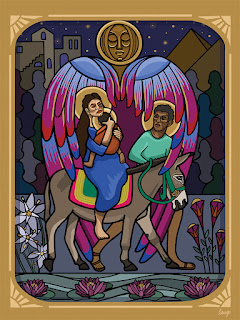

Because shortly after the magi leave to return to their distant land, death prevails. The empires of this world - reflected in Herod, himself titled “king of the Jews” - will not give up power or their way of being so easily. Scripture tells us that both Herod and the people of Jerusalem were “troubled.” This is the same word to describe how Mary felt when the Angel Gabriel first appeared to her to tell her of her participation in the divine plan. Consider her response to this news. And then compare it to Herod’s. Threatened by the news of a child born who is the long-awaited and true “king of the Jews,” his response is to order the slaughter of children under the age of 2. Babies. Killed in order to hold onto his power. And that of the empire.
We’ve seen this conflict of dominions before. This fight between good and evil. God and Satan. As readers of Genesis and Exodus, it is impossible for us to dismiss the parallels and the connection to the story of Moses and Israel’s exodus where the dominion of the Pharaoh collides with the dominion of God. That results in costly plagues for Egypt and a dramatic exodus for Israel in a way that shows God’s steadfast love - God’s hesed - for Israel.
Yet, God’s steadfast love, God’s desire and ability to rescue Israel, does not mean God keeps Israel completely out of danger and away from the risk of death. Israel was constantly jeopardized by the destructive and oppressive policies of the Pharaoh. Just as Joseph and Mary and the young Jesus were jeopardized by the destructive actions of Herod.
And, while we may think things have changed, they have not. In so many ways, our human situation has changed very little from Pharaoh to Herod to us. Matthew’s Gospel calls us to discern God’s will in the midst of currently conflicting powers and dominions. To find our way through. To seek God in the midst of the darkness. To be witness to and people of the light. Whatever the cost. However foreign it may feel. As we, like the gentle and Gentile magi follow a star to Bethlehem to find and worship the true king. Trusting in faith that, even through the times fraught with danger and trouble, God will lead us through.
This is the revelation of scripture. The revelation of God. That God continues to break into our world. To intervene in a way that does not erase the danger, the risks, or the death inherent in life as we know it. But that reveals God’s presence and activity even in the midst of the darkness. God’s dominion will clash with and triumph over Herod’s, whose days will be numbered.
May we continue to seek God even in the midst of our darkest hours. And may we live deeply into our faith, trusting that God will abide with us and lead us, like the magi, to such a place of wonder and awe that our only response will be to fall to our knees. And worship Jesus. King of the Jews. Promised One. God-with-us. Always. Amen.
Preached January 8, 2023, at Grace & Glory, Prospect, with Third, Louisville.
Epiphany Sunday
Reading: Matthew 2:1-23