Showing posts with label darkness. Show all posts

Sunday, January 8, 2023

From Generation to Generation: We Keep Seeking

Today, we formally move into the Gospel of Matthew, where we will spend the remainder of the spring. Matthew is one of three synoptic gospels. (Know what the other two are?) The word synoptic comes from the Greek, which means “to see together.” The three synoptic Gospels do seem to tell the story of Jesus from the same basic perspective, especially when we compare them to John’s Gospel. In the Synoptics, Jesus tells parables. In John, he does not. In the Synoptics, the cleansing of the temple happens near the end of Jesus’ story and precipitates Jesus’ arrest. In John, this story is near the beginning of his ministry. The list of contrasts could continue, but the point is that the synoptics share common language and stories and their placement across large stretches of text. 

Nevertheless, there are differences between the synoptic Gospels. Each of them presents different and distinct pictures of Jesus to different and distinct audiences. It is important for us to understand each of these gospels on their own unique terms. Because, when we do, they present a richer and much more complex picture of God coming to us in Jesus.

The Gospel of Matthew revolves around the five major speeches of Jesus. It reveals the character of Jesus by what he says. In this gospel, written to a Jewish audience, Jesus is depicted as the new Moses who has come, not to destroy the law, but to fulfill it. The structure of Matthew is intended to reflect the books of Moses. The five major discourses of Jesus correspond to the five books of Moses. Through them, Jesus is depicted as the new Moses who has come to complete Israel’s story of redemption. Through many quotes from the Hebrew scriptures - the Old Testament - the writer of this gospel seeks to tie Jesus’ story to Israel’s story. 

We should not think of Matthew as only a “Jewish Gospel.” In today's story, the place of non-Jews in the  history of salvation is present from the beginning of the gospel to the very end.

But, enough theology! Our Gospel reading today is from the second chapter of Matthew and includes a portion that we often choose not to read for reasons that will become evident. 

After Jesus was born in Bethlehem in the territory of Judea during the rule of King Herod, magi came from the east to Jerusalem. They asked, “Where is the newborn king of the Jews? We’ve seen his star in the east, and we’ve come to honor him.”

When King Herod heard this, he was troubled, and everyone in Jerusalem was troubled with him. He gathered all the chief priests and the legal experts and asked them where the Christ was to be born. They said, “In Bethlehem of Judea, for this is what the prophet wrote:

You, Bethlehem, land of Judah,
        by no means are you least among the rulers of Judah,
            because from you will come one who governs,
            who will shepherd my people Israel.”

Then Herod secretly called for the magi and found out from them the time when the star had first appeared. He sent them to Bethlehem, saying, “Go and search carefully for the child. When you’ve found him, report to me so that I too may go and honor him.” When they heard the king, they went; and look, the star they had seen in the east went ahead of them until it stood over the place where the child was. When they saw the star, they were filled with joy. They entered the house and saw the child with Mary his mother. Falling to their knees, they honored him. Then they opened their treasure chests and presented him with gifts of gold, frankincense, and myrrh. Because they were warned in a dream not to return to Herod, they went back to their own country by another route.

When the magi had departed, an angel from the Lord appeared to Joseph in a dream and said, “Get up. Take the child and his mother and escape to Egypt. Stay there until I tell you, for Herod will soon search for the child in order to kill him.” Joseph got up and, during the night, took the child and his mother to Egypt. He stayed there until Herod died. This fulfilled what the Lord had spoken through the prophet: I have called my son out of Egypt.

When Herod knew the magi had fooled him, he grew very angry. He sent soldiers to kill all the children in Bethlehem and in all the surrounding territory who were two years old and younger, according to the time that he had learned from the magi. This fulfilled the word spoken through Jeremiah the prophet:

A voice was heard in Ramah,
    weeping and much grieving.
        Rachel weeping for her children,
            and she did not want to be comforted,
                because they were no more.

After King Herod died, an angel from the Lord appeared in a dream to Joseph in Egypt. “Get up,” the angel said, “and take the child and his mother and go to the land of Israel. Those who were trying to kill the child are dead.” Joseph got up, took the child and his mother, and went to the land of Israel. But when he heard that Archelaus ruled over Judea in place of his father Herod, Joseph was afraid to go there. Having been warned in a dream, he went to the area of Galilee. He settled in a city called Nazareth so that what was spoken through the prophets might be fulfilled: He will be called a Nazarene. --Matthew 2:1-23 (CEB)

Grace, mercy and peace to you from God our Creator and from our Lord and Savior, God-with-us, Jesus Christ. Amen.

As we begin this new year, I’m curious. Did you make New Year’s resolutions? Or, alternatively, intentions for the new year - which is the current trend - to move away from goal-setting to identifying intentions for how we want to be or to feel or to live in the new year? Did you? (I’ll admit that I have set several intentions for this year.)

Another question? In setting resolutions or intentions, did you consult your astrological forecast for the year? How do your planets align? Did you know that Mercury is currently in retrograde? For those of you who are not up on your astrology, Mercury is the planet that rules communication in all forms--listening, writing, reading and so on--as well as activities related to communication, like negotiations and contracts. A few times a year, the planet Mercury appears to reverse direction - to go retrograde. And although this is an illusion caused by the position of Earth in relation to Mercury - it only looks like the planet is moving backward - that when it “reverses” course, astrologers tell us that this time that Mercury is retrograde is often a time associated with confusion, with delay, and with frustration. Mercury has been in retrograde since December 28th and will continue to be in “reverse” motion through January 18th.

Hmmm. It makes one wonder if this - and other astrological signs and wonders - are true. In our world of science and rational thought, there are many reasons to dismiss this practice. Justifiably so. But, for the magi in today’s story, Gentile astrologers from Persia or Babylon, following the planets and using the stars for guidance like sailors of old was not unusual. In fact, the stars, and one star in particular, were symbols of direction and knowledge for the magi - a manifestation of God’s guidance, providing light for the way. A sign of hope and vision for humanity. Leading them to the small village of Bethlehem of Judea, which becomes for them the center of human aspirations and dreams. 

We have added so much to this story over the generations. Giving the magi names: Melchior, Gaspar, and Balthazar. Spiritualizing the gifts they brought - gold, a symbol of royalty; frankincense, a symbol of the divine; and myrrh, an ointment used to embalm, a symbol of death. 

Yet, we really know little about the magi. Were there three of them? We don’t know. Were they all men? We don’t know. Were they astrologers? Perhaps, based on how the word magi is used in other parts of scripture and in other texts from this time. What we do know about them is that they were seekers. Ones coming from a far away land, Gentiles. Moving beyond reason to intuition. Beyond science to faith. Trusting the journey even though they did not know where they were going. Trusting a wisdom beyond their own to take them where they needed to go. Yet, their wisdom was a wondering, wandering kind of wisdom that would bring them to a place of awe and wonder and worship. Offering homage to the wider and more wonderful Wisdom of God. 

But this traditional story that is so lovely and wondrous - told from generation to generation on this Epiphany Sunday - is only part of the story. The full story is so much more complex - as complex as the symbolic aspects we give to the three gifts of the magi, including that of myrrh, which, again, symbolizes death.
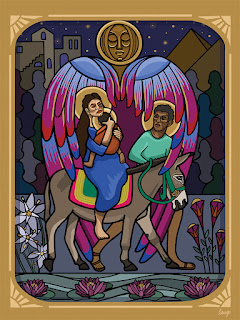
Because shortly after the magi leave to return to their distant land, death prevails. The empires of this world - reflected in Herod, himself titled “king of the Jews” - will not give up power or their way of being so easily. Scripture tells us that both Herod and the people of Jerusalem were “troubled.” This is the same word to describe how Mary felt when the Angel Gabriel first appeared to her to tell her of her participation in the divine plan. Consider her response to this news. And then compare it to Herod’s. Threatened by the news of a child born who is the long-awaited and true “king of the Jews,” his response is to order the slaughter of children under the age of 2. Babies. Killed in order to hold onto his power. And that of the empire.

We’ve seen this conflict of dominions before. This fight between good and evil. God and Satan. As readers of Genesis and Exodus, it is impossible for us to dismiss the parallels and the connection to the story of Moses and Israel’s exodus where the dominion of the Pharaoh collides with the dominion of God. That results in costly plagues for Egypt and a dramatic exodus for Israel in a way that shows God’s steadfast love - God’s hesed - for Israel.

Yet, God’s steadfast love, God’s desire and ability to rescue Israel, does not mean God keeps Israel completely out of danger and away from the risk of death. Israel was constantly jeopardized by the destructive and oppressive policies of the Pharaoh. Just as Joseph and Mary and the young Jesus were jeopardized by the destructive actions of Herod. 

And, while we may think things have changed, they have not. In so many ways, our human situation has changed very little from Pharaoh to Herod to us. Matthew’s Gospel calls us to discern God’s will in the midst of currently conflicting powers and dominions. To find our way through. To seek God in the midst of the darkness. To be witness to and people of the light. Whatever the cost. However foreign it may feel. As we, like the gentle and Gentile magi follow a star to Bethlehem to find and worship the true king. Trusting in faith that, even through the times fraught with danger and trouble, God will lead us through.

This is the revelation of scripture. The revelation of God. That God continues to break into our world. To intervene in a way that does not erase the danger, the risks, or the death inherent in life as we know it. But that reveals God’s presence and activity even in the midst of the darkness. God’s dominion will clash with and triumph over Herod’s, whose days will be numbered.

May we continue to seek God even in the midst of our darkest hours. And may we live deeply into our faith, trusting that God will abide with us and lead us, like the magi, to such a place of wonder and awe that our only response will be to fall to our knees. And worship Jesus. King of the Jews. Promised One. God-with-us. Always. Amen.

Preached January 8, 2023, at Grace & Glory, Prospect, with Third, Louisville.
Epiphany Sunday
Reading: Matthew 2:1-23


Sunday, January 30, 2022

Invitation to Abundant Life: Living in Light

Today and next week, we read two stories back to back that are a study in contrasts. 

Today, we hear about Nicodemus. A man. A Pharisee. A Jewish religious leader. Who comes to meet Jesus at night. Next week, you’ll hear the story of a woman. A Samaritan and an outsider. Who is unnamed. Who meets Jesus at noon - the brightest time of day. The conversation with Nicodemus in this week’s text will last for nine verses. The conversation with the unnamed woman next week will last for twenty-six verses.

But, today, our focus is the first person in this study in contrasts. Nicodemus. We begin today’s reading with the last two verses of last week’s text at the end of chapter 2. In the Greek these verses are much more closely connected to the beginning of the next chapter than they appear in English. They also foreshadow what we will hear today in this story about Nicodemus. So, we begin by reading these transitional verses and continue into chapter 3. We’re reading today in two parts.

While Jesus was in Jerusalem for the Passover Festival, many believed in his name because they saw the miraculous signs that he did. But Jesus didn’t trust himself to them because he knew all people. He didn’t need anyone to tell him about human nature, for he knew what human nature was.

There was a Pharisee named Nicodemus, a Jewish leader. He came to Jesus at night and said to him, “Rabbi, we know that you are a teacher who has come from God, for no one could do these miraculous signs that you do unless God is with him.”

Jesus answered, “I assure you, unless someone is born anew, it’s not possible to see God’s kingdom.”

Nicodemus asked, “How is it possible for an adult to be born? It’s impossible to enter the mother’s womb for a second time and be born, isn’t it?”

Jesus answered, “I assure you, unless someone is born of water and the Spirit, it’s not possible to enter God’s kingdom. Whatever is born of the flesh is flesh, and whatever is born of the Spirit is spirit. Don’t be surprised that I said to you, ‘You must be born anew.’ God’s Spirit blows wherever it wishes. You hear its sound, but you don’t know where it comes from or where it is going. It’s the same with everyone who is born of the Spirit.”

Nicodemus said, “How are these things possible?”

“Jesus answered, “You are a teacher of Israel and you don’t know these things? I assure you that we speak about what we know and testify about what we have seen, but you don’t receive our testimony. If I have told you about earthly things and you don’t believe, how will you believe if I tell you about heavenly things? --John 2:23 - John 12 (CEB)

This play of light and darkness, of night and day, is a frequent theme in John. 

Remember the Prologue - “The light shines in the darkness, and the darkness did not overcome it.” Nicodemus comes in the dark. To come in the dark suggests, in John, one who comes in a state of unbelief. To come in the dark suggests that one neither understands, nor fully believes in who Jesus is.

There’s this back and forth dialogue between Jesus and Nicodemus, who appears to be speaking on behalf of a group, perhaps the rest of the Pharisees. Perhaps the Jewish leaders. It’s not clear in our text. But, he’s come to find out more about Jesus. He asks honest questions. He’s seen the signs. So, he recognizes that this Jesus is one from God. But he misses that this Jesus is God.

Jesus doesn’t really help him out here. Nicodemus takes Jesus literally, when he says that he must be born anew. What? Are you saying I have to be put back in my mother’s womb again? This word in Greek actually has two simultaneous meanings. Born anew - referencing a physical change. And born from above - representing a spiritual change. Nicodemus doesn’t really get it. And Jesus doesn’t really help him out. Our minds immediately go to baptism. But, Nicodemus doesn’t have that connection. He won’t get it. Finishing the conversation with these words, “How is possible?”

It’s at this point that Jesus seems to turn from Nicodemus and address an audience. The pronoun you moves from the singular to the plural. Perhaps his words are for all of the Jewish leaders. Perhaps, his words are for all those who only believe in the signs, who lack a level of faith that leads to a complete change - a rebirth into a new community. And an entirely new way of life. 

Our story continues in verse 13.

No one has gone up to heaven except the one who came down from heaven, the Human One. Just as Moses lifted up the snake in the wilderness, so must the Human One be lifted up so that everyone who believes in him will have eternal life. God so loved the world that he gave his only Son, so that everyone who believes in him won’t perish but will have eternal life. God didn’t send his Son into the world to judge the world, but that the world might be saved through him. Whoever believes in him isn’t judged; whoever doesn’t believe in him is already judged, because they don’t believe in the name of God’s only Son.

“This is the basis for judgment: The light came into the world, and people loved darkness more than the light, for their actions are evil. All who do wicked things hate the light and don’t come to the light for fear that their actions will be exposed to the light. Whoever does the truth comes to the light so that it can be seen that their actions were done in God.” --John 3:13-21 (CEB)

In the midst of this, we hear what is likely the most famous verse in scripture. John 3:16. We hear this so often, it’s almost become meaningless to us, doesn’t it? But there are a couple of things to look at more closely here.

First, when we think of the phrase “eternal life”, we often think of unending life, particularly of life after death. Of heaven. But, a better reading of this is abundant life, which is the life God desires for us. Here and now. And in the future. A life of freedom. And of truth. A life that is free from the shame of our own darkness. Those things we keep hidden. Of which we are most ashamed. Our mistakes. How we treat - or mistreat - those we love the most. More broadly, our thirst for power in this world. Our marginalization of people who don’t think like us. Or look like us. Or live like us. 

Then, there’s this word “perish.” It’s in a reflexive voice. Meaning that the subject of this verb is affected by its own action. In other words, the perishing Jesus is talking about in this most famous verse in Scripture is a perishing of our own making. God’s own Son has come to save us from ourselves. Because we would choose to live in darkness. Yet God, through the Holy Spirit works faith in our hearts. Notice I said that the Spirit works faith in us. We don’t have the capacity to choose. It is God at work in us. Yet, we can refuse to receive that faith. To hang onto the darkness in us. And to the darkness of this world. To perish through our own making.

But, here’s the thing. God doesn’t come to us in Jesus to condemn us. Or anyone else.

God’s approach to us is all about love. God does this horrible thing - let’s name it, it is a horrible thing that God is doing. To give up God’s Son to die on the cross. For us. In love. So, that we might experience abundant life. A life of freedom and joy. A life of openness and trust. A life lived in the light and with others living in the light. People whose actions reflect that light.

The Nicodemuses of the world might be able to say all the right things, but until they put their lives on the line for the faith, in John’s gospel, they are still people who “love darkness more than the light.” 

May you and I, born anew and from above by the power of the Holy Spirit. May we, as people of God, be lovers and actors. Not of the darkness. But of the Light. Amen. 

Preached Sunday, January 30, 2022, online with Grace & Glory Lutheran, Prospect, KY, and Third Lutheran, Louisville, KY.
Epiphany 4
Readings: John 3:1-21; Psalm 139:13-18


Sunday, January 2, 2022

God's Presence Brings Life: Children of Light

In the beginning was the Word, and the Word was with God, and the Word was God. He was in the beginning with God. All things came into being through him, and without him not one thing came into being. What has come into being in him was life, and the life was the light of all people. The light shines in the darkness, and the darkness did not overcome it.

There was a man sent from God, whose name was John. He came as a witness to testify to the light, so that all might believe through him. He himself was not the light, but he came to testify to the light. The true light, which enlightens everyone, was coming into the world.

He was in the world, and the world came into being through him; yet the world did not know him. He came to what was his own, and his own people did not accept him. But to all who received him, who believed in his name, he gave power to become children of God, who were born, not of blood or of the will of the flesh or of the will of man, but of God.

And the Word became flesh and lived among us, and we have seen his glory, the glory as of a father’s only son, full of grace and truth. (John testified to him and cried out, “This was he of whom I said, ‘He who comes after me ranks ahead of me because he was before me.’”) From his fullness we have all received, grace upon grace. The law indeed was given through Moses; grace and truth came through Jesus Christ. No one has ever seen God. It is God the only Son, who is close to the Father’s heart, who has made him known. --John 1:1-18 (NRSV)

Grace, mercy and peace to you from God, our Creator, and from Jesus Christ, the Word made flesh. Amen.

Welcome to the New Testament! For some of you, perhaps you’re breathing a sigh of relief. The Old Testament, or the Hebrew scriptures, which we’ve been focused on for the past several months, can be hard texts. Perhaps, it feels just a bit more comfortable to be back in the New Testament. Familiar ground for us. More familiar territory.

I listen each week to a podcast called Bibleworm. It features two scholars, who dig into our narrative lectionary text each week, coming from two perspectives, one Christian and the other Jewish. The Jewish scholar in this week’s podcast admitted how uncomfortable it was for her in the New Testament. Similar to our discomfort at times in the Old Testament.

But, today, we move into the gospel of John, which will become familiar territory for us from now through the spring, with the exception of the next two weeks. John doesn’t offer us a birth narrative. So, we’ll take a slight detour into Luke and Matthew in the coming weeks, then back into John through Easter and beyond.

The Jesus we find in John is often portrayed as some far away, highly spiritual, barely graspable Messiah. Karoline Lewis, a preaching professor at Luther Seminary, disagrees with this - claiming that, in fact, the Christ portrayed in John as a relational, deeply intimate Christ. The story of the incarnation itself - of God in Jesus coming to us. 

In the first half of the book, we will hear of Jesus’ miracles - signs are what they’re called in John. Their importance is not the miracle itself per se, but that they point to Jesus as the Messiah. The way in which these signs are interpreted is through dialogue - Jesus talking to people in conversation. So, as we move through John, you and I will be talking more in conversation. Less of a one-way discussion from me and more discovering together what God might be saying to us in these rich gospel texts. So, be prepared for a few questions along the way - questions that are not rhetorical but expecting a response. You’ll have to be on your toes!

Then, before we dig into the Prologue - this beginning poetry that sets out the themes we will hear through the gospel - I’d like to make a couple of background notes.

A key word to remember when reading John is “differentiation.” Here’s your first question. What is differentiation? Wait for responses. We could think of ourselves as teenagers. Differentiation is a process we all go through, when we are trying to find our own identity. Along the way, sometimes, we’re not very pleasant. In the same way, the gospel of John is speaking into a family argument, writing to a community within the broader Jewish family that has been ostracized for their belief in Jesus. They need to hear in no uncertain terms what Jesus means for them. And so, as in family arguments, sometimes we say harsh things we don’t necessarily mean, so, too, we will find harsh words mostly leveled against Jewish leaders as this Christian splinter group tries to understand who they are and where they fit in. Some of the language in John has been used as a basis for anti-Semitism. So, where we read about “the Jews” I will intentionally change this phrase to “the Jewish leaders.” A reminder - we are all ancestors of Abraham. And, as Liam and Lorelei discussed this week in confirmation, of Adam and Eve - one human family. 

Now let’s dig into John, chapter 1. “In the beginning” we read. “In the beginning was the Word, and the Word was with God, and the Word was God. “He” was in the beginning with God. All things came into being through “him,” and without “him” not one thing came into being. The author of this gospel was set in two worlds - a Jew fully immersed in the Torah. And a Greek thinker. So, there are references to the Hebrew scriptures and also some references to Stoic philosophy in this text. The word, “Word,” in Greek is logos. It is somewhat ambiguous in terms of gender. In Stoic philosophy, logos was understood as the organizing principle of the cosmos - the principle by which the whole world was held together. 

This is poetry. It requires us to slow down a little to make sense of it. We often read this text on Christmas Eve. But rarely do we take it apart to fully understand what it means. So, understanding the author’s perspective, when you hear these opening words, without using the name “Jesus,” what does this text remind you of and what might it be telling us? 

Continuing on, we read that in him was life and the life was the light of all people. The light shines in the darkness, and the darkness did not overcome it. Do you notice in that last sentence, that the verb used with the word “light” is in the present tense. The verb used with darkness is in a “past” tense. What might that be saying to us?

Moving on, we have a couple of narrative sentences that tell us about John - not the author John, but the one we know as John the Baptist. This John was, according to historical accounts, much more significant than Jesus was in terms of followers. So, perhaps, these few sentences are inserted here to ensure that the listeners understand that John is not the Logos. The author is developing the idea that there is light in the world, but that it’s not always recognized by everyone. 

Continuing in verses 9-14, we read that the world did not know “him.” Kosmos is the world used here in Greek for world. It’s defined as those human structures that come into being through Jesus, but that don’t understand this. These structures of the world - these empires, using another term - think they are of their own origin - self created. Not recognizing that they are part of God’s reality, not their own ultimate reality. This ultimate reality is the kingdom of heaven that is inaugurated in Jesus. You and I participate in the kosmos. When our scripture texts rub up against our modern empires - those we participate in - we are challenged by these words. They can make us feel uncomfortable, angry even. But, perhaps that’s the point. Truth has an edge to it. Yet, grace is very open and accepting. So, where the truth rubs us and we make our best effort to act as children of God, grace fills in any gaps. This is what God’s only Son offers us. The truth. And then grace upon grace.

The Prologue ends with verse 18. Even as we grapple with this text today, the early Christians were grappling with something they couldn’t even fully articulate. That, in Jesus, we see the very nature of God. This is a God who leans more towards grace and away from some of the legalism they were hearing - that we still hear today in the Christian sect. That law matters more than gospel. The Jesus of John’s gospel tells us that this is not who God is. 

So, gathering all of this up, what might this text be saying to us, especially on this last Sunday of Advent? 

One understanding - and there are many ways in which to understand this text - but one understanding is that the Word of God, made present in Jesus is a light that has and will overcome the darkness of empire. That this is about where we live our lives. In the darkness of the human-made structures or in the light of the reign of God - a reign that is characterized by truth and grace upon grace upon grace - all of which opens up for us a new way of being in the world - as children of God.

May we be those children of light. Amen.

Preached December 19, 2021, at Grace & Glory, Prospect, with Third, Louisville.
Advent 4
Readings: John 1:1-18; Psalm 130:5-8


Promises of Hope: A Light in the Darkness

 A reading from Isaiah.

Nonetheless, those who were in distress won’t be exhausted. At an earlier time, God cursed the land of Zebulun and the land of Naphtali, but later he glorified the way of the sea, the far side of the Jordan, and the Galilee of the nations.

The people walking in darkness have seen a great light.
    On those living in a pitch-dark land, light has dawned.
You have made the nation great;
    you have increased its joy.
They rejoiced before you as with joy at the harvest,
    as those who divide plunder rejoice.
As on the day of Midian, you’ve shattered the yoke that burdened them,
    the staff on their shoulders,
    and the rod of their oppressor.
Because every boot of the thundering warriors,
    and every garment rolled in blood
    will be burned, fuel for the fire.
A child is born to us, a son is given to us,
    and authority will be on his shoulders.
    He will be named
    Wonderful Counselor, Mighty God,
    Eternal Father, Prince of Peace.
There will be vast authority and endless peace
    for David’s throne and for his kingdom,
    establishing and sustaining it
    with justice and righteousness
    now and forever.

The zeal of the Lord of heavenly forces will do this.

Alright. Show of hands. Who’s afraid of the dark? Come on, now. Be honest. You know that feeling. That little anxious feeling that, even as an adult, arises inside when it feels like it’s too dark. Just a little too dark.

My fear of the dark began - as, perhaps, for most of us - when I was a child. Honestly, it was thanks to my brother. Like my dad, he was a big practical joker. Always messing with my sister and I.

In the early years of our growing up, my sister and I shared a bedroom. Each night, after the lights had been turned off, we would lie there in complete fear. One of things my brother loved to do was to crawl into our room on his belly. Slither under the bed. And then slowly reach this long, seemingly endless, arm up over the side of our bed and try grab us. We would scream. Move closer into the center of the bed in an attempt to get away from him. And, then, he would laugh. An evil, wicked laugh. As only brothers can do.

Darkness. It still scares me a little today. Maybe because it just feels so uncontrollable. So unknown. So. Dark. 

Darkness was what Judah was experiencing in our text today. With the Assyrians breathing down the necks of Israel in the north, Judah was being pressured to enter into an alliance with Egypt and the northern kingdom. To try to defeat their common enemy. Or, at least, to hold them off even for a little while.

In the previous chapter, Yahweh warns Isaiah not to walk in the way of the wayward people. Isaiah is called not to fear what others fear. But to fear only Yahweh. Isaiah is called not to be in dread of what others dread, but to dread only Yahweh. The text in these preceding verses describes the plight of Yahweh’s people. Who do not “wait.” And who do not place their hope in their God. 

Darkness becomes the metaphor used in chapter 8 to describe these people and their wayward experience. They will experience no dawn. They will be greatly distressed and hungry. They will look everywhere, but will see only distress and darkness. Gloom and anguish. Then, again, Isaiah tells them once more, they will be thrust into thick, thick darkness. 

What is the plight of a people who live only in darkness? A people with no light? With no dawn? With no beginning again? With no hope? Darkness brings only gloom and despair. People walking in darkness walk with hesitancy and fear. Unable to find their direction, they grab onto nothingness as they see to touch something familiar. Something that will give them a perspective. That will help them along the way. 

What are your dark places? Maybe it's the darkness of this pandemic, which once more, especially in other parts of our country and the world, is once again increasing. Maybe it's the darkness of our political world, where compromise has become a dirty word and leaders have become more and more polarized. Unable to truly lead as they have been elected to do. Or maybe it's in our economic life, where we are seeing mass resignations because, as many workers are saying, we’re tired of being treated so poorly for so little. Or maybe it's the darkness of our system of justice that never seems to work for people of color, but just perpetuates “whiteness” again and again.

Maybe the darkness is in your personal life. The darkness of failing health. The darkness of disintegrating relationships. Or the deep, deep darkness of grief and loss. The death of a beloved one. Or the deep grief we are experiencing over these past two years. 

Or maybe the darkness is here. In the church. As we watch fewer and fewer people come in the doors. And it feels as though our way of being is dying a slow. Painful. Death.

What are your dark places? Those places where it feels as though there is just no hope.

I’m reminded of the opening verses that we began this lectionary year with - those beginning words of Genesis. “In the beginning when God created the heavens and the earth, the earth was a formless void and darkness covered the face of the deep. The Spirit of God swept over the face of the waters. Then God said, “Let there be light.”

Friends, God was there. In the dark. All along. Present in the darkness and chaos. Working to bring order and light. Perhaps the light then wasn’t for God. But for us. For “those walking in darkness” to “see a great light.” To see God’s saving action that begins in Genesis. And that we read here of in Isaiah. Where Isaiah names the darkness that will be no more. No more burden. Or oppression. Or tramping warriors. Or garments rolled in blood. Perhaps the light is for us today, too. To see that God has been and is at work in our world in the darkness and that, with the light, we can now finally see the saving action of God.

But, is there enough light to break through the darkness? To break through our apathy? Our cynicism? Is there enough light to cause us to ask ourselves once again whether it is enough to penetrate our darkness? Enough light that can shine in and redeem us?

According to Isaiah, yes. Salvation can come. The light is named. A child will be born, Isaiah tells the people, “for us.” The son is given, Isaiah tells the people, “to us.” This ruler to come is called: Wonderful Counselor. Mighty God. Eternal Father. The Prince of Peace. 

Just as God created our beautiful and ordered world out of darkness. Just as God delivered Judah with a new king. So, too, God has delivered us through the light of Jesus Christ. Salvation can come, Isaiah says, because of the zeal of the Lord. What appears to be beyond possibility can be certain. God, through God’s passion and fury, with a great sense of urgency, will see that the light will come. 

Isaiah found this to be true. May we. Amen.

Preached November 21, 2021, at Grace & Glory, Prospect, and Third, Louisville.
Reign of Christ Sunday
Readings: Isaiah 9;1-7; John 8:12


Sunday, June 13, 2021

Pain and Promise: When the Floods Rise

The psalm we just heard - Psalm 13 - is a psalm of lament. A song written from a place of deep despair and darkness. It suggests to us the nature of our reading today from Jeremiah, which also suggests a time of difficulty. Mostly the difficulty that Jeremiah, the prophet, experiences, from to help the people and their leaders understand their need to turn back to God, to put aside the ways that are contrary to those of God. To repent and seek God’s forgiveness.

To this point, I haven’t provided much context for either the book of Jeremiah or the Prophet Jeremiah. For today’s reading, in particular, this background becomes helpful to know and understand.

Roughly a century before the beginning of Jeremiah’s mission, the northern kingdom had fallen to Assyria. We heard stories of this last fall - the twelve tribes that made up the kingdom of Israel split in two. Ten tribes in the north, forming a nation called Israel. The remaining two tribes in the south forming Judah. So, 100 years before Jeremiah, this northern kingdom had been defeated by the Assyrian Empire, never to return again. They became known to Judah as the “lost” tribes - eliminated forever. This haunted the remaining two tribes in the south. Terrified of being overrun by the Assyrians from the north. But, also, of another growing threat in the north. This time from the Babylonians. 

It was during these hundred years that King Josiah made sweeping reforms, centering the worship of Judah in the temple in Jerusalem in an attempt to bring the people back from worshiping other false and strange gods, worship that had led them to horrific practices, including child sacrifice. Josiah believed that this false worship would lead directly to national disaster and exile as punishment for their failure to honor their covenant with God. So, for a time, there was a brief respite for the southern kingdom. But, not for long. Because Josiah’s successors did not follow his lead. Soon, the Babylonians attacked Judah and began a two-year siege of Jerusalem. 

It was in the midst of this time that Jeremiah was called by God to denounce the wayward behavior of the people of Judah. As you can imagine, he was not a popular public figure. He was jailed over and over by successor kings because, although speaking the Word God gave to him, his message was unwelcome by the political leaders. And the people. It is during one period of confinement where our story today is located - during the reign of King Jehoiakim. 

We read in Jeremiah, chapter 36.

In the fourth year of Judah’s King Jehoiakim, Josiah’s son, this word came to Jeremiah from the Lord: Take a scroll and write in it all the words I have spoken to you concerning Israel, Judah, and all the nations from the time of Josiah until today. Perhaps when the people of Judah hear about every disaster I intend to bring upon them, they will turn from their evil ways, and I will forgive their wrongdoing and sins. So Jeremiah sent for Baruch, Neriah’s son. As Jeremiah dictated all the words that the Lord had spoken to him, Baruch wrote them in the scroll. Then Jeremiah told Baruch, “I’m confined here and can’t go to the Lord’s temple. So you go to the temple on the next day of fasting, and read the Lord’s words from the scroll that I have dictated to you. Read them so that all the people in the temple can hear them, as well as all the Judeans who have come from their towns. If they turn from their evil ways, perhaps the Lord will hear their prayers. The Lord has threatened them with fierce anger.” Baruch, Neriah’s son, did everything the prophet Jeremiah instructed him: he read all the Lord’s words from the scroll in the temple.

The king sent Jehudi to take the scroll, and he retrieved it from the room of Elishama the scribe. Then Jehudi read it to the king and all his royal officials who were standing next to the king. Now it was the ninth month, and the king was staying in the winterized part of the palace with the firepot burning near him. And whenever Jehudi read three or four columns of the scroll, the king would cut them off with a scribe’s knife and throw them into the firepot until the whole scroll was burned up.

The Lord’s word came to Jeremiah after the king had burned the scroll containing the words written by Baruch at Jeremiah’s dictation: Get another scroll and write in it all the words that were in the first scroll that Judah’s King Jehoiakim burned.

The time is coming, declares the Lord, when I will make a new covenant with the people of Israel and Judah. It won’t be like the covenant I made with their ancestors when I took them by the hand to lead them out of the land of Egypt. They broke that covenant with me even though I was their husband, declares the Lord. No, this is the covenant that I will make with the people of Israel after that time, declares the Lord. I will put my Instructions within them and engrave them on their hearts. I will be their God, and they will be my people. They will no longer need to teach each other to say, “Know the Lord!” because they will all know me, from the least of them to the greatest, declares the Lord; for I will forgive their wrongdoing and never again remember their sins. --Jeremiah 36:1-8, 21-23, 27-31 (CEB).

Why does it happen that sometimes everything just falls apart? When we experience chaos, such as that which we experienced over the past 15 months or so, which may not even yet be over as much as we might wish it to be? 

Our traditional Lutheran theology has taught us that “bad things happen” because of sin and human brokenness. This is true, although sometimes it is also true that bad things just happen. Yet, by far they happen because of human action. Certainly, we saw that this past year, as we could see human failure and pride impact and perpetuate the growth of the pandemic - growth and expansion that did not have to happen. Hundreds of thousands of lives that could have been spared. 

All because of our sin and human brokenness.

We also saw the rise of civil unrest and disobedience in our nation last summer, perhaps really seeing for the first time through an apocalyptic-type unveiling of the great injustice in our systems. Systems that keep people of color, the queer community, women, the poor and others on the margin in bondage. That drive and maintain inequality. Not that we, as individuals, necessarily want this. But, perhaps, that we have been less than willing to notice it before, or to simply ignore it, unwilling to step out of our places of comfort. 

All because of our sin and human brokenness.

And, then, there’s the deep division in our world. A seemingly epic struggle that has taken its toll on so many relationships. So many families. So many churches and their pastors. I know of this toll on pastors because I spent a few hours this past week, just sitting and listening. As colleagues literally wept over the division in their congregations, and how many of them have become targets themselves of the vitriol and anger that hovers just below the surface, ready to strike at any time. Not to mention the heavy load that so many of us have been carrying. And the exhaustion, too. Perhaps, the same exhaustion you’ve felt. Is it any wonder that something like 25% of pastors in the church are seriously considering leaving the ministry or have already left?

All because of our sin and human brokenness.

When did you feel most broken in this past year? Was it as we saw pandemic numbers spike, the curve of deaths skyrocket? Or perhaps it was in the summer as we watched the video of George Floyd or heard the horrific story around the death of Brionna Taylor? Was it during the days of protests and civil disobedience? Or perhaps you can’t even remember such a time because you have tried so hard to put it behind you. To not think about it. To pretend it away. To leave behind the despair and the grief and the sense of hopelessness. Too often, as theologian Walter Brueggemann writes, we are afraid to sit in Saturday. You know, Saturday, right? That day after the Friday crucifixion, when the disciples, too, likely had to face their own fear and grief. Their own complicity. Their own sin and human brokenness. Not knowing that Sunday would come. 

Perhaps, we should sit longer in Saturday. Feeling lost and alone. Crying out to God, like the psalmist, “How long, O Lord? Will you forget me forever?

But there is this obscure message - this obscure gospel message - in today’s Jeremiah text. The command by God to Jeremiah to write his words - to write God’s Word - down. Ensuring that this Word will endure forever, notwithstanding any human desire to ignore or erase it. This Word that comes to us. This New Covenant. This Word Incarnate that meets us where we are. In our messiness and chaos. In our human sin and brokenness. That abides with us. Even when we don’t fully realize that, in our guilt and despair and suffering, God has been present with us all along. Right there, beside us. Preparing to lead us to a new day. And a new way of being. 

But, for today, let’s just sit now for awhile in Saturday. Recognizing our sin. And brokenness. Our complicity. But, also remembering and holding fast to the one truth, as the psalmist does, too, that God is faithful. And forgiving. And that soon, we will sing again. Amen.

Preached June 13, 2021, online with Grace & Glory Lutheran, Goshen, KY, and Third Lutheran, Louisville, KY.
3rd Sunday after Pentecost
Readings: Jeremiah 36:1-8, 21-13, 27-31; Psalm 13


Friday, April 10, 2020

God's Triumph: In Light of the Resurrection

Then the soldiers led him into the courtyard of the palace (that is, the governor’s headquarters); and they called together the whole cohort. And they clothed him in a purple cloak; and after twisting some thorns into a crown, they put it on him. And they began saluting him, “Hail, King of the Jews!” They struck his head with a reed, spat upon him, and knelt down in homage to him. After mocking him, they stripped him of the purple cloak and put his own clothes on him. Then they led him out to crucify him.

They compelled a passer-by, who was coming in from the country, to carry his cross; it was Simon of Cyrene, the father of Alexander and Rufus. Then they brought Jesus to the place called Golgotha (which means the place of a skull). And they offered him wine mixed with myrrh; but he did not take it. And they crucified him, and divided his clothes among them, casting lots to decide what each should take.

It was nine o’clock in the morning when they crucified him. The inscription of the charge against him read, “The King of the Jews.” And with him they crucified two bandits, one on his right and one on his left. Those who passed by derided him, shaking their heads and saying, “Aha! You who would destroy the temple and build it in three days, save yourself, and come down from the cross!” In the same way the chief priests, along with the scribes, were also mocking him among themselves and saying, “He saved others; he cannot save himself. Let the Messiah, the King of Israel, come down from the cross now, so that we may see and believe.” Those who were crucified with him also taunted him.

When it was noon, darkness came over the whole land until three in the afternoon. At three o’clock Jesus cried out with a loud voice, “Eloi, Eloi, lema sabachthani?” which means, “My God, my God, why have you forsaken me?” When some of the bystanders heard it, they said, “Listen, he is calling for Elijah.” And someone ran, filled a sponge with sour wine, put it on a stick, and gave it to him to drink, saying, “Wait, let us see whether Elijah will come to take him down.” Then Jesus gave a loud cry and breathed his last. And the curtain of the temple was torn in two, from top to bottom. Now when the centurion, who stood facing him, saw that in this way he breathed his last, he said, “Truly this man was God’s Son!”

There were also women looking on from a distance; among them were Mary Magdalene, and Mary the mother of James the younger and of Joses, and Salome. These used to follow him and provided for him when he was in Galilee; and there were many other women who had come up with him to Jerusalem. --Mark 15:16-41 (NRSV)

I’ve been thinking alot over these past few days about the words spoken by Jesus. The only words spoken by him on the cross. In both Mark and Matthew. And, in Mark, the last words that He will speak on earth.

My God, my God, why have you forsaken me? These words of lament spoken by Jesus from Psalm 22. My God, my God, why have you forsaken me?

If you noticed, they were spoken at 3 o’clock in the afternoon, just 3 hours after everything had grown dark. In the middle of the day - darkness. At a time when things should be brightest. Instead, everything is dark. 

In scripture, the imagery of darkness is often used as an apocalyptic portrayal of God’s judgment. Is this what Jesus was feeling when he spoke these words? Was he feeling the weight of God’s judgment? Or was he, perhaps, feeling as though God had abandoned him completely? After all, everyone else had. His disciples. Peter. Now God?

One has to wonder at his lament. Surely, Jesus knew that this wouldn’t be the end. He had predicted his own death on the cross. He, too, had predicted his resurrection. Yet, in the midst of his crucifixion. In the midst of the pain and agony he is suffering from this cruel means of torture, used only by the Romans for political revolutionaries. In the midst of dying, it is as though Jesus has simply forgotten everything he knows. As he suffers, feeling isolated and abandoned, he cries out, “My God, my God, why have you forsaken me?”

I wonder if, in this time in which we are living, we cry the very same words. Where is God in the midst of this pandemic? Has God abandoned us we wonder? I even recently read a post on Facebook where someone had commented that, occasionally, God lifts the veil of protection from us. Really? The God who comes to us on earth, who shows his very nature in the suffering Jesus, chooses not to protect us?

But, isn’t this where we go in the midst of our own suffering and confusion? When everything we know seems to be falling down around us. When we have socially distanced ourselves into complete isolation. When we feel alone and abandoned. At the mercy of an evil we can’t even see or touch. Don’t we cry out, just as Jesus did, “My God, my God, why have you abandoned me?”

We don’t like to admit this. Our fear. Our sense of isolation. And, mostly, our sense of loss. Our grief. Particularly in the church when we are so accustomed to gathering together each week. And, then, during this Holy Week, when we are unable to gather on these holiest of days. It is hard for us to admit this grief over all of the loss we are feeling in the midst of this time. Because it is easier to be Easter people than it is to be Good Friday people. When death and loss and grief and, like Jesus, our own fear of abandonment meets us head-on.

But isn’t this why God in Jesus came? To experience our very humanity? Our fear and grief and our sense of abandonment? To meet us where we are. To bring us peace.

I’m particularly struck by the closing verses of tonight’s reading. About the women. These verses are the first time in Mark that any women are named. These women, who have been following Jesus, who have cared for and provided for him in the rural parts of Galilee, who have not abandoned him, but who are still there.

It’s a reminder for us, that even in these times of isolation and what may feel like abandonment, God remains with us. In the connections we have with one another. God is still there. And, it is in these connections, even in the darkest of times where God, who knows our fear and our pain and our grief, meets us. In love. Bringing us new life. 

A few days, one of my fellow pastors died in our synod.  Rev. Dick Hunt. I never knew him. But I learned that, for every day of the past 20 years, Pastor Hunt had written a haiku poem. This was the one included in his obituary, entitled “God Delights In Us.”

Alive or dead God
delights in us because love
knows what death feels like
knows what grief and mourning feel
like to search through what is lost
to find the light of new life.

May we, on this Good Friday, trust that God has not abandoned us, but continues to be present. That God continues to meet us in these darkest of times. And that God will lead us through the darkness to find the light of new life. This is not the end, but only the beginning. Amen.

Preached April 10, 2020 online with Grace & Glory Lutheran Church and Shiloh United Methodist, Goshen, KY.
Good Friday
Readings: Psalm 22:1-2, 14-21; Mark 15:16-39


Sunday, May 26, 2019

Gifts of God's Grace: Peace and Hope

Therefore, since we are justified by faith, we have peace with God through our Lord Jesus Christ, through whom we have obtained access to this grace in which we stand; and we boast in our hope of sharing the glory of God. And not only that, but we also boast in our sufferings, knowing that suffering produces endurance, and endurance produces character, and character produces hope, and hope does not disappoint us, because God’s love has been poured into our hearts through the Holy Spirit that has been given to us.

For while we were still weak, at the right time Christ died for the ungodly. Indeed, rarely will anyone die for a righteous person—though perhaps for a good person someone might actually dare to die. But God proves his love for us in that while we still were sinners Christ died for us. Much more surely then, now that we have been justified by his blood, will we be saved through him from the wrath of God. For if while we were enemies, we were reconciled to God through the death of his Son, much more surely, having been reconciled, will we be saved by his life. But more than that, we even boast in God through our Lord Jesus Christ, through whom we have now received reconciliation.  Romans 5:1-11 (NRSV)

Grace to you and peace from God our Father and the Lord Jesus Christ. Amen.

The 509th Infantry Regiment is an Airborne Infantry Regiment of the United States Army. It has a long and proud history. Previously called the 509th Parachute Infantry Regiment or the 509th (PIR), this battalion conducted the first parachute infantry combat jump by the US Army during World War II. In total, the 509th made five combat jumps during that war with its final action during the Battle of the Bulge, where the battalion fought a desperate battle against 2 German Panzer divisions. Vastly outnumbered, the 509th held their ground, later earning the unit a Presidential Unit Citation.  Their second.

After World War II, the 509th remained inactive for nearly two decades, until 1963, when it was reformed and stationed in West Germany on the front lines of the Cold War. Since then, the paratroopers of the 509th have served with distinction, more recently in Operation Iraqi Freedom and Operation Enduring Freedom-Afghanistan. 

In 2011, the 509th was deployed to eastern Afghanistan, situated in the Khost, Paktia, and Paktika provinces, all on the troubled border with Pakistan. It was augmented with two other infantry units: the 4th Brigade Combat Team and the 1st Infantry Division, along with two Provincial Reconstruction Teams and two Army National Guard Agri-Business Development Teams. The total strength of this task force was approximately 4,500 personnel. During the 10 months of its deployment, the brigade, in partnership with Afghan National Security Forces, conducted counter-insurgency operations and supervised governance, development, and agricultural projects in coordination with the Afghan government. During the deployment, eight brigade soldiers were killed in action.

I know all of this about the 509th because my son was assigned to this regiment. And was part of its 2011 deployment to Afghanistan. It was the responsibility of the unit he commanded to safely deliver these 4,500 men and women to the front lines and back. It was also his unit that was responsible for returning the bodies of the eight soldiers killed in action to their families.

“Indeed, rarely will anyone die for a righteous person - though perhaps for a good person someone might actually dare to die...” 

As I read these words written by Paul to the church in Rome, it  was hard not to recall the stories of these eight soldiers that my son had shared with me. Stories of bravery and selflessness. Stories of tragedy and loss. Stories that, on this Memorial Day weekend, we remember, along with so many other stories of the men and women who have bravely served this country. Whom we honor this weekend. Who have given their lives for what seems to be a never-ending search for peace.

The peace, though, for which these eight soldiers sacrificed themselves is not the peace that Paul is talking about in our Romans text today. This peace is not a political peace, an external peace. Instead, it is a peace within. An internal peace. Shalom - that fullness and wholeness that we have talked about so much this year. 

“...[R]arely will anyone die for a righteous person--though perhaps for a good person someone might actually dare to die. But God proves God’s love for us in that while we still were sinners Christ died for us.” 

This peace, this shalom, this inner wholeness - comes to us, not through a successful military campaign, but through the blood of our Lord Jesus Christ. Who, through his death for all people - for all sinners - has fully reconciled us with God. And we, who have been given the gift of faith, are, therefore, no longer at war with God, but at peace. Experiencing that shalom. That fullness of relationship with God who proves God’s love for us through the death of God’s own Son, Jesus Christ. A love that is poured into our own hearts - that is gifted to us through the Holy Spirit.

It sounds so easy, doesn’t it? And, yet, we know it is hard. Because, even though we have been given this gift of faith and this reconciliation with God through Christ, we still struggle. Whether it is challenges at work or in our personal lives. Whether it is conflicts in our relationships at home or here or elsewhere. Whether it is loss and grief over the death of a loved one, whether expected or unexpected. Or over a broken relationship. Or just over our broken world...we struggle. And we wonder. Like Jesus on the cross that Good Friday, who cried out “My God, my God, why have you forsaken me?” we wonder where God is in the midst of this pain and struggle.

Paul knew pain and struggle. Wracked with grief and shame over his own former life as a persecutor of the early believers. Grief and shame he continued to wrestle with and to name in future letters that he would write to those early churches after after he had been converted. Communities who were, themselves, often experiencing conflict and challenge. 

Paul knew pain and struggle. In his 2nd letter to the church in Corinth, a letter I might add was written while he was imprisoned in Rome before he was eventually executed, Paul shared what he had experienced as he had worked to carry out God’s mission. “Five times,” he wrote, “I have received from the Jews the forty lashes minus one. Three times I was beaten with rods. Once I received a stoning. Three times I was shipwrecked; for a night and a day I was adrift at sea; on frequent journey, in danger from rivers, danger from bandits, danger from my own people, danger from Gentiles, danger in the city...in the wilderness...at sea...from false brothers and sisters, in toil and hardship, through many a sleepless night, hungry and thirsty, often without food, cold and naked. And,” he concludes, “besides [all these] other things, I am under daily pressure because of my anxiety for all the churches. Who is weak, and I am not weak?” he cries. “Who is made to stumble, and I am not indignant?” he shouts. 

Paul knew pain and struggle. But, he also knew that God knew pain and struggle. Because God had lived on earth, had experienced the challenges and heartbreak of Paul’s - and our own - humanity. God, who comes to earth. To us. To experience our same struggle and darkness. To be with us. In love.

Because that’s really the point, isn’t it? Love? As we are tested - as our faith is tested and refined through suffering, Paul writes that it is this suffering that produces endurance. That this endurance produces character. And that character produces hope. A hope that does not disappoint. Because it is a hope that is borne out of love. Out of a love that is grounded in the resurrection. A love that says that pain and suffering will not be the end. That death will not be the final word. But that through Christ’s death and resurrection, we experience life. And reconciliation with God. And peace. And hope. All of this - the result of love. Of God’s love. For you. And for me.

Two weeks ago, I shared with you the very difficult story of my father’s death by suicide. The time after his death was a time of deep darkness and confusion for me. Wondering why it had happened. Wondering what I might have done to prevent it.  Wondering how I might have shown better expressed to him how deeply he was loved. Not only by me, but especially by God. 

In was in that time of darkness. In that time of confusion and wondering that I found great comfort in words written in that same letter by Paul to the church in Corinth, words that come at the end of that famous “love” chapter that is so often read at weddings, but really intended for a congregation struggling with conflict and division: 

“For now we see in a mirror, dimly, but then we will see face to face. Now I know only in part; then I will know fully, even as I have been fully known. And now faith, hope, and love abide, these three; and the greatest of these is love.”

Friends, God knows our pain because God knows us fully in Jesus. Yet, God also promises that, even in the midst of our confusion and despair and our dim understanding, God, in love, continues to work in our midst and in our world. To bring peace and hope to a broken humanity. This is the promise of Easter. This is our promise from God, for now and for that future time, when we will see God face to face.

May we trust in this promise. May we share it. And may it give us and all people peace and hope for the future. Amen.

Preached May 26, 2019, at Grace & Glory Lutheran Church, Goshen, KY.
Easter 6
Readings: Romans 5:1-11; Matthew 11:28-30

Friday, March 15, 2019

God's Power: Awe-some Power

Now when Jesus heard this, he withdrew from there in a boat to a deserted place by himself. But when the crowds heard it, they followed him on foot from the towns. When he went ashore, he saw a great crowd; and he had compassion for them and cured their sick. When it was evening, the disciples came to him and said, “This is a deserted place, and the hour is now late; send the crowds away so that they may go into the villages and buy food for themselves.” Jesus said to them, “They need not go away; you give them something to eat.” They replied, “We have nothing here but five loaves and two fish.” And he said, “Bring them here to me.” Then he ordered the crowds to sit down on the grass. Taking the five loaves and the two fish, he looked up to heaven, and blessed and broke the loaves, and gave them to the disciples, and the disciples gave them to the crowds. And all ate and were filled; and they took up what was left over of the broken pieces, twelve baskets full. And those who ate were about five thousand men, besides women and children.

Immediately he made the disciples get into the boat and go on ahead to the other side, while he dismissed the crowds. And after he had dismissed the crowds, he went up the mountain by himself to pray. When evening came, he was there alone, but by this time the boat, battered by the waves, was far from the land, for the wind was against them. And early in the morning he came walking toward them on the sea. But when the disciples saw him walking on the sea, they were terrified, saying, “It is a ghost!” And they cried out in fear. But immediately Jesus spoke to them and said, “Take heart, it is I; do not be afraid.”

Peter answered him, “Lord, if it is you, command me to come to you on the water.” He said, “Come.” So Peter got out of the boat, started walking on the water, and came toward Jesus. But when he noticed the strong wind, he became frightened, and beginning to sink, he cried out, “Lord, save me!” Jesus immediately reached out his hand and caught him, saying to him, “You of little faith, why did you doubt?” When they got into the boat, the wind ceased. And those in the boat worshiped him, saying, “Truly you are the Son of God.” Matthew 14:13-33 (NRSV)

Grace and peace to you from God, our Creator, Redeemer, and Sustainer. Amen.

Did you catch the opening phrase of our reading today? Did you notice it? “Now when Jesus heard this, he withdrew from there in a boat…” When Jesus heard this. Did you wonder what exactly it was that Jesus heard?

If, this past Friday, you read the appointed reading for the day in the handout that I push towards you each week at the door as you’re leaving, you already know that John the Baptist has been arrested by Herod. John had become a problem for Herod, because John had begun to publicly criticize Herod about a woman he was involved with - a woman who happened to be the wife of his brother. And, so, at the beginning of this chapter - chapter 14 - we hear that John is arrested. Then, in the verse just before today’s reading, Jesus learns that John is dead. That he has been beheaded by Herod.

So, it’s no wonder, is it, that, after hearing this devastating news, Jesus retreats in a boat to a deserted place? One has to wonder what he is thinking and feeling. Certainly, he was grieving over the loss of his friend and forerunner. Yet, it’s also hard to ignore that things seem to be escalating. That the conflicts between Jesus and the religious leaders over the Sabbath and other issues have begun. Conflicts that, we know will eventually result in Good Friday. 

This moment at the beginning of our story seems particularly dark, doesn’t it?

It’s kind of how I’ve been feeling over the past few weeks as I’ve accompanied several of you who have been going through hard challenges in your lives - issues related to health, to work, to the very real potential of losing loved ones in your lives. Then, with this winter weather in Kentucky, which, I guess, is the norm, but that I’m still adjusting to. Skies that are so constantly grey. The rain that seems never-ending. And the lack of sunshine. Then, if you add in the daily news out of Washington and from across the world - the ongoing news of our divided country and the seeming growth of totalitarian regimes - well, it all just feels so dark, doesn’t it? Is it just me that feels like this? I don't think so.

Then, just a couple of days ago, I received a text from my son, Michael. He sent me a message that Chip, their beloved guinea pig had died that morning. Now, I don’t mean to be trite. I grew up on a farm and have a very realistic understanding of the difference between the death of a human family member and that of a pet. Yet, our pets can certainly be as beloved as our family, can’t they? And in Chip’s case, well, for a guinea pig, he was pretty beloved. 

But, there’s another aspect to this that Chip’s life and death represents. You see, it was at the end of my son’s year-long deployment in Afghanistan, that Chip and Chestnut, another guinea pig, joined the family of my son and daughter-in-law. It’s as if their arrival marked a turning point for my son. Chip and Chestnut came at the end of a very dark period for him. And, in looking back these 7 years (Chip lived a long time for a guinea pig!), one can see how much Michael’s life has been renewed, finishing his degree in accounting and passing his CPA exam, plus beginning a new career and new life with his new wife. His life has been re-created, coming out of darkness into a new place. Into the light. 

There’s something about God and darkness. And, particularly, about God’s power in darkness. Did you notice in our reading this morning, that both of these events - the feeding of the 5,000 and Jesus’ walking on water - take place in the darkness? In the evening?

In the feeding of the 5,000 - and we should note that the number 5,000 represents only the men and not the women and children who were also present. In this story, Jesus has spent the daylight hours healing people in the huge crowd that had gathered. People have come from miles around, bringing their loved ones to Jesus to be healed. The time has passed quickly. They’ve been incredibly busy. The disciples, recognizing that it is evening, that this crowd is huge, and that they are in the middle of nowhere with no provisions to feed 15-20,000 people - they go to Jesus and say to him, “Send them away!” 

One has to wonder what they are thinking when Jesus tells them to give the crowd something to eat. Especially after the disciples had taken stock of how much food they actually had. Five loaves of bread. Two fish. My guess is that they were not very happy with Jesus. My guess, too, is that they completely underestimated the power of Jesus. Perhaps, even doubted the depth and breadth of that power.

And, then, there’s the story of Jesus’ walking on water. We won’t even go into the rules of matter that Jesus destroys with this one act. This week in a meeting, a few of us were dwelling in this story, focused more on Peter. And laughing at him a little bit.  Initially, he seems so bold, doesn’t he? But, then, as we continued to wonder through the story, we came up with the scenario that, perhaps, it was the other disciples who sent Peter out there. That they knew that Peter would be bold (or, perhaps, stupid) enough to be the one to try to walk on water. And, so, they sent him to go first out into the darkness. And, he almost made it, didn’t he? But, then, he became just a little afraid. And began to sink. And called out to Jesus, who grabbed his hand and who then accompanied him - walking on water with him - back to the boat. And to safety.

You see, I don’t think it’s an accident that both of these stories happen in the evening. At night. In the darkness. Because it is the midst of darkness, where God seems to do God’s best work. Whether it is in the midst of the darkness of the doubt and fear that the disciples experienced that night in the countryside or the next night on the lake. Or whether it’s in the midst of the darkness of our own lives - in times of doubt and fear, or grief and despair. Times that we so often seek to avoid.  

Richard Rohr is a contemporary Roman Catholic theologian. He writes these words: “We can’t leap over our grief work. Nor can we skip over our despair work. We have to feel it. That means that in our life we have some blue or dark days. Historic cultures saw it as the time of incubation, transformation, and necessary hibernation. It becomes sacred space, and yet this is the very space we avoid. When we avoid darkness, we avoid tension, spiritual creativity, and finally transformation. We avoid God who works in the darkness - where we are not in control! Maybe that is the secret.”

Maybe that is the secret. That, in the darkness where we are not in control, where our fear has gotten the better of us. Or where we, as Emmet Fox writes, “...[H]ave more faith in evil than in God.” It is in this darkness, where we are not in control, that God is. And is at work. Because, it is in the darkness where God does God’s best work. It was on that Friday afternoon, as darkness unexpectedly fell in the middle of the day, that God performed God’s most amazing and awe-some display of power. For you. And for me. On the cross. Because God loves us. And continues to love us. Not just once. But over and over and over again. And comes to us, like Peter, gently nudging us in the midst of our doubt and fear. “Oh, you! My beloved! You of such little and weak faith. Why did you doubt? Take courage. It is I. Don’t be afraid!” 

May we be like those disciples, who witnessed Jesus feeding the thousands - Jesus, who continues to care for our every need. May we be like those disciples, after the winds and turbulence of our lives have settled down. May we be like those disciples, after we have witnessed the awe-some power of God at work in our lives. May we be like them. Worshipping Jesus. And declaring for all the world to hear, “Truly, You are the Son of God.” Amen.

Preached February 24, 2019, at Grace & Glory Lutheran Church, Goshen, KY.
Epiphany 7.
Readings: Matthew 14:13-33, Psalm 95:1-5.


Sunday, July 29, 2018

Embodied Faith: Living With Integrity

This is the message we have heard from him and proclaim to you, that God is light and in him there is no darkness at all. If we say that we have fellowship with him while we are walking in darkness, we lie and do not do what is true; but if we walk in the light as he himself is in the light, we have fellowship with one another, and the blood of Jesus his Son cleanses us from all sin. If we say that we have no sin, we deceive ourselves, and the truth is not in us. If we confess our sins, he who is faithful and just will forgive us our sins and cleanse us from all unrighteousness. If we say that we have not sinned, we make him a liar, and his word is not in us.

My little children, I am writing these things to you so that you may not sin. But if anyone does sin, we have an advocate with the Father, Jesus Christ the righteous; and he is the atoning sacrifice for our sins, and not for ours only but also for the sins of the whole world. 1 John 1:5-2:2 (NRSV)


Grace and peace to you from God, our Creator, and from our Lord and Savior, Jesus Christ. Amen.

We are continuing our look at 1st John, which was a letter written to the community of John’s followers sometime after the Gospel of John, near the end of the first century. We learned last week, that this letter was intended to affirm the divine nature of Christ, but, that mostly, it was intended to stress the tangibility, the touchability, the being in community with Christ. Specifically, the human nature Christ. That it is this humanity of Christ--Christ coming to earth in the body to be with us--that suggests to us that our faith is to be lived out in community. Not individually. But, in community.

So, today, we have our second lesson from 1st John. As we think about this lesson, we are going to think about this together. This will be more of a participation sermon! More of a conversation between us. And, perhaps, between all of our ideas and thoughts, we may come to an even greater understanding of this passage than if I simply stood up here and preached a one-way sermon. Because we are so much greater together than we are individually. So, I hope and I invite you to feel free to join into conversation with me around today’s reading.

To begin with, we just heard a reading that is chock full of metaphor. What is a metaphor? (Dictionary definition: a figure of speech in which a word or phrase is applied to an object or action to which it is not literally applicable. Or a thing regarded as representative or symbolic of something else, especially something abstract.) It’s when we transfer some of the meaning of a word or a phrase to something else.

What are some examples of metaphors? These can be from scripture or not. 
I am the good shepherd. (Jesus in John’s gospel.)
All the world’s a stage, and all men and women merely players. They have their exits and their entrances. (William Shakespeare)
Chaos is a friend of mine. (Bob Dylan)

So, metaphors are things that are used to help us better understand something. Would that be a fair description?

In today’s lesson, there is a very famous metaphor that is used for God. “God is light.” What meaning does this particular metaphor for God have for you? What are other examples of metaphors for God that you can think of or that we find in scripture? (I am the gatekeeper. I am the bread of life. Etc.) Why do you think the Bible writers use metaphor so much? (To help us better understand the nature of God.)

So, if metaphors are used in scripture to help us better understand who God is, then, I’m going to do a little demonstration using the “God is light,” metaphor to understand what this might mean for us in our lives as disciples.

(Hold up flashlight.) What is this? Flashlight. What is it used for? To help us see better in dark places or in darkness. What are some other things we use to help us see better in darkness? You have an example of something that was given to you as you entered the sanctuary this morning. Candles, lights, or nightlight.

So, now, I’m going to tap into those who were in the Kerygma class this past spring. In that class, we went deeper into the Gospel of John. In particular, at the start of our study, we looked at specific words and their meaning as they were used by the gospel writer. The epistle of 1st John was likely either written by the same author or group of authors. So, many of the meanings from the gospel of John are transferable to the letter of John.

So, Kerygma experts, how did the author of the gospel define the word “light”? As goodness. So, if “light” means “goodness,” then what is “darkness”? Right, the absence of goodness, or, in one word, “evil.” Let’s go back then to the very first sentence in today’s Gospel lesson and replace the words “light” and “darkness” with “good” and “evil.” Does someone what to read it with those replacements? This is the message we have heard from him and proclaim to you, the God is good and in him there is no evil at all. 

How does this change, or does it change, your understand of who God is? Has anyone ever said this to you, “God doesn’t give you more than you can handle.”? Do you see how bogus that phrase is? It’s bogus because it suggests that God gives us evil things, but never anything more than we can handle. If the nature of God is good and if there is no evil in God at all, does God really send evil to us? 

This leads us to the second point of today’s text. It’s the part that applies to us as people of God. It’s a pretty strong and pointed message for us. I’m going to read it this time from The Message paraphrase:

“If we claim that we experience a shared life with God and continue to stumble around in the dark, we’re obviously lying through our teeth--we’re not living what we claim. But, if we walk in the light, God himself being the light, we also experience a shared life with one another, as the sacrificed blood of Jesus, God’s Son, purges all our sin.”

As Lutherans, over and over again our focus is that we are saved by faith through God’s grace. This is absolutely true! But, what this often led to is a disconnect between our faith--what we say we believe--and our actions.  If we truly have faith, 1st John says, then our faith--our embodied faith where Jesus is incarnated in our very hearts. Then our faith requires us to live with integrity.

Integrity. That’s a big word. What does it mean? There is a consistency between words and actions. When we do what we say we will do. Or when we do what we say we believe. 

When we say we will do something and do it, that is integrity. When we say that God desires we love our neighbors and we go out of our way to help someone, that is integrity. 

But, when we say that, as believers, we are to care for the poor or the marginalized and we act in ways that harm them, then, quite simply, we are lying. And, even worse, if we say we have faith and then walk in darkness, but then say it is light, we “double err.” That’s what Luther calls it. Two evils: to err and, then, to defend error.

My friends, faith is not faith if we don’t live it out. And not just to our family and friends and those people we like. But, particularly, to those we don’t like or to those who we don’t think deserve it. That is an embodied faith that is living with integrity. A faith that walks the talk.

It is not easy. And we often fail, don’t we? The good news is the promise at the end of our lesson today. “My little children, I’m writing these things to you so that you don't sin. But, if you do sin, we have an advocate with the Father, Jesus Christ, the righteous one. He is God’s way of dealing with our sins. Not only ours, but the sins of the whole world.”

This is our comfort. That, as we go about our lives together and seek to truly live out our faith with integrity, here in this place and in our neighborhood, we have the promise that, when we fail, God will be right there to pick up the pieces. To pick us up and forgive us. Because God has given us God’s Son as our advocate. Our own public defender. Our Savior who has dealt with our sins and with the sins of the entire world. 

Thanks be to God, who, loves us so much that, even when we fail, God clears us of guilt and frees us to try one more time!

Amen. 


Preached Sunday, July 1, 2018, at Grace & Glory Lutheran Church, Goshen, KY.
Pentecost 6
Readings: 1 John 1:5-2:2 (John 1:29)