Showing posts with label tired. Show all posts

Sunday, December 4, 2022

Living Out the Covenant: Guns and Butter

Assyria’s King Sennacherib marched against all of Judah’s fortified cities and captured them in the fourteenth year of King Hezekiah. Assyria’s king sent his field commander from Lachish, together with a large army, to King Hezekiah at Jerusalem. He stood at the water channel of the Upper Pool, which is on the road to the field where clothes are washed. Hilkiah’s son Eliakim, who was the palace administrator, Shebna the secretary, and Asaph’s son Joah the recorder went out to them.

Then the field commander stood up and shouted in Hebrew at the top of his voice: “Listen to the message of the great king, Assyria’s king. The king says this: Don’t let Hezekiah lie to you. He won’t be able to rescue you. Don’t let Hezekiah persuade you to trust the Lord by saying, ‘The Lord will certainly rescue us. This city won’t be handed over to Assyria’s king.’

“Don’t listen to Hezekiah, because this is what Assyria’s king says: Surrender to me and come out. Then each of you will eat from your own vine and fig tree and drink water from your own well until I come to take you to a land just like your land. It will be a land of grain and new wine, a land of bread and vineyards. Don’t let Hezekiah fool you by saying, ‘The Lord will rescue us.’ Did any of the other gods of the nations save their lands from the power of Assyria’s king? Where are the gods of Hamath and Arpad? Where are the gods of Sepharvaim? Did they rescue Samaria from my power? Which one of the gods from those countries has rescued their land from my power? Will the Lord save Jerusalem from my power?”

When King Hezekiah heard this, he ripped his clothes, covered himself with mourning clothes, and went to the Lord’s temple. He sent Eliakim the palace administrator, Shebna the secretary, and the senior priests to the prophet Isaiah, Amoz’s son. They were all wearing mourning clothes. They said to him, “Hezekiah says this: Today is a day of distress, punishment, and humiliation. It’s as if children are ready to be born, but there’s no strength to see it through. Perhaps the Lord your God heard all the words of the field commander who was sent by his master, Assyria’s king. He insulted the living God! Perhaps he will punish him for the words that the Lord your God has heard. Offer up a prayer for those few people who still survive.”

When King Hezekiah’s servants got to Isaiah, Isaiah said to them, “Say this to your master: The Lord says this: Don’t be afraid at the words you heard, which the officers of Assyria’s king have used to insult me. I’m about to mislead him, so when he hears a rumor, he’ll go back to his own country. Then I’ll have him cut down by the sword in his own land.”

This is what Isaiah, Amoz’s son, saw concerning Judah and Jerusalem.

In the days to come
    the mountain of the Lord’s house
    will be the highest of the mountains.
    It will be lifted above the hills;
        peoples will stream to it.
Many nations will go and say,
“Come, let’s go up to the Lord’s mountain,
    to the house of Jacob’s God
        so that he may teach us his ways
        and we may walk in God’s paths.”
Instruction will come from Zion;
    the Lord’s word from Jerusalem.
God will judge between the nations,
    and settle disputes of mighty nations.
Then they will beat their swords into iron plows
    and their spears into pruning tools.
Nation will not take up sword against nation;
    they will no longer learn how to make war. --Isaiah 36:1-3, 13-20; 37:1-7; 2:1-4 

Grace, mercy and peace to you from God, our Creator; Jesus Christ, our Redeemer; and the Holy Spirit, our Advocate and Comforter. Amen.

Guns and butter. Guns and butter. What do you think is the relationship between guns and butter? Anyone? Anyone study business? Or economics? If you could choose one over the other, which would you choose? Guns? Or butter?

There actually is a relationship between these two things - guns and butter. It comes to us from the study of macroeconomics. (Are your eyes glossing over?) The guns versus butter model shows the relationship between how much a nation invests in its security and defense. And how much it invests in butter. Or, more fully, spending on social things, investing in things that improve or increase social welfare, such as schools, hospitals, parks and roads. Every nation has to decide which balance of guns versus butter best fits its needs - a choice that can be influenced by both external and internal factors. And a choice that can have an impact not only on a nation’s people, but also who are elected as its leaders.

The phrase originated around the time of the first World War. In 1914, Chile was the leading world producer of nitrates. What are nitrates used for? Yep. Gunpowder. Chile had taken a neutral stance in the war and, although it continued to provide almost all the nitrates the US needed, it still made us a little nervous that we didn’t have control over the production. This led to the passage of the National Defense Act of 1916. This directed the administration to manufacture nitrates for fertilizer - in times of peace, and munitions in times of war. The media presented this as “guns and butter.” Guns in war time. Butter in peace.

Today’s lesson from Isaiah shows us the tension and complexity in making the choice between guns and butter. As our story opens, Jerusalem is surrounded by the Assyrian army. They’ve ravaged the countryside - knocking off, according to Assyrian history, 46 Judaen cities, all heavily fortified. People from villages surrounding Jerusalem have fled into the city. It’s overcrowded. Resources are stretched. Food is scarce. Water, too. The temple treasury has been depleted by a tribute demanded by the Assyrian king, Sennacharib. Even the king’s treasury - that of King Hezekiah - has been depleted. Jerusalem is under siege. 

At his king’s command, Sennacharib’s field commander approaches the city. King Hezekiah sends out three of his high officials. Yet, it soon becomes clear that the field commander isn’t really interested in talking to them. Instead of speaking to them in Aramaic, the language they request, he speaks to them in Hebrew - a language the people of Jerusalem will understand. Their vernacular. Why? To spread propaganda. Propaganda that is intended to invoke fear in their hearts for what will come. The guns. And propaganda intended to convince them to abandon Jerusalem -- this place of hardship and starvation -- and surrender to him to be taken to a much better place. To a land he describes in eerily familiar words. A land of grain and new wine, a land of bread and vineyards. Think “land of milk and honey.” Think butter.

How easy it would be for the people to fall into this trap! Perhaps, this is what terrifies King Hezekiah so, leading him to tear his clothes, to engage in rituals of mourning, to go to the temple. And to send his officials to seek out the prophet Isaiah. He knows how exhausted his people are. So exhausted that, as our text reads, it’s as though children are ready to be born, but there’s no strength left to see it through.

It’s an interesting verse, this birthing metaphor. It brings us back to other water and birthing images we’ve seen over these past many weeks. The birthing of a new creation from the waters of darkness and chaos. The rebirthing of our world in the story of Noah and the flood after its near total corruption. The birthing of a new nation, chosen to be a people to show all nations the way of God. Then, today’s image. Of a mother about to give birth, but so exhausted that there is little hope that the child can be born. 

Perhaps that’s where you are right now. Tired of things in the world as they are. The wars that cause vast numbers of refugees. The corruption that seems to only get worse. The many divides in our world. The lack of agreement around caring for our planet. Perhaps you are tired, too. Exhausted from the many ways we just seem to fall so sort of any possibility of peace. Much less any vision or hope for the future. 

But, there is an alternative view. A way that is not about the guns, but about the butter. A profound vision of peace. Where nations no longer learn about war. Where people are more concerned with cultivating food than producing weapons. A vision of shalom. 

That’s what we hear from the prophet Isaiah as he, literally, sees the Word of God. And sees God’s future for that remnant in Jerusalem. And for you and me, too.

What will the future hold? Guns? Or butter? 

This new age, envisioned by God, pregnant with possibilities, will take us to the mountaintop. A mountaintop that is less about a place than a way of being. That’s not about restoring the temple or Jerusalem, also high up. But, it’s about our citizenship in God’s kingdom - an upside-down kingdom led by an upside-down king. Christ, the King. Who leads not with guns, but with butter. Who comes sacrificially for us. To show us the way. A way of justice, and mercy, and peace. And who leads us to salvation - to that shalom way of life that ensures wholeness in every way for every one. So that all nations might flourish. So that all people might have fullness. So that we - you and I, included - might live. Forever. With all the butter we can imagine!

Thanks be to God! Amen.

Preached November 20, 2022, at Grace & Glory Lutheran, Prospect, with Third Lutheran, Louisville.
Christ the King Sunday
Reading: Isaiah 36:1-3, 13-20; 37:1-7; 2:1-4


Sunday, March 22, 2020

The Call to Serve: The Church at Home - Love

One of the legal experts heard their dispute and saw how well Jesus answered them. He came over and asked him, “Which commandment is the most important of all?”

Jesus replied, “The most important one is Israel, listen! Our God is the one Lord, and you must love the Lord your God with all your heart, with all your being, with all your mind, and with all your strength. The second is this, You will love your neighbor as yourself. No other commandment is greater than these.”

The legal expert said to him, “Well said, Teacher. You have truthfully said that God is one and there is no other besides him. And to love God with all of the heart, a full understanding, and all of one’s strength, and to love one’s neighbor as oneself is much more important than all kinds of entirely burned offerings and sacrifices.”

When Jesus saw that he had answered with wisdom, he said to him, “You aren’t far from God’s kingdom.” After that, no one dared to ask him any more questions.

While Jesus was teaching in the temple, he said, “Why do the legal experts say that the Christ is David’s son? David himself, inspired by the Holy Spirit, said, The Lord said to my lord, ‘Sit at my right side until I turn your enemies into your footstool.’ David himself calls him ‘Lord,’ so how can he be David’s son?” The large crowd listened to him with delight.

As he was teaching, he said, “Watch out for the legal experts. They like to walk around in long robes. They want to be greeted with honor in the markets. They long for places of honor in the synagogues and at banquets. They are the ones who cheat widows out of their homes, and to show off they say long prayers. They will be judged most harshly.”

Jesus sat across from the collection box for the temple treasury and observed how the crowd gave their money. Many rich people were throwing in lots of money. One poor widow came forward and put in two small copper coins worth a penny. Jesus called his disciples to him and said, “I assure you that this poor widow has put in more than everyone who’s been putting money in the treasury. All of them are giving out of their spare change. But she from her hopeless poverty has given everything she had, even what she needed to live on.” --Mark 14:28-44 (CEB)

Grace, mercy, and peace to you from God our Father, Jesus Christ, our Lord and Savior, and from the Holy Spirit, our Advocate and Comforter. Amen.

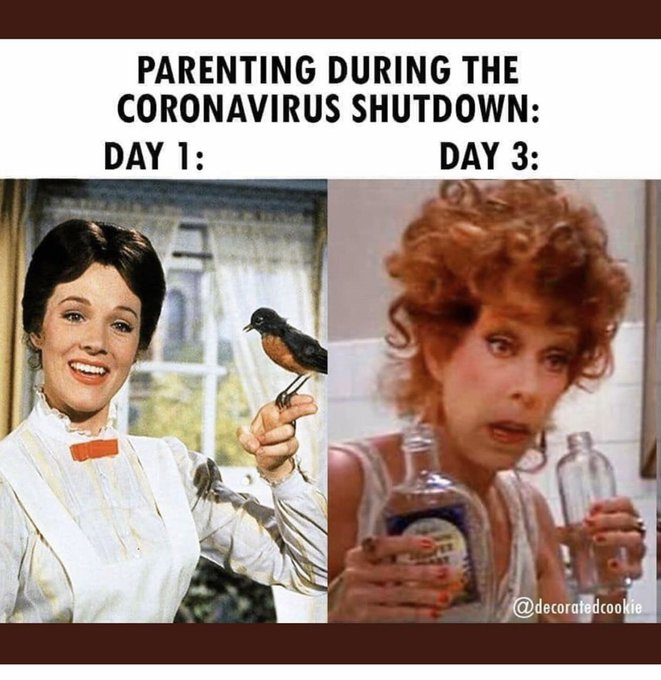
What a week! I don’t know about you, but I’m already getting tired of this new normal. Tired of sitting at my computer screen. Tired of not being able to meet someone in person for coffee. But, thank God, for social media. Because it lets me know I’m not alone. And it makes me laugh.  Here's something fun I saw posted on Twitter.


I think all of this change made me a little grouchy. If you’ve seen my Facebook feed over the past couple of days, you probably already noticed that. It kind of started on Wednesday at pantry.

Now, we have been working on trying to figure out how we do food pantry in a way that is safe. For our volunteers. And for our pantry members, especially for those who are vulnerable. So, we were able to set up this rather elaborate system last weekend. And, honestly, this week, it worked pretty good. We were able to get last minute information out to a pretty large group of people. And, inevitably, that information was shared even outside our typical pantry circles. 

On Tuesday afternoon, after our first day, I returned voice mails, while Susan worked to re-stock and set up for Wednesday. One of them was from someone outside our usual pantry circle. She lived in Prospect. Now, you and I know that Prospect, like this area, is fairly affluent. Yet you and I also know that those who are poor are often very hidden in our communities. She was calling because she had heard about us and wanted to know if she could get food for herself and her husband. I signed her up for the next day. 

Along with all of the other changes we’ve made, We have a new system of welcome. Because Susan is so warm and friendly and because her graciousness is so contagious (in a good way!), on pantry day her job is to greet everyone who comes into our parking lot. And, then, to keep everything in motion so that we don’t get behind. I do check-in. Making sure the person is in our database, making sure they wash their hands (Yes, this is a new pantry requirement!), and explaining to them how our pantry operates. So, that next day - on Wednesday - we both met that lovely woman I had talked to the afternoon before. 

Soon after we got her registered and her hands washed, she then moved into our shopping area with a helper. Susan came up to me and mentioned quietly that, as she greeted this woman, she had engaged her in conversation. And found out that her son was a pretty “big deal” at a very large church here in Louisville. A pretty “big deal.” It was this woman’s son who had referred her to our pantry. 

That next morning, after a restless and short night of sleep, I got up and did the reasonable thing - I got on Facebook. (I’ve been working really hard to stay off Facebook. But it’s hard now, because it’s one place to find connection.) So, I got on Facebook. Shared this story (without any names) and I began to rant. 

Now I’m not naming names, but you see the problem here? This lovely woman’s son - a “big deal” in a big local church - couldn’t even take his mother grocery shopping, instead referring her to a food pantry.

So, do you see why I was a little grouchy? I was really bothered by this. In fact, I was angered by it. So much so that I tossed and turned all night long, thinking about it. And, of course, I had already been reading this text for a couple days. In particular, the part in verse 38. “Watch out for the legal experts - the religious leaders,” Jesus tells the disciples. “They like to walk around in long robes. They wanted to be greeted with honor in the markets. They long for places of honor in the synagogues and at banquets. They are the ones who cheat widows out of their homes, and to show off they say long prayers. They will be judged most harshly.”  

And, I know. I should give her son the benefit of the doubt. There’s that 8th commandment, right? Perhaps, I don’t know the entire story. Perhaps, I’m jumping to very wrong conclusions. Perhaps, I’m just overreacting. I mean, most people are good people, aren’t they? Most people wouldn’t do this, would they?

And, then, I got a private message from a nurse I used to work with in Texas, who’s now a nurse practitioner. He shared a story with me of an acquaintance of his. Who posted picture after picture on Facebook of his son getting into and driving his new Maserati. Which my friend’s acquaintance had just bought for him. So, what’s a Maserati cost these days? Seventy grand? Maybe more. And yet this same acquaintance had the nerve to share a GoFundMe page on Facebook put up by his aunt, who was trying to raise $2,500. “I couldn’t believe the gall of this dude. Just give her the money and shut up,” my friend wrote. 

Is this who we have become?

I have to wonder. When I look at the empty grocery store shelves. The lines of people waiting outside the grocery store or Costco to get in and buy up everything. When I hear stories from our own pantry members who can’t find baby formula for their children. And the only stuff that’s left on the shelf are the containers of formula that cost $40/each, and there’s no way these families could afford that. Especially, not in the times we are in right now. 

Is this who we have become? 

Like the community leaders of Jesus’ day, who parade around, spouting their religion, expecting to be greeted with honor and offended if they aren’t? Cheating widows out of their homes? In the NRSV, it reads that “they devour widows’ houses.” 

Is this who we have become?

This is not who God wants us to be. 

Throughout all of the Hebrew and Christian scripture, God makes it clear that what is important is a commandment in two parts: Love God. And love neighbor. There are a lot of other little rules and regulations. Just like we have our little rules and regulations, often unspoken, in our faith and in our church. But the one commandment - the one, two-part commandment that is at the heart of everything that God teaches us, that is more important than all ritual and sacrifice, more important even than our worship, is that we love God and do justice for our neighbor. And not just the neighbor we know, but, particularly, the neighbor we don’t know. 

If we miss this big picture, we miss everything.

And, then we come to the story of the widow’s offering. When I first read this at the beginning of the week, I laughed. Because the idea of a stewardship sermon at this time, when everything seems to be crashing down around us, was a little much for me to even wrap my head around. But, as I studied this story, I found out that there’s a long line of thought around it - that this story isn’t really about Jesus lifting up this woman as a stewardship example. 

If you look closely at the story, nowhere does he really commend her for her offering. It’s more just like an observation: that she, more than the others, has simply put in the greatest percentage of her wealth, minimal as it may be.  And this line of theological thought suggests that this is really a condemnation by Jesus of a system, of a community that would allow this woman - that would expect this woman - to even have to give an offering, given her poverty. That the failure is on the part of the whole community because they have allowed these deep divisions of wealth to even exist.

Wow. That’s convicting, isn’t it?

But, let me tell you another story from this week. On Thursday, one of our faithful volunteers offered to take my place at check-in so I could get a little work done. You know, don’t you, when I’m in the sacristy changing in or out my alb, or when I’m in the office at church, I hear a lot of stuff. (Just sayin’!)

The office door sits right next to the table where we offer produce to our pantry folks. As I worked there on Thursday morning, over and over I heard pantry members as they were offered produce, turn much of it away with these words, “Why don’t you give it to someone who really needs it?” This, my friends, is the example of who we are to be. Lovers of God. And lovers of neighbor, of stranger, of those who are vulnerable. It’s why, for instance, we self-isolate. Not, if we are healthy, to protect ourselves. But, to protect those who aren’t.

Last week, I mentioned a conversation with a member in which we wondered if what was happening in our world wasn’t part of some big cosmic change. 

When I witness what I’ve witnessed this past week, all I can think is “I hope so.” Now I know that this may be a very frightening thought. That everything we know could change. Yet, we know that God will preserve and protect us. Because, simply put, God has promised to do this. And God is faithful.

So, yes, I do hope that the God, who loves us, who wants us to understand that we are connected with one other and with all creation, and the God who has promised to turn things upside down so that the widows of this world will eventually be on equal footing with the powerful - I do hope that we are in the midst of a huge cosmic change. And, mostly, I hope and pray that God is right there in the middle of it, bringing justice that rolls down like waters, and righteousness like an ever-flowing stream. 

May it be so, God. May it be so. Amen.

Preached March 22, 2020, online, for the community of Grace & Glory Lutheran Church, Goshen, KY.
Lent 4
Readings: Deuteronomy 10:12-13, Psalm 89:1-4, Mark 12:28-44.