Showing posts with label upside down. Show all posts

Sunday, March 12, 2023

God's Power: The Power and Possibility of God's Reign

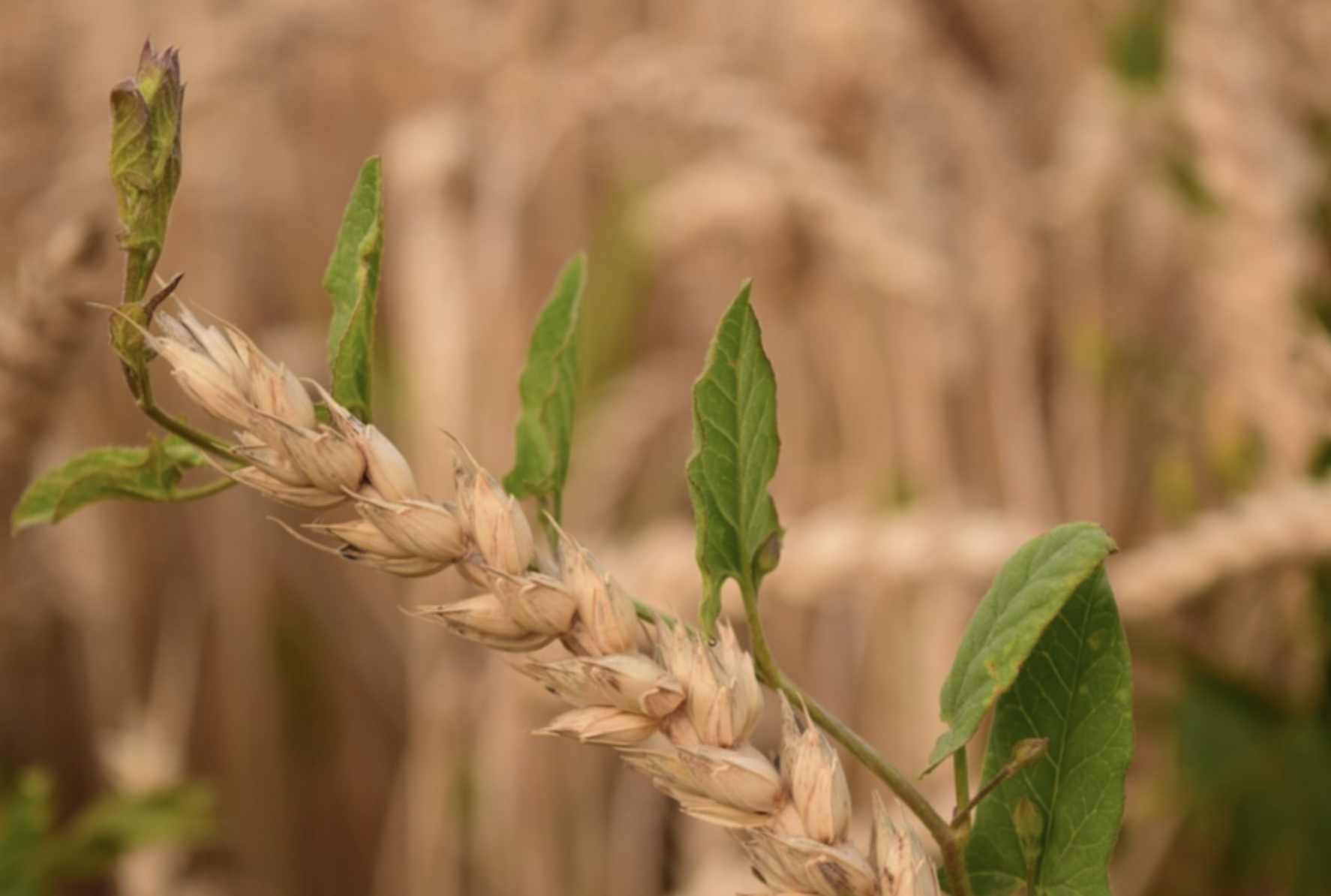
Jesus told them another parable: “The kingdom of heaven is like someone who planted good seed in his field. While people were sleeping, an enemy came and planted weeds among the wheat and went away. When the stalks sprouted and bore grain, then the weeds also appeared.

“The servants of the landowner came and said to him, ‘Master, didn’t you plant good seed in your field? Then how is it that it has weeds?’

“‘An enemy has done this,’ he answered.

“The servants said to him, ‘Do you want us to go and gather them?’

“But the landowner said, ‘No, because if you gather the weeds, you’ll pull up the wheat along with them. Let both grow side by side until the harvest. And at harvesttime I’ll say to the harvesters, “First gather the weeds and tie them together in bundles to be burned. But bring the wheat into my barn.”’”

He told another parable to them: “The kingdom of heaven is like a mustard seed that someone took and planted in his field. It’s the smallest of all seeds. But when it’s grown, it’s the largest of all vegetable plants. It becomes a tree so that the birds in the sky come and nest in its branches.”

He told them another parable: “The kingdom of heaven is like yeast, which a woman took and hid in a bushel of wheat flour until the yeast had worked its way through all the dough.”

Jesus said all these things to the crowds in parables, and he spoke to them only in parables. This was to fulfill what the prophet spoke:

I’ll speak in parables;
        I’ll declare what has been hidden since the beginning of the world.

Jesus left the crowds and went into the house. His disciples came to him and said, “Explain to us the parable of the weeds in the field.”

Jesus replied, “The one who plants the good seed is the Human One. The field is the world. And the good seeds are the followers of the kingdom. But the weeds are the followers of the evil one. The enemy who planted them is the devil. The harvest is the end of the present age. The harvesters are the angels. Just as people gather weeds and burn them in the fire, so it will be at the end of the present age. The Human One will send his angels, and they will gather out of his kingdom all things that cause people to fall away and all people who sin. He will throw them into a burning furnace. People there will be weeping and grinding their teeth. Then the righteous will shine like the sun in their Father’s kingdom. Those who have ears should hear.” --Matthew 13:24-43 (CEB)

I’d like to begin this morning by considering how we hear things. Specifically, depending on who we are or where we are, how we hear things may change. Context. Everything is about context.

Here’s an example. “Throw the book at someone.” Now, if I were a schoolteacher and I heard one of my students say that they were going to throw the book at someone, how might I hear this? How might I respond?

On the other hand, if I were in a courtroom, sitting at a defense table, and I heard the judge talk about throwing the book at someone, how might I hear that? How might I respond?

Today, we have these three parables about the reign of God. The basic meaning of the root of the word, parable, is hidden. Often, the message Jesus is trying to tell is hidden. Mysterious. He even says that in our text when he quotes Isaiah: I speak in parables. I’ll declare what has been hidden since the beginning of the world. Some consider parables to be subversive speech. That Jesus used scenes from everyday life to expose the contradiction between the actual situation of his hearers and the teachings of God’s justice. When I was in Sunday School, I was taught that a parable was an “earthly story with a heavenly meaning.” (Whatever that means!) However you want to consider them, parables are complicated. And, today, we have three of them: the parable of the wheat and the weeds. The parable of the mustard seed. The parable of the yeast. We don’t often hear them read altogether, yet that is exactly how they are placed in this thirteenth chapter of Matthew. One right after the other. Jesus moves from one parable to the next and, immediately, to the third. So, what does this mean? And what is he, through these parables, trying to say?

Again, I would suggest to you that context matters.

For example, if you were one of Jesus’ actual followers, you were likely a member of the bottom tier of society. By Jesus’ day, Israel had become part of the Roman Empire with the top tier of society, the elite of his day - including the ruler, the ruling class, those who did the empire’s bidding, priests, and, perhaps a few merchants - the elite whose primary focus was to maintain the status quo and plunder the wealth of the bottom tier of society, which included the peasants and farmers. So, from the viewpoint of the bottom tier of society, you would immediately get that something wasn’t quite right about these parables. What farmer, after all, would allow the weeds to remain beside the wheat? Or who would even want the mustard seed to grow - because it was considered an invasive plant that could do damage to good crops? Or who would mix yeast into the amount of flour identified in our text - an amount that, once baked into bread, would be the equivalent of 150 loves? Enough to feed an entire village. 

If you were one of Jesus’ listeners, you would begin to understand the upside-down nature of God’s reign. And, then, perhaps you would begin to question the nature of your world. Parables as subversive texts? Perhaps so.

Or consider if you were part of the audience to whom Matthew was writing in this gospel. The first parable might have been understood by your community as the reign of God in the world. That the separation from Israel is now complete and that you are part of the church beginning the Gentile mission. The world is now your field of endeavor, an opportunity for you, as part of Matthew’s community, to begin to bear fruit. 

Or consider if you were a follower of Origen, a third century early church father, who wrote that the parable of the wheat and the weeds was really about what was inside us. Or, to put it in a Lutheran framework - the wheat being the saint in us and that weeds being the sinner in us. 

Context matters. Where you are and who you are as you are reading these parables change their meaning. Which may be a little unsettling. Perhaps so.

But there are a few key understandings that, no matter who you are, where you are, or what time frame in which you are reading these parables, there are a few things we can notice universally about them. 

First. Notice in the parable of the wheat and the weeds who sows the seeds and who controls the reaping process. It’s neither you nor I.  But God.

Second. Notice in the parable of the mustard seed, the subversive nature of God’s reign. Notice, again, who plants the seed so small that it’s almost invisible, but that, through nurturing and care, grows into something large and beautiful that serves others, whether it's the birds of the air or the least among us. It all begins, once, again with God. 

Third. Notice that the parable of the yeast is really not about the yeast at all. It’s about the amount of flour that, along with such a small cake of yeast, can make so. Much. Bread. Such abundance that it can only be shared. An abundance that comes from God. And God alone.

This is what the reign of God looks like. Planted by God and leading to such great abundance, yet with a reminder that it is, once again, God and God alone who will create and grow and, ultimately, be the final arbiter of God’s justice. It is a reign initiated by Jesus, who affirms that it is both a present reality and a future hope. A now, but not yet. A reign that, like pregnancy, is mysterious, miraculous, comes with pain and urgency, and gives new life. A reign that pervades and transforms everything it encounters. A reign that, though we cannot see it fully now, has as its hallmarks, hospitality, generosity, and abundance.

So, whether you are part of Grace & Glory considering what the future may bring. Or whether you are a member of Third on the cusp of something bread new, may we all remember and hold fast to the truth that the reign of God is one of power and possibilities. And that we are called to come alongside and share. 

May we have ears to hear. Amen.

Preached Sunday, February 12, 2023, at Grace & Glory Lutheran, Prospect, with Third Lutheran, Louisville.
Sixth Sunday after Epiphany
Readings: Matthew 13:24-43; Psalm 84:1-7


Sunday, December 4, 2022

Living Out the Covenant: Guns and Butter

Assyria’s King Sennacherib marched against all of Judah’s fortified cities and captured them in the fourteenth year of King Hezekiah. Assyria’s king sent his field commander from Lachish, together with a large army, to King Hezekiah at Jerusalem. He stood at the water channel of the Upper Pool, which is on the road to the field where clothes are washed. Hilkiah’s son Eliakim, who was the palace administrator, Shebna the secretary, and Asaph’s son Joah the recorder went out to them.

Then the field commander stood up and shouted in Hebrew at the top of his voice: “Listen to the message of the great king, Assyria’s king. The king says this: Don’t let Hezekiah lie to you. He won’t be able to rescue you. Don’t let Hezekiah persuade you to trust the Lord by saying, ‘The Lord will certainly rescue us. This city won’t be handed over to Assyria’s king.’

“Don’t listen to Hezekiah, because this is what Assyria’s king says: Surrender to me and come out. Then each of you will eat from your own vine and fig tree and drink water from your own well until I come to take you to a land just like your land. It will be a land of grain and new wine, a land of bread and vineyards. Don’t let Hezekiah fool you by saying, ‘The Lord will rescue us.’ Did any of the other gods of the nations save their lands from the power of Assyria’s king? Where are the gods of Hamath and Arpad? Where are the gods of Sepharvaim? Did they rescue Samaria from my power? Which one of the gods from those countries has rescued their land from my power? Will the Lord save Jerusalem from my power?”

When King Hezekiah heard this, he ripped his clothes, covered himself with mourning clothes, and went to the Lord’s temple. He sent Eliakim the palace administrator, Shebna the secretary, and the senior priests to the prophet Isaiah, Amoz’s son. They were all wearing mourning clothes. They said to him, “Hezekiah says this: Today is a day of distress, punishment, and humiliation. It’s as if children are ready to be born, but there’s no strength to see it through. Perhaps the Lord your God heard all the words of the field commander who was sent by his master, Assyria’s king. He insulted the living God! Perhaps he will punish him for the words that the Lord your God has heard. Offer up a prayer for those few people who still survive.”

When King Hezekiah’s servants got to Isaiah, Isaiah said to them, “Say this to your master: The Lord says this: Don’t be afraid at the words you heard, which the officers of Assyria’s king have used to insult me. I’m about to mislead him, so when he hears a rumor, he’ll go back to his own country. Then I’ll have him cut down by the sword in his own land.”

This is what Isaiah, Amoz’s son, saw concerning Judah and Jerusalem.

In the days to come
    the mountain of the Lord’s house
    will be the highest of the mountains.
    It will be lifted above the hills;
        peoples will stream to it.
Many nations will go and say,
“Come, let’s go up to the Lord’s mountain,
    to the house of Jacob’s God
        so that he may teach us his ways
        and we may walk in God’s paths.”
Instruction will come from Zion;
    the Lord’s word from Jerusalem.
God will judge between the nations,
    and settle disputes of mighty nations.
Then they will beat their swords into iron plows
    and their spears into pruning tools.
Nation will not take up sword against nation;
    they will no longer learn how to make war. --Isaiah 36:1-3, 13-20; 37:1-7; 2:1-4 

Grace, mercy and peace to you from God, our Creator; Jesus Christ, our Redeemer; and the Holy Spirit, our Advocate and Comforter. Amen.

Guns and butter. Guns and butter. What do you think is the relationship between guns and butter? Anyone? Anyone study business? Or economics? If you could choose one over the other, which would you choose? Guns? Or butter?

There actually is a relationship between these two things - guns and butter. It comes to us from the study of macroeconomics. (Are your eyes glossing over?) The guns versus butter model shows the relationship between how much a nation invests in its security and defense. And how much it invests in butter. Or, more fully, spending on social things, investing in things that improve or increase social welfare, such as schools, hospitals, parks and roads. Every nation has to decide which balance of guns versus butter best fits its needs - a choice that can be influenced by both external and internal factors. And a choice that can have an impact not only on a nation’s people, but also who are elected as its leaders.

The phrase originated around the time of the first World War. In 1914, Chile was the leading world producer of nitrates. What are nitrates used for? Yep. Gunpowder. Chile had taken a neutral stance in the war and, although it continued to provide almost all the nitrates the US needed, it still made us a little nervous that we didn’t have control over the production. This led to the passage of the National Defense Act of 1916. This directed the administration to manufacture nitrates for fertilizer - in times of peace, and munitions in times of war. The media presented this as “guns and butter.” Guns in war time. Butter in peace.

Today’s lesson from Isaiah shows us the tension and complexity in making the choice between guns and butter. As our story opens, Jerusalem is surrounded by the Assyrian army. They’ve ravaged the countryside - knocking off, according to Assyrian history, 46 Judaen cities, all heavily fortified. People from villages surrounding Jerusalem have fled into the city. It’s overcrowded. Resources are stretched. Food is scarce. Water, too. The temple treasury has been depleted by a tribute demanded by the Assyrian king, Sennacharib. Even the king’s treasury - that of King Hezekiah - has been depleted. Jerusalem is under siege. 

At his king’s command, Sennacharib’s field commander approaches the city. King Hezekiah sends out three of his high officials. Yet, it soon becomes clear that the field commander isn’t really interested in talking to them. Instead of speaking to them in Aramaic, the language they request, he speaks to them in Hebrew - a language the people of Jerusalem will understand. Their vernacular. Why? To spread propaganda. Propaganda that is intended to invoke fear in their hearts for what will come. The guns. And propaganda intended to convince them to abandon Jerusalem -- this place of hardship and starvation -- and surrender to him to be taken to a much better place. To a land he describes in eerily familiar words. A land of grain and new wine, a land of bread and vineyards. Think “land of milk and honey.” Think butter.

How easy it would be for the people to fall into this trap! Perhaps, this is what terrifies King Hezekiah so, leading him to tear his clothes, to engage in rituals of mourning, to go to the temple. And to send his officials to seek out the prophet Isaiah. He knows how exhausted his people are. So exhausted that, as our text reads, it’s as though children are ready to be born, but there’s no strength left to see it through.

It’s an interesting verse, this birthing metaphor. It brings us back to other water and birthing images we’ve seen over these past many weeks. The birthing of a new creation from the waters of darkness and chaos. The rebirthing of our world in the story of Noah and the flood after its near total corruption. The birthing of a new nation, chosen to be a people to show all nations the way of God. Then, today’s image. Of a mother about to give birth, but so exhausted that there is little hope that the child can be born. 

Perhaps that’s where you are right now. Tired of things in the world as they are. The wars that cause vast numbers of refugees. The corruption that seems to only get worse. The many divides in our world. The lack of agreement around caring for our planet. Perhaps you are tired, too. Exhausted from the many ways we just seem to fall so sort of any possibility of peace. Much less any vision or hope for the future. 

But, there is an alternative view. A way that is not about the guns, but about the butter. A profound vision of peace. Where nations no longer learn about war. Where people are more concerned with cultivating food than producing weapons. A vision of shalom. 

That’s what we hear from the prophet Isaiah as he, literally, sees the Word of God. And sees God’s future for that remnant in Jerusalem. And for you and me, too.

What will the future hold? Guns? Or butter? 

This new age, envisioned by God, pregnant with possibilities, will take us to the mountaintop. A mountaintop that is less about a place than a way of being. That’s not about restoring the temple or Jerusalem, also high up. But, it’s about our citizenship in God’s kingdom - an upside-down kingdom led by an upside-down king. Christ, the King. Who leads not with guns, but with butter. Who comes sacrificially for us. To show us the way. A way of justice, and mercy, and peace. And who leads us to salvation - to that shalom way of life that ensures wholeness in every way for every one. So that all nations might flourish. So that all people might have fullness. So that we - you and I, included - might live. Forever. With all the butter we can imagine!

Thanks be to God! Amen.

Preached November 20, 2022, at Grace & Glory Lutheran, Prospect, with Third Lutheran, Louisville.
Christ the King Sunday
Reading: Isaiah 36:1-3, 13-20; 37:1-7; 2:1-4


Tuesday, May 12, 2020

God Works Through Us: Called to Be Saints

After this Paul left Athens and went to Corinth. There he found a Jew named Aquila, a native of Pontus, who had recently come from Italy with his wife Priscilla, because Claudius had ordered all Jews to leave Rome. Paul went to see them, and, because he was of the same trade, he stayed with them, and they worked together—by trade they were tentmakers. Every sabbath he would argue in the synagogue and would try to convince Jews and Greeks. --Acts 18:1-4 (NRSV)

To God’s church that is in Goshen: To those who have been made holy to God in Christ Jesus, who are called to be God’s people, together with all those who call upon the name of our Lord Jesus Christ in every place—he’s their Lord and ours, grace to you and peace from God our Father and the Lord Jesus Christ.

With just a simple tweak, this is the very same greeting used by Paul in his letter to address those in the Corinth congregation, a portion of which we will hear in just a moment. And a letter that we will be spending the next three weeks in. 

We believe that this letter was written a couple of years after Paul had left Corinth. He first arrived there in approximately 50 CE. Scripture tells us that he stayed there for a “considerable time.” It’s estimated he was there for about a year-and-a-half. At first, he was duo-vocational, meaning he worked both as an apostle and as a tent-maker along with Aquila and Priscilla, two Jewish Christians who had been expelled from Rome, along with others. Tent-making was Paul’s trade. We often think of him as an elite, highly educated as a Pharisee. But, by trade, he was working class. So, he began his stay in Corinth working in his trade and spreading the good news. While Paul was there, he received an offering that had been taken up by the churches in Macedonia (including from the church in Thessalonica in last week’s story). This allowed him at some point during his stay to begin preaching and teaching full-time.

Corinth was an important city. It was located in a strategic location, on a road that connected two ports on the Isthmus of Corinth. This isthmus connected the Peloponnesian peninsula with the rest of Greece. Merchants would arrive in one of the ports, unload their cargo and transport it across the land, through Corinth, to the other port. It was a preferred route, much easier and faster than sailing around the entire peninsula. Corinth was also a strategic political and military location for the Romans. It was the seat of the governor of the entire Roman province of Achaea. So, Corinth was a large, important, powerful, prosperous, diverse, busy, cosmopolitan city. And it was here that Paul settled for some time to build and pastor this young congregation.

In our Acts narrative, we see a growing, vibrant congregation. After some time, Paul left Corinth and moved on to Ephesus. In the time between his departure from Corinth and his letter in 1st Corinthians, the church in Corinth was visited by another Christian preacher named Apollos. It began to face various internal tensions and quarrels and experience much division. So, they wrote a letter to Paul asking for guidance in how to deal with these issues. Paul’s letter, and subsequent letters, are his attempt to deal with these very practical issues. But along with practice advice are deep and important theological statements. Let’s listen now to the first part of 1st Corinthians, chapter 1.

Now I encourage you, brothers and sisters, in the name of our Lord Jesus Christ: Agree with each other and don’t be divided into rival groups. Instead, be restored with the same mind and the same purpose. My brothers and sisters, Chloe’s people gave me some information about you, that you’re fighting with each other. What I mean is this: that each one of you says, “I belong to Paul,” “I belong to Apollos,” “I belong to Cephas,” “I belong to Christ.” Has Christ been divided? Was Paul crucified for you, or were you baptized in Paul’s name? Thank God that I didn’t baptize any of you, except Crispus and Gaius, so that nobody can say that you were baptized in my name! Oh, I baptized the house of Stephanas too. Otherwise, I don’t know if I baptized anyone else. Christ didn’t send me to baptize but to preach the good news. And Christ didn’t send me to preach the good news with clever words so that Christ’s cross won’t be emptied of its meaning.

The message of the cross is foolishness to those who are being destroyed. But it is the power of God for those of us who are being saved. --1 Corinthians 1:10-18 (NRSV)

The central problem in the Corinth church revolved around status. Whether those converted by Paul were the most important? Or those by Apollos? Or even those by Cephas, who we also know as Peter. Each group wanted to be first. Most important. The highest status. This need for status was something that they had learned from the surrounding culture in Corinth, which was filled by those with “new money.” The cultural lessons were those of individualism, of self-importance, of the status one achieved by pulling oneself up by their own bootstrap. Get the picture? Sound at all familiar?

The first part of Paul’s message to the Corinth church was to remind them that they were both holy and called to be saints. To be called has the same sense as being holy. And holiness is not a quality of the individual, but a communal state into which we are placed by our baptism. Paul never uses the word “holy” in reference to the singular of the individual Christian, but always in reference to community. That holiness, that sanctification, that becoming God’s disciples happens in community. Our salvation is wrapped up together, as a community, as the broader church, and ultimately with that of all creation. Paul’s message and that of Christ is not about our individual salvation, but about the salvation of the whole community.

 It is this communal idea, then, that moves Paul to his message of the cross. Of the foolishness of the cross. That a condemned and crucified man, one with the lowest possible status in the world, would be God’s vehicle for this communal salvation. This message of the cross was intended to teach the believers in Corinth (and us) that God’s status markers are not those of the world. These markers of the world - class, wealth, wisdom, rhetorical skill, physical strength, beauty are the status markers important to the world. By contrast, God chooses and places the highest status on those whom the world despises: the weak, the lowborn, the foolish, the poor. Paul’s argument to the church in Corinth doesn’t eliminate the status hierarchy. It inverts it. It turns the world’s status markers upside down. So that the last or the lowest of the world are now the first and highest. This is how our communities are to be. Embracing the message of the cross. Embracing it’s foolishness in the eyes of the world.

What might this mean for us in our current time? As there are so many questions to think through? As the world seems, as usual, to be so divided? Are we all to agree? Is this what Paul is telling us?

I don’t think so. But, what I do believe Paul is saying to us is that even in our disagreements it is important for us to understand and to know, first, where our ultimate allegiance is to lie. It’s not with the world, or with other human leaders, even with your pastor. But our allegiance must be centered, must be grounded in Christ. Christ is our leader. Perhaps this is why God deemed it so important to come to us in human form. Because our natural tendency is to attach ourselves to human leaders. But Paul asks the question, “Was I crucified for you?” We might ask that same question of those human leaders we follow. If our answer is no - and it can only be no - then, we know where our source lies.

Then, finally, Paul calls us to embrace the logic of the cross. To, as a community, accept weakness and humility as marks of God’s favor. And that, in so doing, to seek to eliminate and end the status-seeking behavior that is taught by the world, that is so easy to fall into, often unknowingly. 

Perhaps if we do this, if we both remember where our allegiance is to lie and then to seek to engage and discern our answers to the questions and disagreements in our community, then we, as Paul reminds the church in Corinth - perhaps then, we and they, might recognize that we are already of the highest status in God’s eyes. Already rich. Already been given the gift of life and all we need through the abundant grace and love of God through Christ Jesus. 

What more do we need? 

Preached May 10, 2020, online at Grace & Glory Lutheran Church, Goshen, KY.
Easter 5
Readings: Mark 9:34-35; Psalm 54; Acts 18:1-4, 1 Corinthians 1:10-18.