Tuesday, November 15, 2022

Living in the Covenant: Micah and What God Wants

Listen, all you peoples!
        Pay attention, earth, and all that fills it!
    May the Lord God be a witness against you,
            the Lord from his holy temple.
Look! The Lord is coming out from his place;
        he will go down and tread on the shrines of the earth.
Then the mountains will melt under him;
        the valleys will split apart,
            like wax yielding to the fire,
            like waters poured down a slope.
All this is for the crime of Jacob
        and the sins of the house of Israel.
        Who is responsible for the crime of Jacob?
                Isn’t it Samaria?
            Who is responsible for the shrines of Judah?
                Isn’t it Jerusalem?

As for you, Bethlehem of Ephrathah,
    though you are the least significant of Judah’s forces,
        one who is to be a ruler in Israel on my behalf will come out from you.
    His origin is from remote times, from ancient days.
Therefore, he will give them up
        until the time when she who is in labor gives birth.
        The rest of his kin will return to the people of Israel.
He will stand and shepherd his flock in the strength of the Lord,
        in the majesty of the name of the Lord his God.
        They will dwell secure,
        because he will surely become great throughout the earth;
        he will become one of peace.
When Assyria invades our land and treads down our fortresses,
        then we will raise up against him seven shepherds and eight human princes.

With what should I approach the Lord
        and bow down before God on high?
Should I come before him with entirely burned offerings,
        with year-old calves?
Will the Lord be pleased with thousands of rams,
        with many torrents of oil?
Should I give my oldest child for my crime;
        the fruit of my body for the sin of my spirit?
He has told you, human one, what is good and
        what the Lord requires from you:
            to do justice, embrace faithful love, and walk humbly with your God. 
--Micah 1:3-5, 5:2-5a, 6:6-8 (CEB)

Grace, mercy, and peace to you from the holy Trinity - Creator, Redeemer, Sustainer. Amen.

Elections. How are you doing in the aftermath of Tuesday’s election? Perhaps all you want is to not hear about elections for a long, long time. Perhaps you want to say to me, “Are you serious? Haven’t we had enough election stuff to last us for a good, long while? Just be done with it."

And I get that. But, with my son, both of us being political nerds, we've have spent the last several days reading and sharing back and forth nearly everything we can get about why people voted the way they did.

The exit polls are interesting. As accurate as polls can be. They give us some sense of where voters are. For example, 38% of voters thought the Democratic party was too extreme. And, lest you become arrogant, 39% of voters thought the Republic party was also too extreme.

Then there are voter’s priorities and attitudes. According to a recent poll, about 45% of voters who supported a top GOP House candidate called inflation their number 1 issue from a list of 5. Fifteen percent chose immigration and fewer than that picked any other issue as their top priority. But among voters who backed the Democratic candidate, about 43% called abortion their top issue, with 18% picking inflation and fewer than 15% picking any other issue.

Overall, roughly a third of voters cited inflation as their reason for voting. A third of voters cited the stripping away of a key right for women. And a third of voters cited fear for the future of our democracy as their key issues. As reasons for voting.

Yet, regardless of the issues, or the partisanship, or the way people voted, elections are always a referendum on leadership. On how well leaders are or aren’t doing what they were elected to do. You could say that elections are an indictment of our leadership.

So, too, with the book of Micah, which is at the center of our worship today. It is a referendum on leadership. An indictment by God spoken through the prophet Micah directed toward the leaders of Israel. 

So, who is Micah? Well, to begin with, we call him one of the minor prophets.  Do you know who some of the other minor prophets are? Well, to make it easier, let’s think of who the major prophets would be. Prophets like Isaiah. Or Jeremiah. Or Ezekiel. 

Then, who might be a minor prophet? Think Daniel, Hosea, Joel, Amos, Obadiah, Jonah. Micah! And there are a few more, a dozen to be exact. We categorize the prophetic books in scripture as either major or minor, not because of how good or skilled the prophet was. But, simply, by the volume of writings we have by them. Isaiah, for example, consists of 66 chapters. By contrast, Obadiah has one chapter, divided into 21 verses. 

Micah was a prophet from the southern kingdom of Judah. If you recall, under King Solomon, the nation of Israel had split in two. The northern kingdom, which had retained the name Israel, built its capital in the city of Samaria. The southern kingdom, now known as Judah, kept its capital city, Jerusalem. Each of the two nations were ruled by a series of kings until, in 720 BCE, Israel, the northern kingdom, was destroyed by the Assyrian Empire. It now had Jerusalem in its sights. Micah, over his lifetime, was a witness to all of this. And, seeing the handwriting on the wall, directed his messages primarily toward Jerusalem. A wake-up call for her leaders.

That’s what we hear in the first three chapters of this prophetic book. A critique of those leaders who, in reality, do not know justice, who hate the good and love the evil. It's a troubling indictment from Micah who uses very visual imagery to enhance his critique about how they have been preying upon the powerless: torn flesh, protruding bone, broken bone, and human flesh cut and boiling in a cauldron.

But, are all the leaders corrupt? That’s the nagging question in this first part of Micah, which looks carefully at everyone--rulers, priests, and prophets alike. In so many other prophetic writings, we hear about the external forces that are bearing down on the two kingdoms. But, here we are warned about the internal forces that destroy a nation: the internal longing for power that comes from within those who have authority and positions of leadership in the community. Over and over the critique is that they - all of the leaders - can be bought for a price. And that when their priorities are about gaining power and riches for themselves and not justice for the community they serve, they destroy the people who depend upon them. As if they are ripping off the skin of their people, breaking their bones, and chopping them up like meat for soup. 

Don’t they see this, these leaders? According to the prophet that’s what’s most terrifying - that the lure of power and the abuse of that power is so seductive and so deceptive that they are not even aware that they have become entrapped by it. These prophetic words of Micah in these first three chapters have us fully convinced that there is no hope for this corrupt community. That its destruction is inevitable. 

But, "as for you," the fifth chapter begins. But, "as for you, Bethlehem of Ephrathah." This is the hope we find in these words of the Prophet Micah. In these words about tiny Bethlehem. This small village from which will come great things. This town of David. From which will come the fulfillment of God's covenant with David, the promise that his kingly reign, his line, will never end.  “From you, Bethlehem of Ephrathah, will come a ruler whose origin is from old, from ancient days.” 

Into the midst of political turmoil and upheaval of Micah’s time we hear words that speak to the longing we all have, a longing for ourselves and for the communities in which we live. A longing for security and for peace. Peace and security that often comes from the most insignificant, small and surprising places. 

But, then, what do you want from us, God? That’s the question Micah sets out to answer in these closing words of his book - those words we know so well that we might even have them hanging on our walls at home. He begins chapter 6 by asking this question in two parts. 

First, how should we then approach and bow down before God? How should we make sacrifice - or in our language, how should we worship God? Should we bring a year-old calf? Or perhaps greater sacrifice - an extraordinarily generous one - thousands of rams, torrents of oil? Perhaps that is not enough, what about our firstborn children? Is that enough to please God? What, God? What do you want from us?

It's here that Micah reminds the people - and us - of all that God has done. The wondrous act of deliverance as Israel was led out of bondage. The wondrous victory given to us through that king out of Bethlehem - our Lord and Savior, Jesus Christ. “Don’t you know the story?” God asks them. And us. “Haven’t you heard about my saving acts? Don't you yet know how to be my people?”

Your extravagant gifts. Your gilded and excessive worship. Not what God wants. And not that worship is a bad thing. Empty worship is a bad thing. Worship that does not lead to the transformation of our hearts - that doesn’t lead us to act. What God wants is deceptively simple. One. Two. Three. 

Do justice. Preserve the rights of everyone in the community.

Embrace faithful love. Love in God’s timeless and unconditional way.

Walk humbly with God. Be aware of your need for God, who journeys with us as a partner throughout each of our lives. 

Three simple things. 

Is this possible, we might wonder? Is it possible to be that committed, that inclusive, that loving? It becomes clear to us that God doesn’t want what we own. God wants who we are. Or, at the very least, God wants the world to see whose we are.

Simple. But, oh, so difficult. Only possible with the help of God.

May it be so, God. May it be so. Amen.


Preached November 13, 2022, at Grace & Glory, Prospect, with Third, Louisville.
23rd Sunday after Pentecost
Reading: Micah 1:3-5; 5:2-5a; 6:6-8

Thursday, November 10, 2022

Living in the Covenant: Elisha Heals Naaman

It’s easy for us, when we read First and Second Kings, to think of this as a history of Israel. And while these books do tell the story of Israel and the succession of its kings, the author isn’t writing just for the sake of history. The author is as much a theologian (trying to understand things) as he is a historian. He’s writing a prophetic history of how the word of God in the Torah and the prophets was the true story of Israel’s God. So, Kings is written from the perspective of someone living long after the exile of the northern kingdom, the destruction of Jerusalem in the south, and the exile to Babylonian. This theological history seeks to explain why Israel and Judah are in exile - because their kings and their people have resisted the word of God and persisted in their rebellion. Leading all the way up to exile. 

It’s the story we have heard from the beginning of our readings this fall. God creates a world of beauty and shalom for all of God’s creation. Humanity strays and resists God. Then God works to bring us back into relationship. Over and over and over again. This is the story of the Bible. The narrative arc of scripture.

Today, we read a story about Elisha. Elisha, not Elijah. Elisha was the successor prophet to Elijah. This is a hinge text - helping us make our shift from the monarchy - the reign of Israel’s kings - to the prophets, sent by God to confront and correct Israel’s leaders. They were unsuccessful. Israel’s leaders continued to persist in patterns of idolatry, injustice, and rebellion until finally they were completely wiped out. The kings were wiped out. A remnant of the people would continue. A people who would ache for something or someone better.

But, today and for the next two Sundays, we hear stories of the prophets. 

Naaman, a general for the king of Aram, was a great man and highly regarded by his master, because through him the Lord had given victory to Aram. This man was a mighty warrior, but he had a skin disease. Now Aramean raiding parties had gone out and captured a young girl from the land of Israel. She served Naaman’s wife.

She said to her mistress, “I wish that my master could come before the prophet who lives in Samaria. He would cure him of his skin disease.” So Naaman went and told his master what the young girl from the land of Israel had said.

Then Aram’s king said, “Go ahead. I will send a letter to Israel’s king.”

So Naaman left. He took along ten kikkars of silver, six thousand shekels of gold, and ten changes of clothing. He brought the letter to Israel’s king. It read, “Along with this letter I’m sending you my servant Naaman so you can cure him of his skin disease.”

When the king of Israel read the letter, he ripped his clothes. He said, “What? Am I God to hand out death and life? But this king writes me, asking me to cure someone of his skin disease! You must realize that he wants to start a fight with me.”

When Elisha the man of God heard that Israel’s king had ripped his clothes, he sent word to the king: “Why did you rip your clothes? Let the man come to me. Then he’ll know that there’s a prophet in Israel.”

Naaman arrived with his horses and chariots. He stopped at the door of Elisha’s house. Elisha sent out a messenger who said, “Go and wash seven times in the Jordan River. Then your skin will be restored and become clean.”

But Naaman went away in anger. He said, “I thought for sure that he’d come out, stand and call on the name of the Lord his God, wave his hand over the bad spot, and cure the skin disease. Aren’t the rivers in Damascus, the Abana and the Pharpar, better than all Israel’s waters? Couldn’t I wash in them and get clean?” So he turned away and proceeded to leave in anger.

Naaman’s servants came up to him and spoke to him: “Our father, if the prophet had told you to do something difficult, wouldn’t you have done it? All he said to you was, ‘Wash and become clean.’” So Naaman went down and bathed in the Jordan seven times, just as the man of God had said. His skin was restored like that of a young boy, and he became clean.

He returned to the man of God with all his attendants. He came and stood before Elisha, saying, “Now I know for certain that there’s no God anywhere on earth except in Israel. Please accept a gift from your servant.”

But Elisha said, “I swear by the life of the Lord I serve that I won’t accept anything.”

Naaman urged Elisha to accept something, but he still refused. Then Naaman said, “If not, then let me, your servant, have two mule loads of earth. Your servant will never again offer entirely burned offerings or sacrifices to any other gods except the Lord. But may the Lord forgive your servant for this one thing: When my master comes into Rimmon’s temple to bow down there and is leaning on my arm, I must also bow down in Rimmon’s temple. When I bow down in Rimmon’s temple, may the Lord forgive your servant for doing that.” (2 Kings 5:1-18 CEB)

Grace, mercy and peace to you from God, our Creator, and from our Lord and Savior, Jesus Christ. Amen.

Easy peasy lemon squeezy. Ever heard that rhyming phrase before? I heard it for the first time when I was living in Minnesota. Let me tell you - you’ve never really heard it until you’ve listened to someone with a nasally, Midwestern accent say it. You know that “Minnesota friendly accent.” Easy peasy, lemon squeezy. 

Speaking of easy. Do you remember the marketing campaign by Staples office supply store several years ago that had “Easy” as its tag line? I had one of those “easy” buttons on my desk at work. And whenever someone would come into my office and ask me an easy question or for something that was easy for me to do, I would punch the button and say, Easy peasy, lemon squeezy!

But, seriously, we do like things easy peasy, lemon squeezy. In fact, our society is driven by ease and convenience. From fast food. To online banking. To Amazon orders. We want things to be quick and easy. If something is too cumbersome or time-consuming, we shy away from it. And try to find alternatives. Easier alternatives. 

Yet, at the same time, if something is too easy, what do we do? Well, we don’t trust it. Ever heard a conversation like this? Well, that was easy. Yeah, a little too easy if you ask me. Don’t get your hopes up. Haven’t you ever heard the phrase that if something is really worth having, it’s worth waiting for. Or worth the extra effort. Parents, how often have you said that to your kids?

That paradox is what we find in today’s story from Second Kings. 

Naaman is introduced to us as a “great man” and “highly regarded” by his master, King Aram. He is a warrior. A mighty warrior. Who has brought great success to this king of Aramea, one of Israel’s fiercest enemies. He is successful, respected, victorious in battle. If we look closely at these introductory verses we see that, in fact, he has won these battles because the LORD has given victory to him and to the Arameans. The LORD. Immediately we get a sense of the universality of this story - of how God acts not just through God’s own people, but through other nations, as well. And their leaders. Even when they are not aware that God is working through them.

But, Naaman has a nagging problem. He has a skin disease. Robert Alter calls it “skin blanch,” meaning he lacks pigmentation in his skin. 

Because of his “success” on the battlefield, Naaman has a very close relationship with his king. It is also because of one of those same “successes” that Naaman has captured a young Israelite girl who has been brought into his household as a slave to his wife.

The young woman, unnamed and unnoticed, makes a comment to his wife: “I wish that my master could come before the prophet who lives in Samaria. He would cure him of his skin disease.” The word gets to Naaman, who hears the suggestion, but doesn’t really listen to it. Because, rather than go to the prophet, as she suggests, he goes to his king. Which is how the trouble begins. 

The king agrees to send a letter to Israel’s king. Along with it he prepares an incentive. Ten kikkars of silver - worth $252,565 as of yesterday. And 6,000 shekels of gold - at yesterday’s value of $3,530,100. Plus ten changes of clothing. I have no number on that today, but, trust me, they were valuable in that time! So, here’s this huge incentive for Israel’s king to help Naaman be cured. And what happens? The king - interestingly unnamed here - misconstrues King Aram’s action. There’s no love lost between these two nations. Immediately, he suspects a trap. That, when he fails to heal Naaman, the Arameans will attack. 

Enter Elisha. He intervenes to suggest that Naaman come directly to him. And he does. Our text says that Naaman - with his horses and chariots, a full military contingent. (Was it any wonder that Israel’s king was afraid?) - Naaman goes to Elisha’s house and waits outside.

Rather than come out and prescribe healing directly to Naaman, Elisha sends a messenger with a cure. Go wash in the Jordan seven times. Easy peasy lemon squeezy! Naaman is angry. “Couldn’t this cure be a little grander?” he wonders. Why not wash in the rivers in Damascus, which are so much better than the little, muddy Jordan? But, his servants - his servants - talk him down. He goes. And is healed. And converted. “Now I know for certain that there’s no God anywhere on earth except in Israel.”

Do you notice that conversion isn’t required for healing? In fact, the healing comes first. With no demand from Elisha that Naaman worship God. His worship of God comes from his being healed. His being made whole.

Do you also notice the unexpected voices in this story? Those small, seemingly insignificant players? The slave girl. Naaman’s servants. They are ones - rather than those with power and wealth - through whom God seems to be working most fully to ensure Naaman’s healing. How many times do we see this in scripture? How God works through the most powerless to move God’s reign forward.

How have you experienced God working through the unexpected voices, the small, seemingly insignificant saints in your life? Those offering a well-placed word of hope? Or those who simply modeled faithfulness for you? Those are the ones who, especially today, we are remembering. The quiet voices of those most often insignificant to our world. 

But, not to God. Because these are the ones - we heard earlier - these are the ones who made it through the great ordeal. Who now live that promised life of shalom. A life a wholeness. A life of peace and joy. A life in the very presence of God. A life that we will experience one day, too.

Or as St. Paul writes, For now we see in a mirror, dimly, but then we will see face to face. Now we know in part; then we will know fully, even as we have been fully known. (1 Cor. 13:12 NRSV)

May God grant it. Amen.

Preached November 6, 2022, at Grace & Glory, Prospect, with Third, Louisville.
All Saints Sunday
Reading: 2 Kings 5:1-18


Living in the Covenant: Solomon's Wisdom

Last week, we heard the story of David and his sin against Bathsheba, her husband, Uriah, and, particularly, about David’s sin before God. We heard him confronted in his sin by the Prophet Nathan. His repentance. And God’s forgiveness.

Yet, as I also mentioned, forgiveness does not always mean escaping the consequences of one’s sin. The dysfunctional aspects of David’s actions led to the death of that first child he had with Bathseba, the sexual assault of a daughter by one of his own sons, the murder of that son by another, and a third son who attempted to overthrow David and who lost his own life in the process. 

Today’s reading is about King Solomon. He was the second son of David and Bathsheba. He was not David’s oldest son so, according to tradition, should never have become king. But, unlike last week, when we saw Bathsheba with no agency, by the time a successor to David must be named, she claims her agency to ensure that the line of succession will be turned upside down. And that her son - Solomon - will ascend to the throne. After a great deal of political turmoil, Solomon has taken the reigns of the kingdom - most likely as a teenager. It is here where the reading begins.

The king went to the great shrine at Gibeon in order to sacrifice there. He used to offer a thousand entirely burned offerings on that altar. The Lord appeared to Solomon at Gibeon in a dream at night. God said, “Ask whatever you wish, and I’ll give it to you.”

Solomon responded, “You showed so much kindness to your servant my father David when he walked before you in truth, righteousness, and with a heart true to you. You’ve kept this great loyalty and kindness for him and have now given him a son to sit on his throne. And now, Lord my God, you have made me, your servant, king in my father David’s place. But I’m young and inexperienced. I know next to nothing. But I’m here, your servant, in the middle of the people you have chosen, a large population that can’t be numbered or counted due to its vast size. Please give your servant a discerning mind in order to govern your people and to distinguish good from evil, because no one is able to govern this important people of yours without your help.”

It pleased the Lord that Solomon had made this request. God said to him, “Because you have asked for this instead of requesting long life, wealth, or victory over your enemies—asking for discernment so as to acquire good judgment— I will now do just what you said. Look, I hereby give you a wise and understanding mind. There has been no one like you before now, nor will there be anyone like you afterward. I now also give you what you didn’t ask for: wealth and fame. There won’t be a king like you as long as you live. And if you walk in my ways and obey my laws and commands, just as your father David did, then I will give you a very long life.”

Solomon awoke and realized it was a dream. He went to Jerusalem and stood before the chest containing the Lord’s covenant. Then he offered entirely burned offerings and well-being sacrifices, and held a celebration for all his servants.

Sometime later, two prostitutes came and stood before the king. One of them said, “Please, Your Majesty, listen: This woman and I have been living in the same house. I gave birth while she was there. This woman gave birth three days after I did. We stayed together. Apart from the two of us, there was no one else in the house. This woman’s son died one night when she rolled over him. She got up in the middle of the night and took my son from my side while I was asleep. She laid him on her chest and laid her dead son on mine. When I got up in the morning to nurse my son, he was dead! But when I looked more closely in the daylight, it turned out that it wasn’t my son—not the baby I had birthed.”

The other woman said, “No! My son is alive! Your son is the dead one.”

But the first woman objected, “No! Your son is dead! My son is alive!” In this way they argued back and forth in front of the king.

The king said, “This one says, ‘My son is alive and your son is dead.’ The other one says, ‘No! Your son is dead and my son is alive.’ Get me a sword!” They brought a sword to the king. Then the king said, “Cut the living child in two! Give half to one woman and half to the other woman.”

Then the woman whose son was still alive said to the king, “Please, Your Majesty, give her the living child; please don’t kill him,” for she had great love for her son.

But the other woman said, “If I can’t have him, neither will you. Cut the child in half.”

Then the king answered, “Give the first woman the living newborn. Don’t kill him. She is his mother.”

All Israel heard about the judgment that the king made. Their respect for the king grew because they saw that God’s wisdom was in him so he could execute justice. (1 Kings 3:4-28 CEB)

Grace, mercy, and peace to you through God our Father and through our Lord and Savior, Jesus Christ. Amen.

Imagine if Aladdin appeared here today right in our midst. You are offered three wishes. What are your wishes?

There are many tales throughout history of some supernatural power that offers someone a wish. Or two. Or three. I’m a child of the 70’s - remember “I Dream Of Jeannie? Of course, there is also Aladdin, who I just mentioned. Can you think of any others?

Then there's the story about the married couple? Both of them were 60 years old and celebrating their 35th wedding anniversary. During their party, they were given a gift. They opened it and found a lamp. Out popped a genie who congratulated them on their anniversary, then offered each of them one wish. The wife wanted to travel around the world. Poof! Into her hand popped tickets for a world cruise. Then, the genie turned to her husband to ask what he wanted. His response? “I wish I had a wife 30 years younger than me.” The genie picked up his wand and “poof!” The husband was immediately 90 years old. (Sometimes we need to be very careful for what we wish!)

Now God isn’t a magic genie or a magic piggy bank - even though we might like to think so. But, in today’s story, God comes to Solomon - this teenage king - and actually says, “Ask for anything you want. And I’ll give it to you.” I wonder if I, as a teenager, would have had the presence of mind to ask for what Solomon did - a “discerning mind.” More literally in Hebrew - a “listening heart.” 

In Hebrew, the heart was not the place of feelings or emotions, as we think today. But the center of understanding and will. It’s the heart that determines what our spiritual direction will be. It’s also the heart where God influences and determines who we will be. So, to ask for a “listening heart,” Solomon is asking for unity between himself and God. And that this unity would influence his own reign as king.

It was a pretty impressive request, coming from one so young. God was pleased by it. And, in addition to giving Solomon that “listening heart” God also gave him other things - things Solomon didn’t ask for. Wealth. Fame. And a promise that, if Solomon would continue in God’s ways, he would life a long life, just like his father, David.

Then, in the second half of today’s story, this listening heart is immediately put to the test with the story of the two sex workers.

It’s important for us to understand that, being a sex worker or a prostitute in ancient Israel did not carry with it the same moral judgment then as it does today. It likely meant that both of these women were widowed, with no family and, thus, no means of support other than prostitution. They lived together. Each with a baby.

We might wonder why Solomon’s first test concerns women, especially women who were single parents and sex workers. Perhaps it’s because, at least for God, justice belongs as much with the wealthy and the powerful as it does with the least in our society. And it is a wise leader who will work to ensure that everyone - rich or poor, powerful or powerless - that everyone experiences justice.

Very soon, we will be casting our votes in an election. If one measure of justice in a society is the well-being of the most vulnerable, might this be something for us to consider as we go about the business of electing leaders? Who is the best choice on the ballot for a leader that will work to ensure that everyone experiences justice? Who should we vote for - the leader that protects only our interests? Or the leader with wisdom who protects the interests of everyone, who works to ensure that social and economic inequities will be addressed and that no one will be ignored? 

Or as one theologian writes, “Wisdom arrives when the soul discerns its destiny, when life aligns in sync with the soul. Wisdom pleases the Lord when it is not self serving, but other serving.” 

Solomon will make many mistakes in his reign. Yet, he is given the gift of wisdom - a discernment that allows his soul to be in sync with God. But he is not the only one in our story with wisdom. So, too, is the heart of the true mother of the child. And, isn't she, perhaps, the real hero of this story? That she, for the sake of her son, is willing to give up her life with him? This is the same Wisdom - the same, self-sacrificing love - that we experience from God through Christ Jesus. Who came to us, to be with us, to serve us - that we, too, might live lives of service, especially to those most in need.

This year, as we go to the ballot box, may this, like Solomon, be our wish, too - that our hearts might be fully in sync with God. And our actions, as well. May God grant it, through Christ Jesus. Amen.

Preached October 30, 2022, at Grace & Glory, Prospect, with Third, Louisville.
Reformation Sunday
Reading: 1 Kings 3:4-28


Tuesday, October 25, 2022

ReMember: David's Regret

In the spring, when kings go off to war, David sent Joab, along with his servants and all the Israelites, and they destroyed the Ammonites, attacking the city of Rabbah. But David remained in Jerusalem.

One evening, David got up from his couch and was pacing back and forth on the roof of the palace. From the roof he saw a woman bathing; the woman was very beautiful. David sent someone and inquired about the woman. The report came back: “Isn’t this Eliam’s daughter Bathsheba, the wife of Uriah the Hittite?” So David sent messengers to take her. When she came to him, he had sex with her. (Now she had been purifying herself after her monthly period.) Then she returned home. The woman conceived and sent word to David.

“I’m pregnant,” she said.

So the Lord sent Nathan to David. When Nathan arrived he said, “There were two men in the same city, one rich, one poor. The rich man had a lot of sheep and cattle, but the poor man had nothing—just one small ewe lamb that he had bought. He raised that lamb, and it grew up with him and his children. It would eat from his food and drink from his cup—even sleep in his arms! It was like a daughter to him.

“Now a traveler came to visit the rich man, but he wasn’t willing to take anything from his own flock or herd to prepare for the guest who had arrived. Instead, he took the poor man’s ewe lamb and prepared it for the visitor.”

David got very angry at the man, and he said to Nathan, “As surely as the Lord lives, the one who did this is demonic! He must restore the ewe lamb seven times over because he did this and because he had no compassion.”

“You are that man!” Nathan told David. “This is what the Lord God of Israel says: I anointed you king over Israel and delivered you from Saul’s power. I gave your master’s house to you, and gave his wives into your embrace. I gave you the house of Israel and Judah. If that was too little, I would have given even more. Why have you despised the Lord’s word by doing what is evil in his eyes? You have struck down Uriah the Hittite with the sword and taken his wife as your own. You used the Ammonites to kill him. Because of that, because you despised me and took the wife of Uriah the Hittite as your own, the sword will never leave your own house.

“This is what the Lord says: I am making trouble come against you from inside your own family. Before your very eyes I will take your wives away and give them to your friend, and he will have sex with your wives in broad daylight. You did what you did secretly, but I will do what I am doing before all Israel in the light of day.” --2 Samuel 11:1-5, 12:1-12 (CEB)


Grace, mercy and peace to you from God, our Creator, and our Lord and Savior, Jesus Christ. Amen.

Three in one. Three in one women in our culture today will be sexually assaulted. And though the numbers are not good for men either and I do not want to negate the very real experience of boys and men who also experience sexual assault, it is women and girls who are, too often, disbelieved in our world today.

This is not a text that I want to preach today. It is not a text that I even wanted to read today. Because this is a text about rape and an attempt by the perpetrator to cover up and escape from consequences of his actions. But, more than this, it is the story of what happens to leaders - and to us - when we forget our place in the order of creation. In God’s order of creation.

As today’s story opens, there is an immediate foreshadowing of the horror of things to come. “In the spring,” we read. “In the spring, when kings go off to war…David remained in Jerusalem.” David has become, as Robert Alter writes, a “sedentary king.” Lazy, not fulfilling his obligations or responsibilities as king, sending others to do his work. This is hinted at in verse 2 of our text that tells us that David - in the evening - gets out of bed. A traditional siesta would begin shortly after the noontime meal. This means that David has been in bed for hours before he finally gets up in the cooler evening to stroll on the palace roof - a building placed high on the hill so that the king could look out over all Jerusalem. The only other example we have in scripture of a king walking on the roof of his palace is that of Nebuchadnezzar who, while on the roof, proclaims, “Look at Babylon! I built this great city. It is my palace.” 

The monarchy under David has become lazy. Arrogant. Institutionalized. This story will be the pivot point in David’s life. The downhill slide will begin here.

As David is walking on his roof he sees a woman bathing on her roof, part of the rite of cleansing herself after her period - a ritual commanded in Leviticus. This is a woman who is following ritual law. A woman whom we later learn is named Bathsheba. It is unusual that she would be named. Only nine percent of the personal names in the Hebrew Bible belong to women. Yet, not only is she named, but her ancestral family is named, as well as that of her husband’s. Perhaps this is, as theologian Wil Gafney writes, an attempt to identify her as a “good” woman - as coming from a “good” family, so that she doesn’t become identified in the way women who are raped are identified by their “character” - by what they were or weren’t wearing, or by what they were or weren’t doing. There are many preachers - too many preachers today - who still accuse Bathsheba of being a seductress. Even when the text does not say this. Even when it is clear that she has no agency here. David - from a position of power - sends for her. And takes her. In every sense of the word.

Soon we learn that she is pregnant. We know the child belongs to David because of that earlier tidbit of information about her ritual bathing. It is then that David enters into a manipulative and murderous plot to arrange for the killing of her husband Uriah on the front lines of battle. With Uriah out of the way, David is free to marry Bathsheba, pregnant with his child, to save his reputation. To simply add her to the other women he has collected along the way.

Then, just as David has sent so many others to do his work, God sends someone - the prophet Nathan - to do God’s work. Not in the manipulative way David has used his messengers to perpetuate evil, but through a human messenger to carry a message of conscience. Through the use of a parable.

Robert Alter writes that the poetic construction of this parable spoken by Nathan would have been immediately apparent to anyone native to ancient Hebrew culture - that David himself should have known that this was a parable and not a true story. Yet, he is so caught up in his arrogance, so blinded by his guilty conscience, that he immediately demands justice for the poor man - the one less powerful who has been harmed by the one with power. It is only when Nathan confronts David about the many layers of his sin and its consequences, that David repents and acknowledges his sin. Only against God. Not, though, against Uriah. Nor Bathsheba. Nor their unnamed, infant child who will die because of his sin. David’s repentance seems somehow lacking here. 

Later, though, David will acknowledge his deep sense of regret and shame and anguish in Psalm 51, which we used as the basis for our confession this morning. In it, he will plead for God to be merciful, to blot out his sin, to wash him, to clean him, to teach him, to purge him, to make him listen and to create in him a clean heart. To restore and sustain him.

It may seem odd that we end these seven weeks of remembering with such a story of pain and regret. Yet, as for David, Psalm 51 speaks to the deepest fear of our human hearts - that we might, because of our own actions or mis-actions, completely divorce ourselves from God’s love. That we might blot ourselves out of God’s own memory.

Yet, for us - as for David - divorce is not possible. The remembrance of the depth of harm we do to ourselves, to others, to the world, ignites in God an even greater remembrance of God’s love and forgiveness. For us. God’s memory of love for sinners is so much greater than God’s memory for harm. 

David did not lead a sinless life after this episode. But he - as we so often do - returned again and again to God, begging to be remembered - not for what we have done, but for who God is.

Even when we, like David, remember with regret, God remembers us with grace. This is always the end of the story. Thanks be to God! 

Amen.

Preached October 23, 2022, at Grace & Glory, Prospect, with Third, Louisville.
Pentecost 20
Readings: 2 Samuel 11:1-5, 12:1-12; Psalm 51 


Sunday, September 18, 2022

ReMember: Abraham Forgets


Before we move into today’s reading, I’d like to transition us from last week’s story to today’s text in Genesis 12. While the move from chapter 8 in Genesis to chapter 12, today, doesn't seem like a big jump, there’s a lot that goes on in the chapters in-between.

After the story of the flood and of God’s covenant promise to Noah and his descendants, humankind didn’t really improve. In fact, in the verses immediately after God’s promise of the rainbow as an aid to God’s remembering, we have the story of Noah getting drunk. And naked. Probably not the image of the patriarch we want to keep, right?

Things don’t get better from there. There is a human inclination - a human desire - for power and control, especially to serve oneself. In the chapter that precedes today’s text, we read the story of the Tower of Babel. And of the attempt by humans to seek more and more power - to be like God. So, God mixes up their language so they can no longer easily communicate with one another. Then, God disperses them over all the earth so they can no longer together seek greater and greater power. It’s like the ultimate anti-trust action by God to ensure that humankind doesn’t become too big for its britches. 

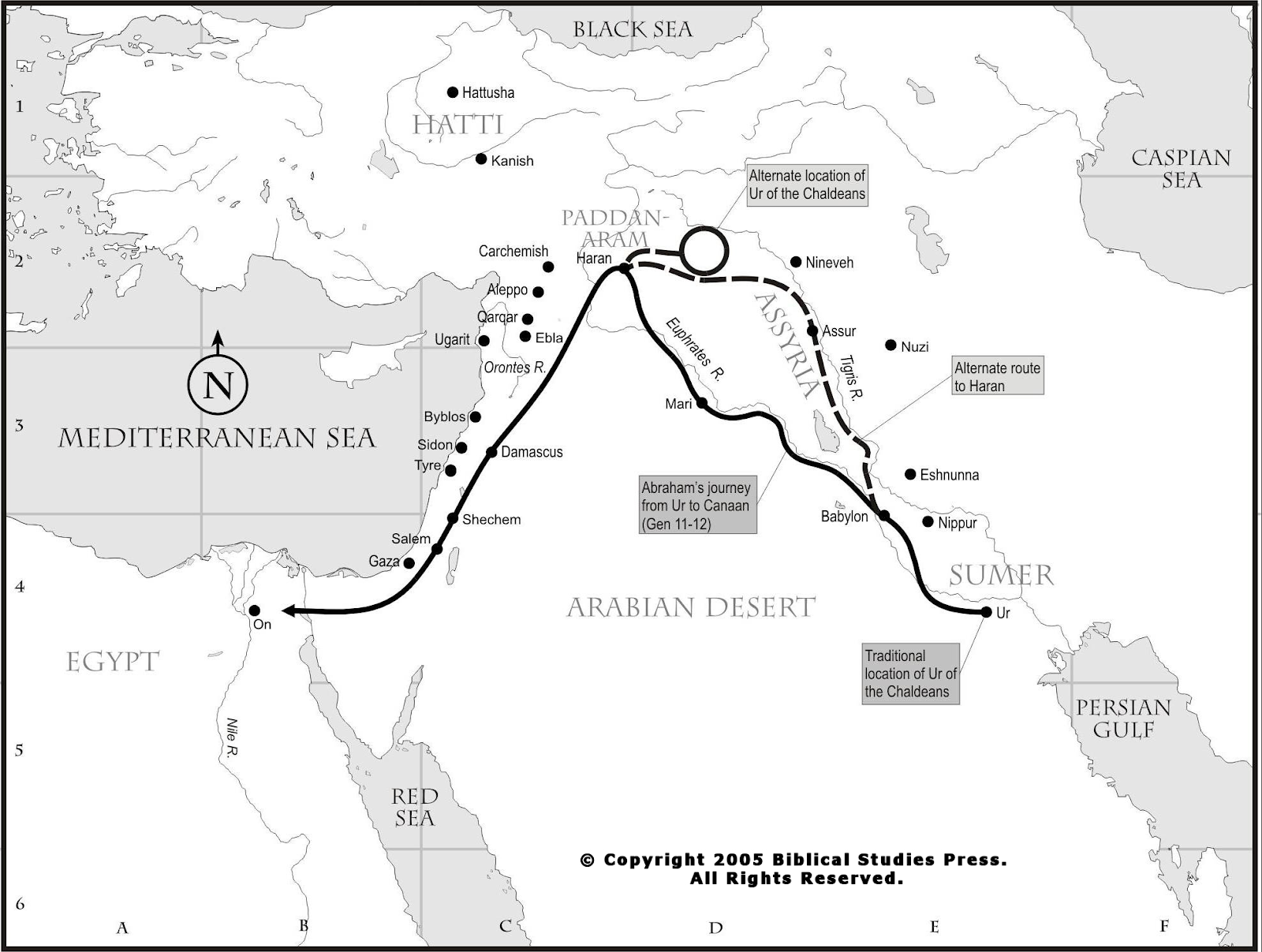
The story continues down the generations from Shem, Noah’s son, to Terah, father of Abram, who we know better as Abraham. At the end of chapter 11, we learn two things. First, that Terah lives in Ur. (Refer to the map.) 

Ur is in the same location as Babel (or Babylon). Terah decides to move from Ur to Canaan. This means traveling an ancient trade route along what is called the Fertile Crescent (Remember your western civilization history?) to get there. But, Terah never reaches Canaan. Instead he, his family, and his household settle at the top of the Fertile Crescent in Haran. Then, the second thing we learn is that Sarai is unable to have children.

So, it is here where we find Abram and Sarai - where today’s story opens in Genesis 12. In Haran. With no children.

The Lord said to Abram, “Leave your land, your family, and your father’s household for the land that I will show you. I will make of you a great nation and will bless you. I will make your name respected, and you will be a blessing.

I will bless those who bless you,
    those who curse you I will curse;
        all the families of the earth
            will be blessed because of you.”

Abram left just as the Lord told him, and Lot went with him. Now Abram was 75 years old when he left Haran. Abram took his wife Sarai, his nephew Lot, all of their possessions, and those who became members of their household in Haran; and they set out for the land of Canaan. When they arrived in Canaan, Abram traveled through the land as far as the sacred place at Shechem, at the oak of Moreh. The Canaanites lived in the land at that time. The Lord appeared to Abram and said, “I give this land to your descendants,” so Abram built an altar there to the Lord who appeared to him. From there he traveled toward the mountains east of Bethel, and pitched his tent with Bethel on the west and Ai on the east. There he built an altar to the Lord and worshipped in the Lord’s name. Then Abram set out toward the arid southern plain, making and breaking camp as he went.

When a famine struck the land, Abram went down toward Egypt to live as an immigrant since the famine was so severe in the land. Just before he arrived in Egypt, he said to his wife Sarai, “I know you are a good-looking woman. When the Egyptians see you, they will say, ‘This is his wife,’ and they will kill me but let you live. So tell them you are my sister so that they will treat me well for your sake, and I will survive because of you.”

When Abram entered Egypt, the Egyptians saw how beautiful his wife was. When Pharaoh’s princes saw her, they praised her to Pharaoh; and the woman was taken into Pharaoh’s household. Things went well for Abram because of her: he acquired flocks, cattle, male donkeys, men servants, women servants, female donkeys, and camels. Then the Lord struck Pharaoh and his household with severe plagues because of Abram’s wife Sarai.  --Gen. 12:1-17 (CEB)

It’s interesting to me that, as with Noah in last week’s story, God once more is moving from the distant - from a broader dealing with humanity - to the personal. To Abram and Sarai. 

God calls this couple through whom God promises to bless the whole earth. Abram and Sarai have one function in God’s plan. That is to be a blessing to all families of the “ground.” In most translations this phrase is translated as “families of the earth” or “people of the earth”. But this obscures a crucial aspect of this story of Abram and Sarai. The better translation is "families of the 'ground.'" The Hebrew word here, adamah, is the word first used in Genesis 2 to describe the creation of human beings from the “dust of the ground.” It’s the ground referenced in Genesis 3 to which all life will return in death. It’s the ground that literally opened its mouth to receive the blood of Abel after he was murdered by his brother, Cain, in Genesis 4 - and the ground from which Cain is cursed. In the Noah story, we read in Genesis 5, the hope that he will bring rest from this curse of the ground. But, then, in Genesis 9 it is from the ground that Noah receives wine that leads to his drunken nakedness and the breakup of his family. So, when we hear the call of Abram and Sarai to be a blessing to all families of the “ground” we understand what this is - a new attempt on the part of God to reconstitute the harmony of creation. This is a missionary call for Abram that will be echoed throughout the entire biblical narrative - including to you and to me. That, having been blessed by God in our many and unique ways, we then become a blessing to others.

So, Abram and Sarai go to the land they are promised, stopping at various points along the way to offer sacrifices of gratitude to the God who has called them. But, it is not long before a crisis comes. And the promise of God through Abram and Sarai is soon in trouble.

A famine strikes Canaan. They go south to Egypt - the bread basket of the ancient Near East. On the way, Abram does some thinking - about himself and his future. He devises a scheme to ensure his own safety by trafficking - let’s be honest here that’s what he’s doing, right? - trafficking his own wife to ensure his self-serving plan. 

Now, we first need to recognize that we live in a time and culture that is very, very distant from Abram’s. Women were viewed as property. Polygamy was common. Cousins married cousins. Spouses were not true partners - a husband was the lord and master of the wife and exercised complete control over her body. Over her responsibilities. Over her life. 

The other thing we need to know is that, further on in Genesis, we learn that Sarai really is Abram’s sister. His half-sister. So, in many respects, Abram is telling the truth here. But, remember God’s call for Abram and Sarai? To be a blessing to all the families of the ground. Abram’s actions here end up harming an innocent man - whether the man is powerful or not. Abram is not a blessing to the Pharoah. Either Abram has misheard God or simply forgotten God’s promise to preserve and protect him. His fear has gotten in the way of his trust in this promise - a promise from God of blessing. 

I wonder how many of us forget the promises of God in the midst of our own fears and worries. Wondering about our lives. Or about our loved ones’ lives. Fearing the worst. And, as a result of that fear, acting out of self-preservation, even if it harms innocent people.

Friends, God wants us to be free of fear. God wants us to truly trust that God will do what God says. The core of the relationship between God and Abram was to be blessed and to be a blessing. God remembered and honored that promise for him. 

Abram was given that promise. It has been given to us, as well. We may forget it. But, as with Abram, God did not forget him. And God has not forgotten us. Amen.

Preached Sunday, September 18, 2022, at Grace & Glory, Prospect, with Third, Louisville.
15th Sunday after Pentecost
Reading: Genesis 12:1-17

Sunday, September 11, 2022

ReMember: God Remembers

The Lord saw that humanity had become thoroughly evil on the earth and that every idea their minds thought up was always completely evil. The Lord regretted making human beings on the earth, and he was heartbroken. So the Lord said, “I will wipe off of the land the human race that I’ve created: from human beings to livestock to the crawling things to the birds in the skies, because I regret I ever made them.” But as for Noah, the Lord approved of him.

These are Noah’s descendants. In his generation, Noah was a moral and exemplary man; he walked with God. Noah had three sons: Shem, Ham, and Japheth. In God’s sight, the earth had become corrupt and was filled with violence. God saw that the earth was corrupt, because all creatures behaved corruptly on the earth.

God said to Noah, “The end has come for all creatures, since they have filled the earth with violence. I am now about to destroy them along with the earth, so make a wooden ark. Make the ark with nesting places and cover it inside and out with tar. This is how you should make it: four hundred fifty feet long, seventy-five feet wide, and forty-five feet high. Make a roof for the ark and complete it one foot from the top. Put a door in its side. In the hold below, make the second and third decks.

“I am now bringing the floodwaters over the earth to destroy everything under the sky that breathes. Everything on earth is about to take its last breath. But I will set up my covenant with you. You will go into the ark together with your sons, your wife, and your sons’ wives. From all living things—from all creatures—you are to bring a pair, male and female, into the ark with you to keep them alive. From each kind of bird, from each kind of livestock, and from each kind of everything that crawls on the ground—a pair from each will go in with you to stay alive. Take some from every kind of food and stow it as food for you and for the animals.”

Noah did everything exactly as God commanded him.

After forty days, Noah opened the window of the ark that he had made. He sent out a raven, and it flew back and forth until the waters over the entire earth had dried up. Then he sent out a dove to see if the waters on all of the fertile land had subsided, but the dove found no place to set its foot. It returned to him in the ark since waters still covered the entire earth. Noah stretched out his hand, took it, and brought it back into the ark. He waited seven more days and sent the dove out from the ark again. The dove came back to him in the evening, grasping a torn olive leaf in its beak. Then Noah knew that the waters were subsiding from the earth. He waited seven more days and sent out the dove, but it didn’t come back to him again.

God said to Noah and to his sons with him, “I am now setting up my covenant with you, with your descendants, and with every living being with you—with the birds, with the large animals, and with all the animals of the earth, leaving the ark with you. I will set up my covenant with you so that never again will all life be cut off by floodwaters. There will never again be a flood to destroy the earth.”

God said, “This is the symbol of the covenant that I am drawing up between me and you and every living thing with you, on behalf of every future generation. I have placed my bow in the clouds; it will be the symbol of the covenant between me and the earth. When I bring clouds over the earth and the bow appears in the clouds, I will remember the covenant between me and you and every living being among all the creatures. Floodwaters will never again destroy all creatures. The bow will be in the clouds, and upon seeing it I will remember the enduring covenant between God and every living being of all the earth’s creatures.” God said to Noah, “This is the symbol of the covenant that I have set up between me and all creatures on earth.” --Genesis 6:5-22, 8:6-12, 9:8-17 (CEB)

Grace, mercy and peace to you from God, our Creator, Redeemer and Sustainer. Amen.

Holy moly! Isn’t it a little crazy that so many people - some of us likely included - have decided that the events of Noah and the flood are appropriate with which to decorate nurseries. Seriously. This story is terrifying.

Welcome to the beginning of the lectionary year. In the Narrative Lectionary, it is customary that on the first Sunday of the lectionary year, we hear a story from what is called the primordial history. This primordial (or primeval) history consists of the first eleven chapters of Genesis. These are the mythic stories of faith - stories that speak to us in universal truths. They describe not only how things came to be for us as people of faith, but why things are the way they are. 

Usually, we begin with one of the two creation stories in Genesis 1 or 2. But, once every four years, we hear this story. Of God. Of God’s regret. And, then, of Noah and the flood. In some respects it’s a story of creation. But, really, it's more a story of un-creating than it is creating. Do you notice, especially, when we hear the language describing the creatures as they are loaded onto Noah’s ark - the language and its cadence - that it sounds remarkably similar to many of the lines of Genesis 1? This account of God un-creating the world borrows and echoes words and phrases from the first story. Even the sequence moves backwards from humanity, to land animals, to birds, then to food plants.

But, before we get too far into the story, I want to back up to the very beginning. In its opening lines, we hear the depth of God’s emotion. The heartbreak. And, perhaps most troubling, the regret that God felt at having created humanity. God is grieved “to the heart” and twice “sorry” about having spoken creation into being in the first place. God intended a world that behaved and believed very differently from the one that developed. That God was facing in this story. Perhaps, even, the one that God is facing in our world today.

I don’t know about you, but, as a parent, I get it. There were many times when I just wanted to walk away. Tired and exhausted and dealing with one more challenge with my son, I understand, even in some very minute way, how God was feeling. 

It was an evil place, this time of Noah. Wickedness abounds, both in the imagination of the heart and also in societies these humans have created. God is ready to call it quits. One Jewish theologian to whom I frequently listen put it this way. “Have you ever started a project with all excitement and energy, but then come to a realization that things are a mess. That this is not going to work. And that it's time to just shut it down." That’s where God is, she suggests. Ready to “blot out” every living thing from the face of the earth. The Hebrew word meaning to “rub away” as one might rub ink off old parchment. To un-remember. And simply forget it ever happened. Some theologians have suggested that God’s uncreating in this story is less a kid kicking his sandcastle apart at the beach and more a simple turning away. And without God’s sustaining and creative presence, things fall apart. 

But. That’s how chapter 8 begins. It’s in the word “but” where we hear the good news. “But God remembered Noah and all of the beasts and cattle that were with him in the ark.” God can’t quite go all the way, apparently. As God responded to the disobedience of Eve and Adam in the story in Eden and as we will see time after time in the stories that follow, God’s deadly wrath is overcome by our Creator’s more powerful inclination toward salvation. At the heart of this story, setting every challenging aspect aside for just a moment, is a God who, no matter how grieved and angry, is in love with the universe and its creatures, particularly those of us of the two-legged variety who somehow share that same mysterious image of God.

We’re reminded of this in the words of Isaiah 49, “Can a woman forget her nursing baby, that she should have no compassion on the child of her womb? Even these may forget, yet I will not forget you. Behold, I have inscribed you on the palms of my hands.”

God remembers that last good remaining speck of creation and turns again toward it. Notice the movement of God from distant to intimate. From the broader view of humanity to Noah. God sees Noah and moves toward him. To a personal relationship with him.  To save him. God’s remembering of Noah leads to God’s salvation of Noah. And a promise - a covenant - to Noah to never again abandon creation to chaos, but to stay in relationship. To stay in the sustaining relationship with creation that makes life possible. A promise marked by a sign. A rainbow. Not so much to help us remember, but to help God remember. 

It is here, in this primordial story, in this teachable moment for God, that God opts in for the sacrificial, messier, more inefficient, more vulnerable route of real relationship. With Noah. And with you. And with me. And God promises, in Christ, to remember us. Forever and ever.

Amen.

Preached September 11, 2022, at Grace & Glory Lutheran, Prospect/Goshen, KY, with Third Lutheran, Louisville, KY.
14th Sunday after Pentecost
Reading: Genesis 6:5-22, 8:6-12, 9:8-17

Sunday, September 4, 2022

Unraveled: Unraveling Fear

They came to the other side of the sea, to the region of the Gerasenes. And when he had stepped out of the boat, immediately a man from the tombs with an unclean spirit met him. He lived among the tombs, and no one could restrain him any more, even with a chain, for he had often been restrained with shackles and chains, but the chains he wrenched apart, and the shackles he broke in pieces, and no one had the strength to subdue him. Night and day among the tombs and on the mountains he was always howling and bruising himself with stones. When he saw Jesus from a distance, he ran and bowed down before him, and he shouted at the top of his voice, “What have you to do with me, Jesus, Son of the Most High God? I adjure you by God, do not torment me.” For he had said to him, “Come out of the man, you unclean spirit!” Then Jesus asked him, “What is your name?” He replied, “My name is Legion, for we are many.” He begged him earnestly not to send them out of the region. Now there on the hillside a great herd of swine was feeding, and the unclean spirits begged him, “Send us into the swine; let us enter them.” So he gave them permission. And the unclean spirits came out and entered the swine, and the herd, numbering about two thousand, stampeded down the steep bank into the sea and were drowned in the sea.

The swineherds ran off and told it in the city and in the country. Then people came to see what it was that had happened. They came to Jesus and saw the man possessed by demons sitting there, clothed and in his right mind, the very man who had had the legion, and they became frightened. Those who had seen what had happened to the man possessed by demons and to the swine reported it. Then they began to beg Jesus to leave their neighborhood. As he was getting into the boat, the man who had been possessed by demons begged him that he might be with him. But Jesus refused and said to him, “Go home to your own people, and tell them how much the Lord has done for you and what mercy he has shown you.” And he went away and began to proclaim in the Decapolis how much Jesus had done for him, and everyone was amazed. --Mark 5:1-20 (NRSV)

Grace, mercy and peace to you from God our Creator, Jesus Christ, our Redeemer, and the Holy Spirit, our Advocate and Sustainer. Amen.

Fear. It’s the topic of our text today - a story that is preceded by the story of Jesus and his disciples crossing the Sea of Galilee. It’s that story of a storm that comes up while they are in the middle of the Sea of Galilee - a big lake really. And of Jesus calming the waters. Yet, it's interesting to me that the very last thing Jesus says before they reach the eastern shore and step into today’s story - the last thing Jesus says to the disciples is “Why are you afraid? Have you no faith?”

Fear. Why are you afraid? What are you afraid of? Now, I know our very American culture demands that we respond to that question with “Nothing. I’m afraid of nothing.” Yet, I wonder. I wonder if we move beyond that claim and think about those times, perhaps. Or those people, perhaps. Or those places, perhaps. That, if we are paying attention to our body and the reaction of our body to those particular times, people or places, we have to admit our fear.

On my vacation last week I had an opportunity to have a long conversation with an old friend who has lived in Los Angeles since he moved there from southern Indiana right after college. Like so many of us when we’re first starting out, he lived in what could be called “not the best part of town.” Maybe you’ve had a similar experience, where with limited income you had to find a place you could afford. A place that didn’t always feel safe. Even if you haven’t had that experience, think about what it feels like to walk at night from a restaurant or a bar or some other place in a “not so good” location. Those little twinges you feel as you hold your keys in your hand ready to open your car door. Or to protect yourself. Or as you pull your purse or your loved one closer to you. Just a little fearful of something or someone that might step out of the dark and turn your life upside down.

So, this friend, as he moved up and made more money, then, as he got married to a woman who was also successful, he began to move closer and closer to the westside of Los Angeles. The side where those with money live. And as he made that move, his attitudes began to change. Especially his attitude around the homeless.

Homelessness is a huge problem in Los Angeles as it is in many cities, including here in Louisville. There, especially, it’s a combination of the climate, housing costs that have spiraled out of control and out of reach for so many, plus drug addiction and a lack of mental health resources. All of this together has created a huge homeless population in L.A. - a population that, especially over the last ten years, has moved throughout the city, including into the west side. Into his neighborhood. 

There’s been a lot of public discussion there over how to deal with this issue, especially around how to deal with the homeless who suffer from mental illness. My friend has a good heart, but he, like many, has come to the position that the laws should be changed to allow those with mental health issues, especially those who seem out of control, to be forcibly removed from the streets and institutionalized. 

Out of sight, out of mind.

Just like the man in today’s story. This man named Legion is demon-possessed. Not just by one demon, but by many. He is uncontrollable. And, according to our text, not violent toward the people in the nearby village, but hurtful to himself. And as much as the villagers have tried to control him, placing him in chains and leg irons, their attempts have been futile. So, he has been banished apparently. Wandering in the tombs and hills nearby.

Out of sight, out of mind.

It’s a story that would make any Jew uncomfortable. Located in the land of the Gerasenes, it’s a Gentile area, so to begin with it’s unclean and out of bounds. There's a herd of swine there, too, which suggests impurity. Plus there’s that cemetery nearby, which for a Jew would be off limits. The man who comes to Jesus has an unclean spirit. This whole place, this man, this whole situation would be taboo for any Jew. But, as we have seen so often before, this is exactly the forbidden territory into which Jesus ventures.

He sends the man’s demons packing. Specifically, at their request, into a herd of swine nearby. Who, then, unexpectedly run off a cliff into the sea, drowning the unclean spirits. The word gets around and the villagers come out to see this man, previously possessed, now clothed and in his right mind. One might think that they would rejoice with him, celebrate over a life restored. But, instead, when they see him sitting there, they are afraid. 

Jesus’ healing action has upset their status quo. They find Jesus threatening. Their world, as they have created, it is tolerable. Even demons can be endured as long as the possessed are relegated to a place outside civilized territory - among the tombs on the outskirts of town. But, when they see the transformation of this man, they are fearful. 

What’s so frightening about Jesus and this action? Because, unlike them - and unlike us, Jesus refuses to leave the world as it is. Jesus transgresses those boundaries and rescues those who are “beyond help.” Such a person - like Jesus - can’t be controlled. Such a person - like Jesus - can only be followed. And they are unwilling. So, they ask him to leave. Because the cure of this demon-possessed man is too expensive. Not just in terms of pigs, but in terms of social stability. Jesus upsets the status quo. The Kingdom of God upsets the status quo. And, as we see in this story and in many of the stories of these past 13 weeks, humanity, its society and its institutions - we - often impede the in-breaking of God’s kingdom more than we expedite it. 

But God’s reign breaks into the world. Not so much through flawed institutions and individuals, but in spite of them. God’s reign comes with power - power to do things neither you nor I, nor any other human being, can do on our own. God’s reign forces us to perceive the truth that we are not in control. As we seek to control our lives and our world, we hold onto what we perceive as safe. As we push down our fear with the claim that nothing frightens us. As our world unravels around us and we lose complete control. Or we lose the control we thought we had. It is then, and only then, when we are vulnerable enough to see that only God is in control. That only God is at work in our midst. Turning things around. Skewing the world toward justice. Bringing resurrection out of death. For us. So that we might be free.

And so that our fear might be out of sight, out of mind.

May God grant it. Amen.

Preached September 4, 2022, at Grace & Glory Lutheran, Prospect, KY, with Third Lutheran, Louisville, KY.
13th Sunday after Pentecost
Readings: Mark 5:1-20, Psalm 65